

Every week, thousands of investors in Saudi Arabia open their phone's app store and search for a mobile stock trading app in Saudi Arabia that they can trust. The results look similar at first glance, clean interfaces, bold promises of low fees, and logos that project professionalism. But underneath the surface, the differences between a well-regulated, genuinely investor-friendly platform and a poorly structured one can cost you real money.
This manual takes care of the details. The app presents a straightforward and informative guide to testing any stock trading application in Saudi Arabia, regardless of whether you're using it on your current device or have previously used one. Once you finish reading, you'll be able to identify which questions to ask, which warnings to pay attention to, and how to distinguish between a trustworthy trading app and one that only takes your eyes out.
Ready to see what a well-regulated platform looks like? Join Raseed — SFSA-regulated, fee-capped at $3, available in KSA today. Open your account in 2 minutes.
Why Your Choice of Trading App Matters More Than the Stocks You Pick
Most first-time investors in Saudi Arabia spend 80% of their preparation time researching which stocks to buy and almost no time researching the platform through which they will buy them. This is backwards. The stocks you pick can always be changed. But a poorly chosen platform affects every single trade you make, its fees erode your returns on every transaction, its regulatory status determines whether your money is protected, and its tools (or lack of them) shape every decision you make.
The platform is not just a vehicle. It is the environment in which you invest. Choosing a safe stock trading app in Saudi Arabia is one of the most consequential decisions a Saudi investor makes before placing their first trade.
Criterion 1: Regulation and Licensing — The Non-Negotiable First Check
No other factor matters if a platform is not properly regulated. A trading app's regulatory status tells you whether a recognised authority holds it accountable, whether your money is segregated from company funds, and what recourse you have if something goes wrong. Before downloading any mobile stock trading app in Saudi Arabia, verify the following:
Who regulates it? Legitimate platforms operating for Saudi Arabia investors are typically regulated by recognised financial authorities — such as the DFSA, FSA, FCA, or SEC/FINRA. The regulator's name should be clearly stated in the app's footer, disclosures section, or 'About' page — not hidden.
Is the licence verifiable? Every legitimate regulatory licence has a public register where you can look it up. Do not rely on the platform's own claims, verify the licence number directly on the regulator's official website.
Are client funds segregated? A regulated platform holds your money in accounts separate from its own operating funds. This ensures that a safe stock trading app in Saudi Arabia protects investor capital even in adverse situations.
Why this matters: The collapse of FTX in 2022 wiped out billions in client funds. The platform was not regulated to the standard of a licensed securities firm. Checking regulation first is not paranoia — it is basic financial due diligence.
Raseed Invest Limited is regulated by the SFSA (Financial Services Authority Seychelles) for arranging deals in investments with a retail endorsement. Brokerage services are provided through Fullerverse (SC) Limited, licensed by the Financial Services Authority Seychelles (Licence No. SD152). Both licences are publicly verifiable.
Related Article - Is Raseed Safe? A Full Review of Regulation, Security and Fund Protection
Criterion 2: Fee Structure — Total Cost, Not Just the Advertised Rate
Every platform advertises low fees. The question is not what the headline fee is — it is what the total cost of using the platform actually is across every type of transaction you will make. When evaluating a trading app's fee structure, calculate the full cost across five categories:
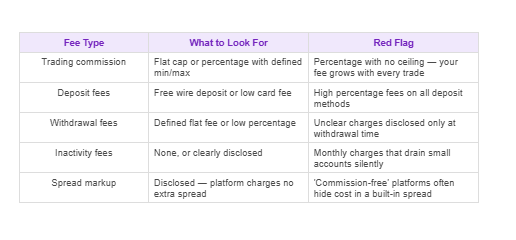
Raseed's fee structure as an example: US stocks and ETFs trade at 0.5%, minimum $0.50, capped at $3 per trade. Saudi stocks at 0.1%. Crypto is charged at 0.5% of the total transaction value. Options are charged at $0.99 per contract, with a minimum fee of $1.49 per transaction. Wire deposits carry no Raseed-side fee. Card deposits are 3.75%. Wire withdrawals are $15 flat. Card withdrawals are 0.99%. No inactivity fee. No spread markup on trades.
That level of complete, public disclosure is what to benchmark against. A mobile stock trading app in Saudi Arabia that is transparent about fees builds long-term trust and helps investors plan better.
If a platform cannot clearly explain its full pricing structure upfront, consider it a warning sign.
Related Article - Lowest Trading Fees in Saudi Arabia: A Full Platform Comparison 2026
Related Article - Hidden Fees in Stock Trading Apps: What Saudi Investors Need to Watch Out For
Criterion 3: Market Access — What Can You Actually Trade?
The Tadawul is not the sole destination for Saudi Arabia investors in 2026. US exchanges have a significant number of actively sought-after stocks, including Apple, Nvidia, Microsoft, Amazon, and Tesla. These stocks are not listed as publicly traded. A platform that confines you to regional markets severely limits your potential to diversify and access global growth prospects.
When evaluating market access, ask specifically:
Does it offer real stocks or CFDs? Real stock ownership means you genuinely own shares, are eligible for dividends, and benefit from the company's actual performance. CFDs (Contracts for Difference) are derivative products that track prices without ownership, they come with additional risks and fees that are not always clearly communicated.
Does it include both Tadawul (TASI) and US exchanges (NYSE, Nasdaq)? The best platforms for Saudi investors serve both local and international markets from a single account.
Does it support fractional shares? Being able to invest SAR 100 in a company like Amazon, which trades at over $180 per full share dramatically increases the flexibility of smaller investors.
Does it include ETFs and other asset classes? A platform that serves only individual stocks limits your ability to build diversified, lower-risk positions through index ETFs.
Access to 14,000+ US-listed stocks and ETFs, combined with Saudi market access, represents the practical standard a serious investor should expect from a platform in 2026. Anything less is a constraint on your ability to build a genuinely diversified portfolio.
Related Article - Fractional Shares Explained: How to Own Apple Stock from $1 in Saudi Arabia
Criterion 4: Security Features — How Your Account and Money Are Protected
A trading app's security architecture should be evaluated on two distinct levels: account security (protecting your login and transaction access) and fund security (protecting your deposited capital).
Account Security Features to Verify
Two-factor authentication (2FA): Every legitimate platform requires a second verification step via SMS, an authenticator app, or biometric, when logging in or confirming transactions. If 2FA is optional rather than enforced, treat that as a weakness.
Biometric login: Modern trading apps should support fingerprint or facial recognition for faster, secure access on mobile devices.
Encrypted communications: All data transmitted between you and the platform should use industry-standard TLS encryption. Look for HTTPS in the web address and confirm the platform's security disclosures.
Fund Security Features to Verify
Separate client accounts are required to hold your trading capital and operational funds separately from the platform.
Investor protection disclosures: A regulated platform publishes clear documentation on how client funds are held, what insurance or protection schemes apply, and what the process is in case of platform failure.
Criterion 5: User Experience — Does It Work for the Way You Actually Invest?
User experience is not a luxury consideration, it directly affects the quality of your investment decisions. A confusing interface that makes it difficult to find price data, understand your position, or execute a trade quickly during a fast-moving market costs money in exactly the moments when clarity matters most.
The right user experience depends on your investment style:
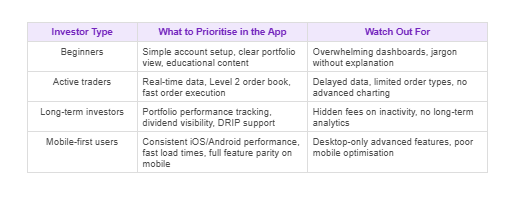
When evaluating a platform, open a demo or trial account if one is available and try to complete three specific tasks: open a simulated trade, find the fee disclosure for that trade, and locate your portfolio performance summary. If any of those three is unclear or difficult, that difficulty will compound over real trades.
Criterion 6: Data and Research Tools — Can You Make Informed Decisions?
A platform that gives you access to markets but not the information to navigate them is only half a solution. The quality of data and research tools available on a trading app directly determines the quality of decisions you can make.
Minimum Data Standards for a Serious Investor
Real-time price quotes: Delayed data (15 to 20 minutes behind) is inadequate for active trading. Verify whether the platform provides live, real-time price data.
Level 2 market data (order book): The order book shows not just the current price but the full depth of buy and sell orders queued at every nearby price level. It is the most complete picture of supply and demand available for any stock, and it is the tool institutional traders use to assess entry and exit points. Some platforms charge $10 to $30 per month for this. Raseed provides it free to all users.
Advanced charting: Technical technical indicators, such as moving averages, RSI, MACD, support and resistance levels, are utilized in advanced charting to convert raw price data into useful information. When using a platform without appropriate charting tools, the workflow becomes fragmented and ineffective by relying on third-party software.
News integration: Real-time financial news relevant to the stocks you hold or watch should be integrated directly into the platform, not require a separate subscription or tab.
Criterion 7: Customer Support — Who Helps You When Something Goes Wrong?
Support quality only becomes visible when you need it most — a failed deposit, a trade that did not execute as expected, or an account verification issue. By then, a platform with poor support has already caused you a problem. Evaluate support before you commit:
Response time: Test the chat or email support before depositing. Ask a simple question about their fee structure and see how long it takes to receive a clear, accurate answer.
Language and timezone: For Saudi Arabia investors, support available in Arabic and during GCC business hours is significantly more valuable than English-only support operating on US Eastern Time.
Support channels: Live chat is the minimum standard. Phone support adds additional confidence, particularly for larger account issues.
Published help documentation: A platform that has invested in comprehensive, clear help documentation — covering account setup, trading mechanics, fee explanations, and common issues — signals that it takes investor education seriously.
The Five-Question Pre-Commitment Test
Before depositing any funds on a trading app, get clear answers to these five questions — either from the platform's documentation or its support team:
Who regulates this platform, and where can I verify the licence?
What is the exact fee for buying $1,000 of Apple stock, including all deposit and withdrawal costs?
Are my deposited funds held in a segregated client account, separate from company funds?
Is Level 2 market data (the order book) available, and does it cost extra?
If I want to withdraw my funds, how long does it take and what is the exact fee?
A legitimate, transparent platform answers all five clearly and without hesitation. Vague responses, redirections to terms-and-conditions documents without direct answers, or answers that contradict the published fee schedule are serious warning signs.
The right trading app does not just give you access to markets — it protects your capital, keeps your costs predictable, and gives you the tools to make better decisions. In a market as dynamic as Saudi Arabia's in 2026, that difference is not marginal. It is the foundation of every trade you will ever make.
Frequently Asked Questions: Comparing Stock Trading Apps in Saudi Arabia
Is it legal to use international trading apps in Saudi Arabia?
Yes. Saudi residents can legally use internationally regulated trading platforms to invest in global markets including US stocks. The platform must be regulated by a recognised financial authority. Always verify that the platform's regulatory status is current and publicly verifiable.
Do I need a local Saudi bank account to fund a trading app?
Most internationally regulated platforms accept wire transfers from any Saudi-based bank account. Card deposits are also typically supported. Raseed supports both wire transfers (no Raseed-side deposit fee) and card deposits (3.75% fee).
What is the difference between a regulated and a licensed platform?
All licensed platforms are regulated, but the level of regulation is highly varied across jurisdictions. An investor's protection is one of the most crucial aspects of a DFSA or FCA licence worldwide. Licences from obscure offshore jurisdictions offer significantly reduced investor protection. It is advisable to always verify the license holder and their enforcement history.
What does 'Level 2 market data' mean and why does it matter?
Level 2 data shows the complete order book for a stock — all pending buy and sell orders at every nearby price level, not just the current market price. It gives active traders a real-time picture of supply and demand pressure around the current price, enabling more informed entry and exit decisions. Many platforms charge for this data. Raseed provides it free to all users.
Securities brokerage services are provided by Fullerverse (SC) Limited, a security broker dealer licensed and regulated by the Financial Services Authority Seychelles (Licence No. SD152). Fullerverse is a wholly-owned subsidiary of Raseed Invest Inc. All investing involves risk. Capital is at risk.