Every experienced investor in Saudi Arabia was once where you are right now: curious about the stock market, not entirely sure where to begin, and probably encountering conflicting information about what to do first. This guide is written to change that. It is not a quick overview that leaves you with more questions than you started with. It is a complete, practical, honest explanation of how to start trading stocks in Saudi Arabia in 2026, from the very first concept to your very first trade.
You do not need a finance degree. You do not need a large amount of capital. You do not need to already understand the jargon. What you need is a willingness to learn methodically and the patience to start small. Everything else this guide provides.
Start your investing journey on a regulated, beginner-friendly platform. Raseed: fractional shares from $1, SFSA-regulated, open account in 2 minutes.
Step 1: Understand What a Stock Actually Is
A stock (or equity) is essentially a small piece of ownership in a publicly traded company. When you buy one single share of options shares outstanding and Apple become a partial owner of Apple, Inc, proportionately. Prior to buying or depositing any money into your account you must first make sure to fully understand what the specific item being purchased entails as per the terms and conditions.
This ownership comes with two potential benefits. First, if the company grows and becomes more valuable, your share is worth more than you paid for it, capital appreciation. Second, many companies pay a portion of their profits directly to shareholders on a regular basis, these payments are called dividends. Not all companies pay dividends; some reinvest profits back into growth instead.
Key principle: When you make a stock purchase, you are not guessing about the price on a chart you are purchasing an ownership stake in a legitimate business. The price of your ownership reflects what other people believe the worth of that business is. As an investor, grasping this distinction is one of the biggest mindset changes you can make when investing.
Stock exchanges are markets where both buyers and sellers buy stocks, resulting in a system of equal distribution. The main stock exchange of Saudi Arabia is the Saudi exchange (Tadawul). The Tadawul lists the shares of several major Saudi companies, such as Al Rajhi Bank, STC, and Saudi Aramco. Shares in companies such as Apple, Microsoft, and Amazon can be found on both the NYSE and Nasdeq.
Related Article - TASI vs US Stocks: Where Should Saudi Investors Put Their Money in 2026?
Step 2: Know the Saudi Arabia Context — What's Legal, Who Regulates It, and What Changed in 2026
The Saudi Arabian government supports stock trading as part of Vision 2030, which aims to enhance the development of the Kingdom's capital markets and encourage greater financial participation by Saudi citizens.
The Saudi Exchange (Tadawul): The Saudi exchange (Tadawul) is the main market for domestic stocks, and it is regulated by the Capital Market Authority (CMA). All companies listed on the exchange are evaluated by the Tadawul All Share Index (TASI). From Sunday to Thursday, trading hours are from 10:00 am to 3:00 pm (Saudi Arabia Standard Time).
The Capital Market Authority (CMA): Saudi Arabia's financial markets regulator. The CMA licenses domestic brokers, enforces trading rules, and protects investor rights in the Saudi market.
International trading: Saudi investors can access US and other international markets through internationally regulated platforms. This is legal and widely practised. In February 2026, the CMA abolished the Qualified Foreign Investor (QFI) programme, making it significantly easier for investors to access global markets — including for non-Saudi residents living in the Kingdom.
Taxes on investment gains: Saudi Arabia does not levy personal income tax on capital gains or dividends earned from stock investments in the Kingdom. If you're an expatriate and have obligations abroad, it's best to get a tax adviser before investing in Saudi Arabia.
Related Article - Saudi Stock Market Climbs Amid Global Trends: Insights for Today's Traders
Step 3: Decide Between Saudi Stocks, US Stocks, or Both
One of the earliest practical decisions for a new Saudi investor is where to begin investing. There are no universally right answers, it really depends on your investment objectives as well as your familiarity with various businesses and how much time you will devote to monitoring your investments.
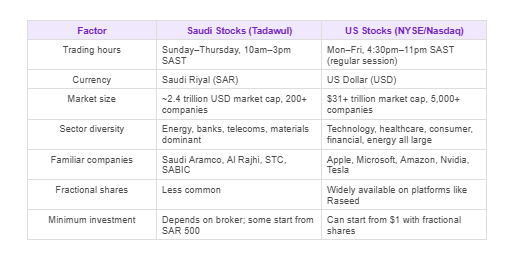
Most beginners start with companies they already know and understand. If you use an iPhone, understand the technology industry, or follow US companies in the news, US stocks may be your natural starting point. If you are more familiar with Saudi companies, their business models, and the local economic environment, TASI may feel more accessible. There is no wrong answer, and many investors hold both.
Related Article - Fractional Shares Explained: How to Own Apple Stock from $1 in Saudi Arabia
Step 4: Choose the Right Platform for a Saudi Arabia Beginner
Your pre-investment decision regarding the platform you select will be the most important one that you make. It will determine what and how you can trade, how much it will cost you, how secure your money is and how pleasant your initial trading experience will be while you learn. If you are a beginner In Saudi Arabia, there are five criteria to evaluate every platform on.
Regulation first, always: Prior to opening an account with an online broker, make sure the broker holds a valid licence from either international financial authorities (such as the DFSA, FCA, FSA Seychelles) or a recognised Tier 1 or Tier 2 regulator. You should confirm that the licence is still valid through the regulator's public database and not based solely on what the broker has posted as proof of their licence.
Transparent, capped fees: Understand exactly what you will pay per trade, to deposit, and to withdraw before you sign up. Look for a fee cap on trades — a platform that charges 0.5% capped at $3 per transaction is predictable and fair. Percentage-only fees with no ceiling mean your costs grow with your portfolio and your activity level.
Fractional shares: A beginner investor may not have enough money to invest in fractional shares. A fractional share enables you to purchase costly stocks like Amazon ($180+) and Nvidia ($100+), regardless of the denomination (even $10).. Investing in these shares will enable you to create an investment-rich portfolio with minimal capital.
Beginner-friendly interface: The platform should make it straightforward to open an account, fund it, find a stock, understand its price and basic information, and place a trade. If the setup process is confusing before you have deposited anything, it will only become more confusing once you are managing real positions.
Access to the markets you want: If you want US stocks, verify the platform actually provides real US stock ownership (not CFDs or price-tracking derivatives). If you want Saudi stocks, verify it connects to Tadawul. Ideally, choose a platform that offers both from a single account.
Related Article - Lowest Trading Fees in Saudi Arabia: A Full Platform Comparison 2026
Related Article - Hidden Fees in Stock Trading Apps: What Saudi Investors Need to Watch Out For
Step 5: Open Your Account — What to Expect
Opening a stock trading account is now a fully digital process on most modern platforms. For Saudi investors, the standard process involves:
Providing your basic personal information — name, date of birth, Saudi national ID or Iqama number for expats, and contact details.
Completing a Know Your Customer (KYC) identity verification — uploading a copy of your national ID, Iqama, or passport. This is a regulatory requirement, not optional.
Completing a short investor suitability questionnaire — most platforms ask about your investment experience, financial situation, and risk tolerance. Answer honestly; this assessment helps the platform confirm you understand the risks involved.
Setting up security features — two-factor authentication and biometric login where available. This is essential for protecting your account.
On a well-designed platform, the full account opening process takes 10 to 15 minutes. Verification typically completes within 24 hours, sometimes instantly. On Raseed, the process is designed to take approximately 2 minutes for the initial setup.
Step 6: Fund Your Account — Understanding Your Deposit Options
Once your account is verified, you need to deposit funds before trading. The two main deposit methods for Saudi investors are:
Bank wire transfer: Transferring directly from your Saudi bank account to your trading account. This is the most cost-effective method for larger deposits — Raseed charges no fee on its end for wire deposits. Standard Saudi bank wire fees apply on the sending side. Transfers typically arrive within 1 to 3 business days.
Card deposit: Using your debit or credit card for an instant deposit. More convenient for smaller amounts or when you want to start trading immediately. Raseed charges 3.75% on card deposits, which is standard for card processing costs in financial services.
To begin with, choose an amount that is genuinely secure in a market where it may decrease in value, as this will happen at some point during your investment journey. For Saudi beginners, it is common and sensible to begin with a reasonable investment of SAR 500 to SARS 2,000 (around $130 to $530), which can help build shale stocks or ETFs while mitigating the financial losses associated with early learning errors.
Related Article - Deposits and Withdrawals on Raseed: Everything You Need to Know
Step 7: Understand the Basic Order Types Before Placing Your First Trade
Before you click 'buy', you need to understand what type of order you are placing. Two order types are essential knowledge for every beginner:
Market order: Executes immediately at the best available current price. Use this when you want guaranteed execution and are not concerned about small price variations. Be cautious with market orders on illiquid stocks or during the opening minutes of a trading session — spreads are wider and prices can move quickly.
Limit order: Executes only at a price you specify or better. A limit buy order at $150 will only execute if the stock is available at $150 or less. This gives you price control at the cost of guaranteed execution — if the stock never reaches your limit price, the order does not fill. During extended hours trading (including pre-market and after-hours sessions on Raseed), limit orders are required.
For most beginners making their first few trades in liquid, large-cap stocks, a market order is the simpler choice. As you gain experience and trade more actively, understanding limit orders becomes essential.
Related Article - Can I Trade US Stocks at Night from Saudi Arabia?
Step 8: Your First Investment — A Practical Framework
With your account funded and your platform selected, you are ready to make your first investment. Here is a practical framework for thinking through the decision:
Start with what you understand: Your initial investment should be in a company that you have prior knowledge of. Companies such as Apple, Microsoft, Coca-Cola or Saudi Aramco are clear examples of what s/he sells and who buys it and why they keep buying it.’ The company' By investing in companies that you are familiar with, avoiding panic-selling during price drops is a wise decision because of your rational thinking.
Or start with an index ETF: If you are not confident in picking individual stocks yet — which is entirely reasonable — a broad index ETF like the S&P 500 (VOO or SPY on Raseed) gives you instant diversification across 500 US companies in a single investment. Index ETFs are the starting point that most financial educators recommend for beginners, because they remove the risk of individual company failure while still providing market exposure.
Invest an amount you will not monitor obsessively: Put money into an investment that you won't be able to check daily: When selecting the amount of your first investment, choose a small enough amount that you will not worry about a 20% loss. Experiencing volatility in the process of learning to invest requires a sufficient level of confidence to keep from panicking. For you to gain that confidence, you need enough capital to help you maintain your perspective regarding the level of risk.
Document your reasoning: Before you buy, write one or two sentences explaining why. Not a sophisticated investment thesis — just a clear statement of your logic. 'I am buying Apple because I believe the iPhone 17 upgrade cycle will sustain revenue growth and the Services business will continue expanding margins.' When the stock moves against you, this written reasoning is what you refer to for deciding whether to hold or reassess.
Step 9: Managing Your Portfolio Over Time
Your first trade is not the end of the journey — it is the beginning of a practice that develops over years. The habits you build in the first months of investing will shape the quality of your decisions for much longer than the initial returns you generate.
Habits that distinguish successful long-term investors:
Check your portfolio on a schedule, not constantly: Maintain a regular schedule to evaluate your portfolio: Daily price monitoring fosters fear and encourages unplanned investments.
Add to your investments regularly: Dollar-cost averaging — investing a fixed amount at a regular interval regardless of market conditions — is one of the most powerful and behaviorally straightforward investment strategies. It removes the impossible challenge of timing the market.
Learn something from every position: Whether a position goes up or down, understand why. Read the earnings reports of companies you own. Follow the news relevant to your sector. This learning compounds your analytical capability over time.
Reinvest dividends where possible: Having the option to reinvest dividends in stocks is advantageous when your platform supports dividend issuance (DRIP), which allows you to purchase additional shares and achieve compound growth automatically.
Common Beginner Mistakes — And How to Avoid Each One
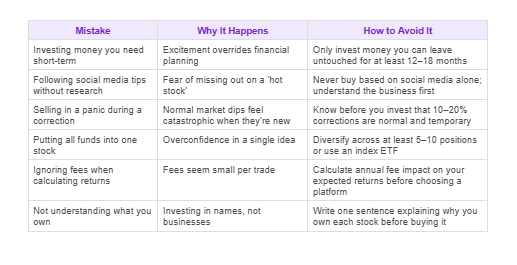
The most expensive mistake most Saudi beginners make is not the first stock they pick. It is the platform they choose without properly evaluating it and paying unnecessarily high fees, experiencing avoidable security incidents, or lacking the data to make good decisions as a result. Getting the platform right is not the boring part of starting to invest. It is the most important part.
Frequently Asked Questions: Starting Stock Trading in Saudi Arabia
How much money do I need to start trading stocks in Saudi Arabia?
You can start with as little as SAR 100 to SAR 500 on platforms that support fractional shares. There is no legal minimum investment amount. However, a practical starting point that allows meaningful diversification without excessive concentration in one or two positions is SAR 1,000 to SAR 2,000 (approximately $265 to $530).
Is stock trading halal?
Most Islamic scholars believe that trading in the stocks of companies engaged in permissible business activities is halal, as long-term ownership of real shares (not derivatives or interest-based instruments) and avoidance of prohibited activities such as alcohol, tobacco, gambling, or conventional interest banking are not allowed. Numerous sites such as Raseed offer investors who need stock filtered by Shariah and ETFs that are halal.
Read More - Best Halal Stocks to Buy in 2026: Top Shariah-Compliant Picks for Investors
Do I pay capital gains tax on stock profits in Saudi Arabia?
The current personal income tax exemption for Saudi nationals is only applicable to capital gains and dividend payments made from stock investments.
Can I trade US stocks from Saudi Arabia?
Yes. Saudi residents can access US stocks through internationally regulated trading platforms. You do not need to be physically present in the US or have a US bank account. Platforms like Raseed provide direct access to NYSE and Nasdaq-listed stocks and ETFs from Saudi Arabia.
What is the difference between buying real stocks and trading CFDs?
Real stock ownership means you genuinely own shares in a company, are entitled to dividends where applicable, and your return reflects the company's actual performance. CFDs (Contracts for Difference) are derivative instruments that track prices without ownership. CFDs typically involve leverage, overnight funding charges, and additional complexity. For long-term, fundamental investing, real stock ownership is the appropriate instrument. CFDs are designed for short-term speculation and carry significantly higher risk.
Disclaimer
This article is for educational and informational purposes only. It is not investment advice, nor a recommendation, offer or solicitation to buy or sell any security or digital asset. Investing involves risk, including possible loss of principal. Past performance does not guarantee future results.
Securities brokerage services are provided by Fullerverse (SC) Limited, a securities broker-dealer licensed and regulated by the Financial Services Authority of Seychelles (Licence No. SD152). Fullerverse (SC) Limited is a wholly-owned subsidiary of Raseed Invest Inc. Registered address: House of Francis, Room 302, Ile Du Port, Mahe, Seychelles.
Cryptocurrency services are made available by Raseed Crypto LLC ("Raseed Crypto"), a FinCEN-registered money services business (MSB Registration No. 31000316890439) and a wholly-owned subsidiary of Raseed Invest Inc. Cryptocurrencies are not stocks and your cryptocurrency investments are not protected by either FDIC or SIPC. Cryptocurrency is highly speculative in nature and involves a high degree of risk, including volatile market price swings, market manipulation, flash crashes and cybersecurity risks. Cryptocurrency regulations are continuously evolving, and it is your responsibility to understand and abide by them. Cryptocurrency trading can lead to large, immediate and permanent loss of financial value. You should have appropriate knowledge and experience before engaging in cryptocurrency trading. For additional information, please see our Crypto Risk Disclosures (https://files.raseedcapital.com/disclosures/library/CryptoRiskDisclosures.pdf).
Cryptocurrency services are not offered by, and are not available through, Raseed Invest Limited, which is regulated by the Dubai Financial Services Authority. Products and services referenced in this article are not available in all jurisdictions and are not directed at any person in a jurisdiction where their offer or availability would be contrary to local law or regulation.