Why Saudi Investors Are Increasingly Focused on US Dividend Stocks in 2026
The combination of investments in U.S. stocks and dividends paid by these stocks provide two benefits for Saudi Arabia and GCC investors looking to build portfolios of U.S. equities. The first is that dividend-paying stocks provide regular (quarterly) periods of cash income regardless of market prices over that period of time. They are also mature companies with established management and business models that return capital to shareholders on an ongoing basis. Dividends from the S&P 500's yield approximately 1.2% as of early April 2026, while the yield on 10-year U.S. Treasury bonds was about 4.3%. Because of these differences, it will be critical to select the right individual dividend stock in this period as compared to other periods.
In this reference book, we will cover the foundational concepts to use when evaluating stocks paying dividends, in addition; to providing a list of dividend paying stocks which are well-established and have been researched heavily by many professionals who invest in the US. The Yields given for each stock are approximate numbers, and come from Financial Data that is publicly available as of early April 2026.
Related: Dividend Reinvestment (DRIP): Turning Cash Payouts into Long-Term Growth
Related: How to Build a Passive Income Portfolio in Saudi Arabia: 2026 Guide
How to Evaluate a Dividend Stock: The Three Criteria That Matter Most
Not all dividend yields are good investments. A high yield can be a warning sign rather than a feature, it often indicates the stock has fallen sharply in price, making the mathematical yield look attractive even as the underlying business deteriorates. The three criteria that professional dividend investors apply consistently are:
Dividend Safety: Did the business raise and maintain its dividends throughout many economic cycles, including recession years? Companies that have raised dividends 25 or more consecutive years (Dividend Aristocrats) or 50 or more years (Dividend Kings) show a great deal of business durability and financial discipline to make these payments.
Payout ratio: What percentage of earnings does the dividend represent? A payout ratio below 60% provides a comfortable safety margin, the company can absorb an earnings decline without cutting the dividend. Ratios above 80–90% are warning signs.
Fundamentals of Business: Is the company generating consistent, increasing free cash flow? (Free Cash Flow (Not Just Accounting Profits) Is How Companies Fund Dividend Payments). Strongly Growing Free Cash Flow Will Allow A Company To Continue Paying And Increasing The Dividend For Many Years.
Related: TASI vs US Stocks: Where Should Saudi Investors Put Their Money in 2026?
Established US Dividend Stocks Worth Monitoring in 2026
These companies have an abundance of research conducted on them, being talked about for dividends through professional research (still being done). There is no complete list to choose from and therefore should be only a point to begin your own research, not necessarily a final recommendation.
Procter & Gamble (PG) — Dividend King, 68 Consecutive Years of Increases
Procter & Gamble is a major company with a collection of important products used by many consumers, including Tide, Pampers, Gillette, Ariel, and Head & Shoulders. Because they are such reliable products in terms of use no matter how the economy is doing, P&G has been able to increase its dividend for over 68 consecutive years into 2026. Only a few companies have this type of dividend history. The current dividend yield is around 2.4% to 3.0%, depending on the share price. For Saudi Arabian investors, PG is a classic defensive dividend stock; this means it is not an exciting stock but will provide the investor with stable/income throughout their investment.
Johnson & Johnson (JNJ) — Healthcare Dividend King with 60+ Year Track Record
As of 2023 when Kenvue was sold off (the consumer health part), Johnson & Johnson (JJ) has become solely a pharmaceutical and medical device company. J&J has been named a Dividend King (60+ consecutive years of raising their dividend), currently has a dividend yield of approximately 3.0 –3.5%, and has a favorable outlook because of an aging global population, an ongoing strong demand for pharmaceuticals and medical devices and many diverse products offered through many different types of healthcare organizations.
Chevron (CVX) — Energy Giant with ~3.4% Yield
Chevron is one of the world's largest integrated energy companies, with operations across exploration, production, refining, and chemicals. As of early April 2026, Chevron's forward dividend yield is approximately 3.44%, with an annual dividend of approximately $7.12 per share. For Saudi investors, Chevron offers exposure to the global energy sector including assets in regions relevant to the GCC with one of the most stable dividend records among major energy companies. CVX has maintained and grown its dividend through multiple oil price cycles.
AbbVie (ABBV) — Dividend Growth Leader with 330%+ Payout Increase Since 2013
AbbVie is widely considered to be one of the largest pharmaceutical companies in the world based on its exceptional portfolio which includes Humira (AbbVie’s flagship product) and other pharmaceutical products in oncology and immunology launched or planned since the loss of patent protection to offset the loss of revenue from Humira.
AbbVie has provided its shareholders with an over 330% increase in its dividend since it spun off from Abbott Labs in 2013, making it a dominant story of dividend growth among companies in the S&P 500, with a current yield of approximately 3.5% - 4.5%, depending on its share price. Risk: the company will be navigating a complex transition across its pipeline portfolio due to present biosimilar competition for Humira.
Realty Income (O) — Monthly Dividend REIT with ~5-6% Yield
Realty Income Corporation (“Realty Income”) is a Realty Investment Trust (REIT) that pays dividends monthly instead of quarterly, which sets Realty Income apart from other REITs in that it favors income-oriented investors. Realty Income has approximately 15,000 properties leased to retail and commercial tenants on a long-term net lease basis. Realty Income's dividend yield is around 5 – 6% in 2026. All REITS are required by federal law to pay out 90% of their taxable income in the form of dividends, creating a structure of REITS as income-oriented investments. Note: U.S. REIT dividends are taxed as ordinary income with non-U.S. investors subject to withholding taxes.
Microsoft (MSFT) — Technology Dividend Grower, Under 1% Yield but 2,700%+ Total Return Since 2009
Despite having a low enough dividend yield (0.8%) to disqualify it from most lists of dividend stocks, Microsoft is certainly a candidate for long-tenured investors due its long history of raising its dividend (annually), its significant stock buybacks over the last several years, and its very high total return (>2,700%) since 2009, including reinvested dividends. Microsoft is a growth investment but provides additional income through a dividend paid by a company that produces above-average free cash flow each year.
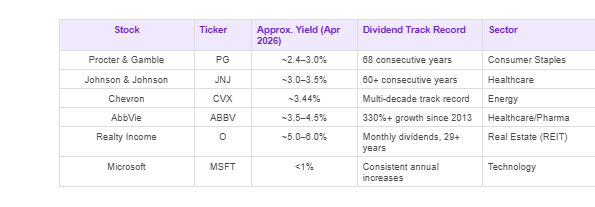
Data note: All yield figures are approximations based on publicly available data as of early April 2026. Yields fluctuate continuously with share price. Verify current yield, payout ratio, and dividend history through Raseed's platform data before making any investment decision.
Related: Dividend Reinvestment (DRIP): Turning Cash Payouts into Long-Term Growth
Related: Fractional Shares Explained: How to Own Apple Stock from $1
Dividend Reinvestment (DRIP): How to Compound Your Income Over Time
For Saudi investors focused on long-term wealth building rather than immediate income, Dividend Reinvestment Plans (DRIP) represent one of the most powerful applications of dividend stocks. Rather than taking dividend payments as cash, DRIP automatically reinvests each dividend payment to purchase additional shares of the same stock. Over time, this compounds your position, you own more shares, which generate more dividends, which purchase even more shares. The mathematical effect over 20 to 30 years is substantial.
Raseed supports dividend reinvestment, giving Saudi and GCC investors access to the same compounding mechanism that has driven the long-term wealth of countless disciplined investors globally.
Related: Dividend Reinvestment (DRIP): Turning Cash Payouts into Long-Term Growth
Frequently Asked Questions: Dividend Stocks for Saudi Investors
How often are US dividends paid?
The majority of US dividend-paying stocks pay quarterly (four times per year). Realty Income is a notable exception, paying monthly. Some international companies pay semi-annually or annually. Dividend payment schedules are always disclosed in advance and available on Raseed's platform.
Are US dividends taxable for Saudi investors?
US companies withhold 30% tax on dividends paid to non-US investors as a standard rate. This withholding applies before dividends reach your account. Saudi investors should be aware of this structure and factor it into yield calculations. Consult a qualified tax adviser for guidance specific to your situation.
What is a Dividend Aristocrat?
A Dividend Aristocrat is a business listed in S&P 500 Index which has raised its dividends each year for a minimum of 25 successive years. Companies that have done this over a period of 50 or more years are known as Dividend Kings. These two groups seem to generally be viewed as having the best records and to possess the most financial discipline when it comes to being good dividend payers.
Important Disclaimer: The stocks, ETFs, and assets mentioned in this article are for informational and educational purposes only and do not constitute financial advice, a recommendation to buy or sell, or a solicitation. All investing involves risk, including the possible loss of principal. Always conduct your own research and consider your personal financial situation before making any investment decision. Securities brokerage services are provided by Fullerverse (SC) Limited, a security broker dealer licensed and regulated by the Financial Services Authority Seychelles (Licence No. SD152). Fullerverse is a wholly-owned subsidiary of Raseed Invest Inc. All investing involves risk. Past performance does not guarantee future results. Capital is at risk.