


What Are Sector ETFs and Why Do They Matter for Saudi Investors?
A sector ETF is an exchange-traded fund that provides targeted exposure to a specific industry segment of the US economy technology, healthcare, energy, financial services, and others rather than the broad market. Where a broad index ETF like the S&P 500 gives you proportional exposure to all sectors simultaneously, a sector ETF lets you overweight the industries you believe will outperform or underweight those you expect to lag.
For Saudi Arabia and GCC investors, sector ETFs serve three particularly valuable purposes. First, they provide instant diversification within a sector, buying the Technology Select Sector SPDR ETF (XLK) gives you exposure to Nvidia, Apple, Microsoft, Broadcom, and dozens of other technology companies in a single trade. Second, they let investors express views about macro themes, the AI buildout, ageing demographics, energy transition without needing to identify individual winning stocks. Third, the major sector ETFs from State Street's Select Sector SPDR family are among the most liquid ETFs in the world, with billions in daily trading volume.
The State Street Select Sector SPDR family covers all 11 GICS (Global Industry Classification Standard) sectors. The 4 sectors with the greatest importance and analyst interest for GCC (Gulf Coast) investors as they prepare for investments through 2026 are: Technology (XLK), Healthcare (XLV), Energy (XLE), and Financials (XLF).
Related: How to Invest in the S&P 500 from Saudi Arabia: Step-by-Step Guide
XLK — Technology Select Sector SPDR ETF
Key Facts (as of April 2026)
XLK tracks the Technology Select Sector Index, which includes S&P 500 companies in the information technology sector. The fund is approximately 99% invested in technology stocks with minimal exposure to other sectors. Its largest holdings are Nvidia, Apple, Microsoft, Broadcom, and other leading technology companies. The expense ratio is among the lowest in its peer group, consistent with the entire SPDR Select Sector suite.
Performance Data
XLK's one-year total return as of April 2026 is approximately 23%, significantly outperforming the S&P 500's broader return over the same period. The ETF delivered approximately 51% total return over the past two years, reflecting the exceptional performance of AI-driven technology stocks during this period. In 2025 alone, XLK gained approximately 25%, led by Nvidia and software infrastructure companies.
2026 Outlook and GCC Investor Considerations
Analyst consensus heading into 2026 rated XLK as one of the top outperform sectors, driven by continued AI hardware and software demand, Nvidia's next-generation Vera Rubin server platform, and Azure/cloud spending growth. XLK is the natural choice for GCC investors who want broad technology exposure without having to select individual stocks.
The concentration risk is significant: XLK's top 10 holdings account for approximately 63% of the fund's weight. Nvidia, Apple, and Microsoft alone represent roughly half the entire ETF. This means XLK is less diversified than it might appear, it is effectively a leveraged bet on the continued dominance of a handful of mega-cap technology companies. Investors comfortable with this concentration will find XLK one of the most efficient ways to express an AI technology thesis.
XLK delivered ~51% total return over two years giving Saudi investors exposure to Nvidia, Apple, Microsoft, and Broadcom in a single trade. Buy XLK on Raseed from just $1 in fractional shares. One ETF. Dozens of the world's most powerful technology companies. Maximum $3 per trade. Invest in XLK on Raseed today →
XLV — Health Care Select Sector SPDR ETF
Key Facts and Performance
XLV follows the Health Care Select Sector Index and is made up of S&P 500 companies which fall into the following categories: pharmaceuticals; biotechnology; medical devices; managed care; and healthcare services. Some of XLV's largest holdings include: UnitedHealthcare, Eli Lilly, Johnson & Johnson, AbbVie, and Abbott Laboratories. As of early April 2026, XLV's current share price is approximately $146-$147. Over a one year period, the total return is expected to be either slightly less than or about equivalent to that of the broader market.
Why Healthcare Matters for GCC Investors in 2026
Healthcare has consistently been among the most reliable areas for investing during economic uncertainty or downturns; therefore, healthcare equities tend to perform better than most other asset classes. Most importantly, the demand for both drugs and the provision of hospital care or usage of medical devices is not reliant on the economic situation.
The structural tailwind for US healthcare in 2026 is the GLP-1 weight loss drug revolution, led by Eli Lilly (Mounjaro/Zepbound) and Novo Nordisk (Ozempic/Wegovy). These drugs have created one of the largest new pharmaceutical categories in history, with potential applications extending beyond obesity to cardiovascular disease, diabetes, and cognitive health. Eli Lilly's market dominance in this category positions XLV as a beneficiary of one of the most significant healthcare innovations of the decade.
Analysts at Seeking Alpha rated XLV as an Outperform sector heading into 2026, supported by Eli Lilly's market dominance and resilient economic growth supporting healthcare spending. For Saudi investors who want defensive portfolio ballast without sacrificing growth potential, XLV provides a compelling balance.
XLE — Energy Select Sector SPDR ETF
Key Facts and Performance
XLE is an ETF that follows the energy portion of the S&P 500 index. It includes all the companies in the S&P 500 that develop, produce, refine, store , and transport oil, natural gas, and consumable fuels. The largest components listed in XLE include ExxonMobil, Chevron, ConocoPhillips, EOG Resources and Schlumberger. Therefore every company in XLE is defined as being in the "Energy" sector. The total balance of assets held through XLE are 100% allocated and diversified into the only sector of Energy and not across multiple sectors.
One of the most impressive aspects of XLE's 2026 performance is its return (up to the first week of April 2026) has been around 16.40% for the year so far; this gives it a great deal of relative outperformance against the S&P 500, thus putting XLE as the best performing ETF in Q1 2026, with various sources reporting that XLE gained over 33% just during Q1 due to both energy cost and global economic conditions. XLE's three-year return is approximately 30%.
The Contrarian Case for XLE Among GCC Investors
Energy is a sector with special resonance for Saudi and GCC investors. The Kingdom's economy, and the fiscal position of neighbouring Gulf states, has historically been deeply linked to global energy prices. XLE provides Saudi investors with a way to express a view on global energy demand through the equity market, specifically through the world's largest and most profitable US energy companies.
The investment thesis for XLE in 2026 is centered on several key factors: institutional investors have a considerable under-allocation of capital to energy stocks versus their relative weight in the overall economy; the demand for power created by data centre and artificial intelligence infrastructure will be a large new source of demand for electricity, benefiting both traditional energy producers and utilities; and, based on earnings and free cash flow, energy company valuations are attractive compared to other industry sectors.
An analyst at a Seeking Alpha wrote an analysis of XLE in December 2025 rating it a contrarian buy for 2026. The analyst cited technology as the crowded trade and energy as the underappreciated segment, with structural upside potential created by electrical consumption in data centers not being fully priced into the market.
Risk Factors
XLE is the most volatile of the four sector ETFs in this guide, with a beta (market sensitivity) of approximately 1.36 relative to the broader market. Oil price swings, geopolitical events involving Middle Eastern energy production, and the ongoing energy transition away from fossil fuels all create significant uncertainty for energy stock valuations over a medium-to-long-term horizon.
XLE was the best performing sector ETF in Q1 2026 gaining over 33% in a single quarter. As a Saudi or GCC investor, you already understand energy markets better than most. Now you can invest in them directly through ExxonMobil, Chevron, and the world's largest US energy companies from just $1 on Raseed. Buy XLE on Raseed and invest in global energy →
XLF — Financial Select Sector SPDR ETF
Key Facts and Performance
The XLF ETF follows financial institutions from the S&P 500, including banks and insurance companies. The top holdings in this ETF are: Berkshire Hathaway, JPMorgan Chase, Visa, Mastercard, and Bank of America. At the beginning of April 2026, the XLF has achieved approximately 17.36% over the last twelve months and has outperformed the entire market.
Why XLF Is Worth Monitoring for GCC Investors
The macroeconomic environment is particularly advantageous for financial stocks when interest rates remain elevated for an extended period of time, thus widening the net interest margin banks earn on loans, and when the overall economy is strong enough to experience fewer loan defaults and sustained consumer spending, including credit card purchases. To date in 2026, each of these criteria have been satisfied to some degree. Leading U.S. Banks, including JPMorgan Chase & Co., continue to report large profits resulting from elevated interest rates, growth in wealth management, and consistent lending to both consumers and businesses.
XLF, an ETF that tracks the performance of financial stocks on the S&P 500 Index, can be considered as indirect access to how well the U.S. economy and financial markets are performing for GCC investors. Additionally, the Berkshire Hathaway position (which is also XLF’s largest holding) gives access to Warren Buffett’s diversified company (insurance, utilities, and manufacturing) along with his substantial equity investments in U.S. corporations.
Sector ETF Comparison for GCC Investors
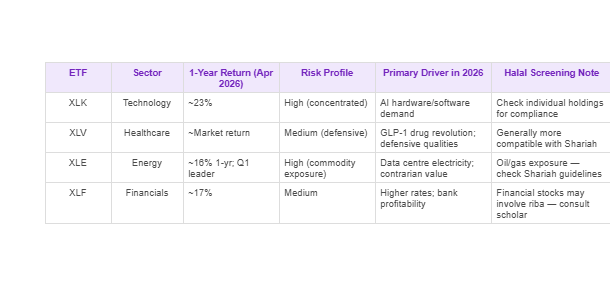
Halal Note: GCC investors seeking Shariah-compliant sector exposure should note that XLF (financial sector) presents the clearest compatibility concern due to interest-based business models among its holdings. XLK, XLV, and XLE require individual holding review rather than sector-level prohibition. Consult Raseed's Halal ETF guide for compliant alternatives.
Related: Best Halal ETFs for Saudi Investors in 2026
Related: Best Halal Stocks to Buy in 2026: Top Shariah-Compliant Picks
XLK. XLV. XLE. XLF. Four of the most powerful sector ETFs in the world all available to Saudi and GCC investors on one DFSA-regulated platform. Position your portfolio across technology, healthcare, energy, and financials from a single Raseed account. Fractional investing from $1. Maximum $3 per trade. No hidden fees. Open your Raseed account and start investing in sector ETFs today →
Frequently Asked Questions: Sector ETFs for Saudi Investors
Can I invest in sector ETFs with fractional amounts on Raseed?
Yes. Sector ETFs are tradeable on Raseed with the same fractional share capability as individual stocks. You can invest SAR 200 in XLK, SAR 150 in XLV, and SAR 100 in XLE without needing to purchase full units of each fund.
Are sector ETFs riskier than broad index ETFs?
Yes, in most scenarios. Sector ETFs focus on one industry which means that an industry-specific decline (e.g. technology pullback, energy crash, healthcare regulation) will have a greater impact than if it were to hold broad market index ETF(s), making the decision to use sector vs. broad market ETFs vast for tradeoffs; i.e., gain greater from the sector's tailwinds. Professional investors often use the broadest index as their main investments and use the sectors as tactical 'overweight' versus reverse.
What is the expense ratio for the SPDR Select Sector ETFs?
The Select Sector SPDR ETFs are known for having very low expense ratios, consistently among the lowest in the sector ETF category. Exact current rates are available on the SSGA (State Street Global Advisors) website and in the Raseed platform.
Important Disclaimer: The stocks, ETFs, and cryptocurrencies mentioned in this article are for educational and informational purposes only and do not constitute financial advice, a recommendation to buy or sell, or a solicitation. All investing involves risk, including the possible loss of principal. Market data and performance figures referenced are approximate and sourced from publicly available financial sources as of early April 2026; they may change at any time. Always conduct your own research before making any investment decision. Securities brokerage services are provided by Fullerverse (SC) Limited, a security broker dealer licensed and regulated by the Financial Services Authority Seychelles (Licence No. SD152). Fullerverse is a wholly-owned subsidiary of Raseed Invest Inc. All investing involves risk. Past performance does not guarantee future results. Capital is at risk.