


The Three Technology Giants Every Saudi Investor Is Watching in 2026
In October 2026, Apple, Nvidia, and Microsoft make up the three largest weights of the Nasdaq 100, with total market capitalizations over $9 trillion, making them the most well-known tech companies in the world and the most frequently traded US stocks by both Saudi and GCC investors, and they reflect three different technology strategies, including Apple's ownership of the end-user hardware and service environment; Nvidia's ownership of the infrastructure layer of the AI revolution; and Microsoft's ownership of software and cloud technology that allows AI to be integrated into products and services for consumers and enterprises all around the world.
Understanding these three companies in depth, their actual financial results, their competitive positions, their risks, and how they each fit differently into a GCC investor's portfolio, is more valuable than a simple 'buy or sell' recommendation. This guide provides exactly that analysis, grounded in verified data from official filings.
Related: TASI vs US Stocks: Where Should Saudi Investors Put Their Money in 2026?
Related: Fractional Shares Explained: How to Own Apple Stock from $1
Nvidia (NVDA) — The AI Infrastructure Story in Numbers
What the Earnings Actually Say
Nvidia's full fiscal year 2026 numbers, from official SEC filings, tell one of the most extraordinary corporate growth stories in technology history. Full-year revenue of $215.94 billion represents 65% growth year-over-year. Net income of $120.07 billion. Q4 revenue of $68.13 billion, up 73% year-over-year. Data Center revenue, the segment driven by AI GPU demand was $62.31 billion in Q4 alone, representing approximately 91% of total company revenue.
The estimated revenue growth through to FY 2026 by quarter over time is $44B, $47B, $57B, $68B with growth of this rate not only being unprecedented in the Enterprise technology space but again clearly unprecedented in general. Nvidia has guided to revenue for Q1 FY 2027 of about $78B which means Nvidia continues to expect sequential double-digit revenue growth.
Gaming revenue (Nvidia's original core business) was also strong, up 42% year-over-year in Q4, driven by the Blackwell architecture. Networking revenue surged 263% year-over-year to $10.98 billion in Q4, driven by NVLink compute fabric deployment.
The Investment Framework for GCC Investors
The argument made by Nvidia for being included in an investor’s portfolio from the Gulf Cooperation Council comes down to its simple structural thesis: globally, capital expenditure on AI is going through a multi-year acceleration phase, which will flow directly into Nvidia’s GPU business. Capital expenditure from the hyperscale cloud providers (i.e., Google, Microsoft, Amazon, Meta) is projected to be $520 billion in total dollars in 2026, compared to $400 billion in total dollars in 2025. Furthermore, there will be further increases in AI semiconductor demand as both training and inference workloads scale up.
The risk equation is equally clear: Nvidia's current valuation implies continued extraordinary growth. Any meaningful deceleration, driven by competition from custom silicon (Google's TPUs, Amazon's Trainium, Broadcom's custom AI chips), efficiency improvements that reduce per-task GPU requirements, or macroeconomic pressure on capital expenditure would likely produce significant stock price correction. Nvidia is the highest-potential and highest-risk of the three stocks analysed here.
Competitive Moat and Risk Assessment
Nvidia's competitive advantage rests on the combination of its CUDA software ecosystem (which took decades to build and would require years for any competitor to replicate), the network effects of its installed developer base, and the Blackwell and future Vera Rubin hardware platforms. The emergence of DeepSeek, a Chinese AI model offering comparable performance at lower compute cost, caused a temporary sell-off in early 2026, but CEO Jensen Huang argued credibly that efficient models expand the total addressable market for inference computing rather than reduce it.
Related: Advanced Charts & Order Book on Raseed: Trading With Clarity
Nvidia delivered $215.94 billion in revenue in FY2026 — 65% growth year-on-year. Saudi investors can own a piece of the world's leading AI chip company from just $1 in fractional shares on Raseed. No minimum trade size. Maximum fee of $3 per trade no matter the position. Buy Nvidia (NVDA) on Raseed today →
Microsoft (MSFT) — The Compounding Platform Accumulating AI Advantage
What the Earnings Actually Say
Microsoft's fiscal Q2 2026 results: revenue of $81.3 billion (+17% YoY), Intelligent Cloud segment revenue up 29%, non-GAAP EPS of $4.14 (+24% YoY). Microsoft is on course for approximately $100 billion in infrastructure spending in 2026, the largest capital commitment to AI infrastructure in the company's history. Azure growth of approximately 28.6% is outpacing AWS in the latest comparable period.
Why Microsoft Is Structurally Positioned for GCC Investors
Microsoft's investment thesis has three distinct pillars that compound together: the cloud infrastructure business (Azure, which powers the AI ambitions of enterprises globally), the software subscription business (Microsoft 365, which embeds Copilot AI into the productivity tools used by hundreds of millions of workers daily), and the OpenAI investment (approximately 27% stake, providing direct financial exposure to the most influential AI lab in the world).
Unlike Nvidia, which is almost entirely dependent on the AI capital expenditure cycle, Microsoft is diversified across multiple software, cloud, and hardware categories. A slowdown in AI GPU spending would hurt Nvidia far more than Microsoft. This resilience, combined with Microsoft's consistent dividend growth and share buyback programme, makes it a fundamentally different risk profile, higher growth than traditional dividend stocks, more stability than pure AI infrastructure plays.
Valuation and Near-Term Considerations
Microsoft shares have been stalled in early 2026 as there has been no sustained progress with the stock price, despite good recent earnings. Zacks' analysts have rated Microsoft stock a "Buy," with analysts noting the stock has good support at the $470 level and has good risk/reward characteristics if that level continues to hold. While Microsoft has an elevated P/E relative to its historical averages, the company's current P/E is lower than the high-for-the-pandemic numbers from 2021, allowing more room for earnings growth to narrow the gap between the current multiples of share and earnings than needing a dramatic expansion of multiples to achieve.
Apple (AAPL) — Record Revenue, But Premium Valuation in a Challenging Year
What the Earnings Actually Say
Apple's fiscal Q1 2026 — the holiday quarter, Apple's seasonally strongest, delivered $143.76 billion in revenue, up 15.7% year-over-year and a new all-time quarterly revenue record. Apple Intelligence (the branded AI feature suite) drove the iPhone 17 upgrade cycle. The company regained the number one position in China smartphone market share. Services revenue — App Store, iCloud, Apple Pay, Apple TV+, licensing — continues to grow at double-digit rates and carries margins substantially above the hardware business.
The GCC Investor Perspective on Apple
Apple's brand recognition in Saudi Arabia and the GCC is unmatched among technology companies. The iPhone is the dominant premium smartphone in the region. For Saudi investors, Apple's blend of brand strength, consistent dividend growth (even at sub-1% yield), and massive share buyback programme has historically made it a low-drama long-term holding.
The 2026 complication: Apple is identified by multiple analysts as one of only two Magnificent 7 stocks in a sustained price downtrend heading into the year (alongside Tesla). Its valuation at approximately 31 times forward earnings, the second-highest in the Magnificent 7, requires continued execution. The ongoing US Department of Justice antitrust case, while unlikely to produce dramatic near-term outcomes, creates regulatory uncertainty. On the Zacks framework, Apple needs to demonstrate that the iPhone 17 upgrade cycle is sustainable before the valuation premium becomes easier to justify.
Apple posted a new all-time quarterly revenue record of $143.76 billion in Q1 2026 and Saudi investors can own a fractional share of Apple from just $1 on Raseed. The same iPhone brand that dominates the GCC market is one of the most accessible long-term investments available. Buy Apple (AAPL) on Raseed from $1 →
Three-Way Comparison: Nvidia vs Microsoft vs Apple for GCC Investors in 2026
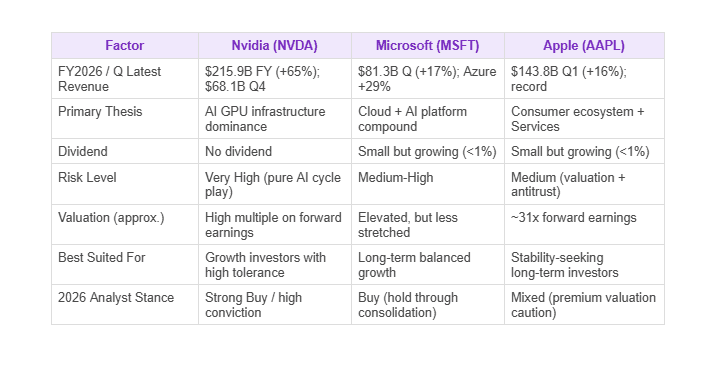
For GCC investors asking which of the three to own in 2026: Nvidia offers the highest potential return and highest risk; Microsoft offers the most balanced combination of growth, stability, and AI exposure; Apple offers the most defensive characteristics but carries valuation risk. All three are reasonable components of a diversified technology allocation — and all three are accessible from Saudi Arabia through Raseed with a maximum fee of $3 per trade.
Related: Lowest Trading Fees in Saudi Arabia: Full Platform Comparison 2026
Related: US Stock Market Correction 2026: Should GCC Investors Be Worried?
Nvidia. Microsoft. Apple. Three of the world's most valuable tech companies, all available to Saudi and GCC investors on one DFSA-regulated platform. Pick one, pick all three, or start with $1 in fractional shares and build your position over time. No account maintenance fees. No hidden charges. Maximum $3 per trade. Open your Raseed account and start trading US tech stocks today →
Frequently Asked Questions: Tech Stocks for Saudi Investors 2026
Is it too late to buy Nvidia after its extraordinary run?
This is a legitimate question with no simple answer. Nvidia's revenue growth trajectory remains exceptional, but the stock price already reflects very high future expectations. Whether the current price represents fair value depends primarily on whether you believe the $3–4 trillion annual data centre capital expenditure projection materialises by 2030. Many professional analysts maintain Buy ratings; others caution that the entry point matters for medium-term holders. No single stock should dominate a portfolio.
Do these tech stocks pay dividends?
All three pay small dividends. Nvidia historically has not prioritised dividends; Microsoft and Apple both pay small but consistently growing dividends and have extensive buyback programmes. None are high-yield dividend stocks — they are primarily growth investments where total return comes through share price appreciation and moderate dividend growth over time.
How do I buy Apple, Nvidia, or Microsoft as a Saudi investor on Raseed?
Search for the ticker symbol, AAPL for Apple, NVDA for Nvidia, MSFT for Microsoft — in the Raseed app. Use the fractional share option to invest any dollar amount you choose, from $10 to $10,000. Raseed charges a maximum of $3 per trade regardless of trade size.
Important Disclaimer: The stocks and ETFs mentioned in this article are for educational and informational purposes only and do not constitute financial advice, a recommendation to buy or sell, or a solicitation. All investing involves risk, including the possible loss of principal. Market data and performance figures referenced are approximate and sourced from publicly available financial sources as of early April 2026; they may change at any time. Always conduct your own research before making any investment decision. Securities brokerage services are provided by Fullerverse (SC) Limited, a security broker dealer licensed and regulated by the Financial Services Authority Seychelles (Licence No. SD152). Fullerverse is a wholly-owned subsidiary of Raseed Invest Inc. All investing involves risk. Past performance does not guarantee future results. Capital is at risk.