


Understanding Bull and Bear Markets
Financial markets move through cycles. Some periods are characterised by rising stock prices and strong investor confidence, while others are marked by falling prices and increased uncertainty. These periods are commonly known as bull markets and bear markets.
Understanding how these market conditions work is an important part of long-term investing. Whether you invest in Saudi stocks through the Tadawul All Share Index (TASI), US stocks, ETFs, or a diversified portfolio across global markets, recognising market cycles can help you make more informed investment decisions.
Three key concepts help explain how bull and bear markets work:
A market decline of 20% or more from a recent high is generally considered a bear market.
A market increase of 20% or more from a recent low is generally considered a bull market.
Historically, bull markets have tended to last longer than bear markets, although every cycle is different.
Both the TASI Index and US stock markets move through repeated bull and bear cycles. Understanding these market conditions can help investors manage risk, stay disciplined, and avoid making emotional decisions during periods of market volatility.
What Is a Bull Market?
A bull market refers to an extended period when stock prices rise by at least 20% from a recent market low. Bull markets are typically supported by economic growth, strong corporate earnings, improving business conditions, and positive investor sentiment.
Bull markets often last for several years and can create meaningful opportunities for long-term investors
Common Characteristics of a Bull Market
Rising stock prices across multiple sectors
Strong economic growth and business activity
Improving corporate profits
Lower unemployment levels
Increased investor confidence
Higher levels of investment and market participation
Increased IPO and capital market activity
The term "bull market" comes from the way a bull attacks by thrusting its horns upward, symbolising rising asset prices.
Historical Bull Market Examples
The Longest US Bull Market (2009–2020)
One of the most notable bull markets in modern history began after the Global Financial Crisis in March 2009.
From 2009 to early 2020, the S&P 500 delivered substantial gains as the US economy recovered, corporate earnings expanded, and investor confidence strengthened. During this period, investors who remained invested benefited from one of the longest bull markets on record.
The Post-COVID Recovery
Following the COVID-19 market crash in March 2020, the US market experienced one of the fastest recoveries from a bear market in modern history.
After falling approximately 34% in a matter of weeks, the S&P 500 recovered rapidly and reached new record highs later in 2020. This episode reinforced an important investing principle: while market downturns can be severe, markets have historically recovered over time, although the timing and pace of recovery can vary.
Saudi Market Recovery (2020–2022)
Saudi Arabia's stock market also experienced a strong recovery following the pandemic-related market decline.
Between 2020 and 2022, TASI benefited from improving economic conditions, higher oil prices, strong corporate earnings, and continued progress under Vision 2030 initiatives. This period demonstrated how local economic developments can support sustained market growth.
Whether we are in a bull market or a bear market, the investors who benefit most are the ones who are already in the market. Start investing in Saudi stocks and US stocks from just $1 on Raseed DFSA-regulated, no account maintenance fees, trades capped at $3. Open your free Raseed account now →
What Is a Bear Market?
A bear market occurs when stock prices fall by 20% or more from a recent market high. Bear markets are often associated with economic slowdowns, rising uncertainty, weaker corporate earnings, or broader financial stress.
While bear markets can be challenging, they are a normal part of long-term market cycles.
Common Characteristics of a Bear Market
Declining stock prices across multiple sectors
Slower economic growth or economic contraction
Rising unemployment
Lower corporate earnings
Reduced investor confidence
Higher market volatility
Increased risk aversion among investors
The term "bear market" comes from the downward swiping motion of a bear's claws, representing falling market prices.
Historical Bear Market Examples
The Dot-Com Crash (2000–2002)
During the dot-com bubble, technology company valuations reached unsustainable levels. When investor expectations failed to match business performance, the market corrected sharply.
The NASDAQ Index lost a significant portion of its value between 2000 and 2002, providing an important lesson about valuation risk and speculative investing.
The Global Financial Crisis (2007–2009)
The Global Financial Crisis triggered one of the most severe bear markets in recent history.
As problems in the US housing market spread throughout the global financial system, stock markets worldwide experienced significant declines. Investors across the GCC and Saudi Arabia who held international equities were also affected.
TASI Market Weakness (2022–2025)
Following record highs reached in previous years, TASI experienced periods of weakness influenced by higher global interest rates, geopolitical uncertainty, and changing energy market conditions.
This period highlighted the importance of diversification and risk management, even in markets supported by strong economic fundamentals.
US Bear Market Territory in 2025
In 2025, the S&P 500 briefly entered bear market territory following heightened concerns around trade policy, tariffs, and global economic uncertainty.
The episode demonstrated how quickly investor sentiment can change and how global events continue to influence financial markets.
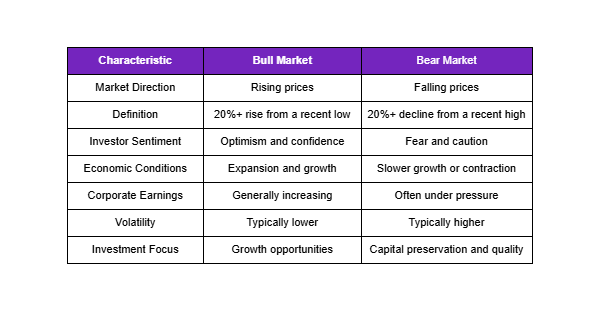
Bull Market vs Bear Market: Key Differences
How to Invest During a Bull Market
1. Stay Invested
One of the most effective bull market strategies is remaining invested and allowing long-term compounding to work.
Attempting to predict market peaks consistently is extremely difficult, even for professional investors.
2. Maintain Diversification
While bull markets often create strong returns, diversification remains important. A balanced portfolio helps manage risk if market conditions change unexpectedly. The NASDAQ 100 stocks guide covers the high-growth technology companies that have historically led bull market gains.
3. Rebalance Your Portfolio
As stock prices rise, your portfolio allocation may drift away from its original target. Periodic rebalancing helps maintain an appropriate level of risk.
4. Continue Dollar-Cost Averaging
Regular investing through dollar-cost averaging (DCA) allows investors to remain disciplined and avoid emotional decision-making during periods of strong market performance.
Bull markets reward investors who stay in the market consistently — not those who try to time it. Set up a regular investment on Raseed from as little as $1 per month and let compounding do the work. Saudi stocks, US stocks, and halal ETFs — all in one platform. Start investing consistently on Raseed →
How to Invest During a Bear Market
1. Avoid Panic Selling
Many investors make the mistake of selling during periods of fear. Historically, markets have recovered from bear markets, although recovery periods can vary significantly.
2. Continue Investing Consistently
Bear markets can create opportunities to accumulate investments at lower prices through regular contributions.
3. Focus on Quality Investments
Companies with strong balance sheets, stable earnings, and sustainable business models often demonstrate greater resilience during market downturns.
4. Diversify Across Markets
Holding exposure to both Saudi and international markets may help reduce concentration risk and improve long-term portfolio resilience. Halal ETFs and Shariah-compliant funds often hold large positions in quality dividend-paying companies that tend to be more resilient.
Common Mistakes Investors Make
During Bull Markets
A common mistake is assuming strong market performance will continue indefinitely. Every bull market eventually experiences corrections or transitions into different market conditions.
During Bear Markets
Many investors attempt to identify the exact market bottom. In reality, consistently timing market turning points is extremely difficult.
In Both Market Conditions
Reacting to short-term headlines instead of focusing on long-term investment goals can lead to poor decision-making and unnecessary portfolio changes.
Frequently Asked Questions
How do I know if the market is in a bull or bear phase?
A market is generally considered to be in a bull market when it has risen 20% or more from a recent low. A bear market is typically defined as a decline of 20% or more from a recent high.
How long do bear markets usually last?
Historical data shows that bear markets have generally been shorter than bull markets, although no two market cycles are identical.
Should investors sell everything during a bear market?
Investment decisions should always reflect individual goals, risk tolerance, and time horizon. Historically, long-term investors who remained invested have participated in subsequent market recoveries.
Is TASI affected by US market conditions?
Yes. While TASI has its own drivers, including oil prices and domestic economic conditions, global events and US market trends can influence investor sentiment and capital flows across international markets.
Final Thoughts
Bull and bear markets are natural parts of the investing journey. Understanding how market cycles work can help investors make more informed decisions, manage risk more effectively, and maintain a long-term perspective during periods of both optimism and uncertainty.
For investors in Saudi Arabia and across the GCC, recognising these market conditions is an important step toward building a disciplined investment strategy that can adapt to changing economic environments.
Related Articles on Raseed Learn
Understanding Risk in Stock Trading | What Is Market Volatility? | Protect Your Portfolio During Geopolitical Events
TASI vs US Stocks — Where Should Saudi Investors Invest? | 5 Steps to Diversify Your Portfolio