


Why Understanding Crypto Risk Is as Important as Understanding Crypto Opportunity
The cryptocurrency market in 2026 is more mature, more institutionally integrated, and more widely accessible than at any previous point in its history. Bitcoin spot ETFs have brought digital assets into mainstream portfolios. Ethereum's infrastructure supports a growing ecosystem of decentralised applications. And for Saudi Arabia and GCC investors, access to crypto through regulated, transparent platforms is now straightforward. However, maturity and accessibility do not eliminate risk. If anything, the continued expansion of the market brings new risks alongside new opportunities. This guide provides a thorough, honest account of the risks every GCC investor should understand before committing capital to cryptocurrency trading.
Related: Stocks AND Crypto in One App: Which GCC Platforms Support Both?
Risk 1: Market Volatility — The Defining Characteristic of Crypto
Cryptocurrency is among the most volatile asset classes in global finance. Bitcoin, the most liquid and widely held crypto, has experienced intraday price moves of 10–20% in single sessions on multiple occasions throughout its history. More speculative cryptocurrencies can move 30–50% in a single day. This volatility operates in both directions and with significant speed.
For context: The S&P 500 (a very volatile equity market) has averaged about 14% per year in terms of drawdowns for the last 50+ years (we're wondering how long we have to wait for the market to go back up), while Bitcoin has had an average of over 50% from peak to bottom and most recently (in 2018) over 80% (the last two dips were about 80+%). Even though Bitcoin in the "institutionalized" time frame from 2024 to 2025 had about a 30%+ correction from its peak of around $125,000 at the end of 2020.
What this means practically is that any allocation to cryptocurrency should be sized with the explicit assumption that a 50% or greater drawdown is possible at any point, and that a total loss, while unlikely for established assets like Bitcoin and Ethereum, is not impossible.
Risk 2: Liquidity Risk — Not All Crypto Is Created Equal
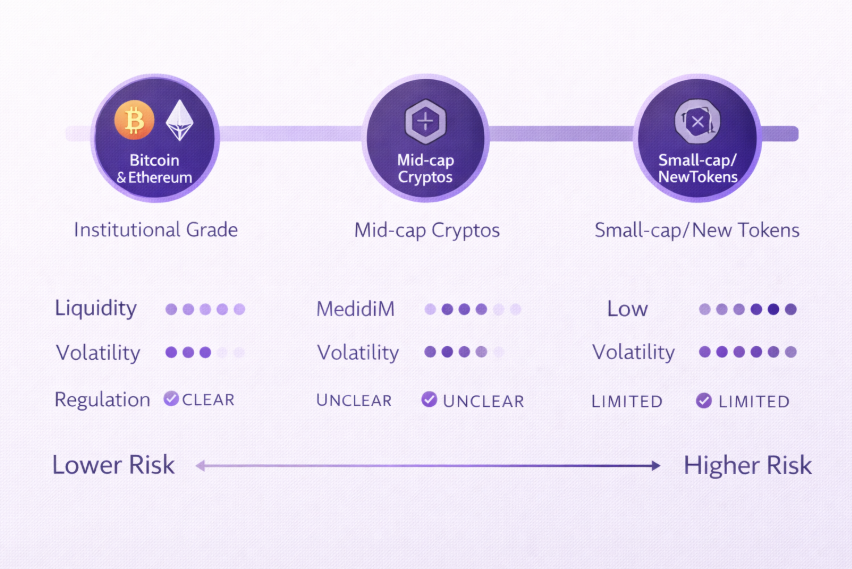
Bitcoin and Ethereum trade billions of dollars in daily volume on legitimate regulated exchanges. They are genuinely liquid, you can typically enter or exit a substantial position without meaningfully moving the price. However, the crypto market includes thousands of assets, the vast majority of which have very limited liquidity.
Low-liquidity cryptocurrencies pose two specific dangers. First, the bid-ask spread (the difference between the price you pay to buy and the price you receive to sell) can be enormous, representing an immediate 5–15% cost of entering a position. Second, in adverse market conditions, it may be difficult or impossible to exit a position at any reasonable price, because there are no buyers available. The risk of being 'trapped' in a low-liquidity position is not hypothetical; it has caused catastrophic losses for retail investors in every crypto market cycle.
The risk management implication: restrict crypto exposure to assets with genuine, verifiable liquidity. Bitcoin and Ethereum meet this standard comfortably. Beyond the top 10 to 20 assets by market capitalisation and daily trading volume, liquidity risks increase significantly.
Related: Free Level 2 Market Data: Why It Matters in GCC
Risk 3: Regulatory Risk — An Evolving Landscape
There are numerous regulations around the world regarding cryptocurrency; this means that these types of industry standards will be constantly changing from country to country. The regulations in some countries are more mature than others. There are many laws and regulations governing cryptocurrencies in various jurisdictions, and they differ significantly in their approach to regulating this type of asset.
This is also true of how each jurisdiction treats cryptocurrencies as either transactions or forms of payment. Additionally, how a jurisdiction distinguishes between the use of cryptocurrencies for speculation as compared to everyday purchases can also have implications for businesses that deal with cryptocurrencies.
The term regulatory risk refers to the changes that may occur (and can happen quickly) in rules that could affect your ability to maintain, trade or profit from cryptocurrencies. An example of a favorable development is the approval of a spot ETF, which may greatly increase the value of cryptocurrencies.
An example of an adverse development is a trading ban imposed by a major market (for an exchange or trader) that could significantly decrease the value of cryptocurrencies. Investors in the Gulf Cooperation Council region must be aware of regulatory developments in both Saudi Arabia and the United Arab Emirates as these will impact the location and manner in which businesses operate.
Regulatory note: Raseed's brokerage and crypto services are provided through Fullerverse (SC) Limited, licensed and regulated by the Financial Services Authority Seychelles (Licence No. SD152), a wholly-owned subsidiary of Raseed Invest Inc. Always ensure any platform you use for crypto is operated by a regulated entity.
Risk 4: Platform and Counterparty Risk
The fall down of FTX in 2022 – one of the largest crypto exchanges on the planet at the time – stands among some of the biggest risk events in all of cryptocurrency's history. The failure of the exchange ceased billions of dollars worth of customer funds, creating a cascade of destruction across the crypto ecosystem. A very real and material risk exists in crypto today from the risk associated with your assets being held by a platform that fails, is hacked, or engages in fraudulent conduct, otherwise known as platform risk.
To reduce platform risk, it is important to operate within the controls of a governed and audited financial institution who maintains documented segregation of client funds from its own. For Saudi and GCC region investors, things to consider when selecting a platform are: Is the financial institution that provides the trading platform regulated by an appropriate regulatory body? Do they maintain separate accounts for customers/traders and company accounts? Are they regularly, independently audited? How do I make a claim if there is an issue?
Related: Is Raseed Safe? Regulation, Security & Fund Protection
Related: Why Your Money Is Secure on Raseed Platform
Risk 5: Concentration Risk — Crypto in a Broader Portfolio Context
Even investors who accept the risks of crypto individually must manage the concentration risk of holding crypto alongside other assets. Crypto markets have shown increasing correlation with technology equities during periods of risk-off sentiment, when markets broadly sell off, crypto tends to sell off simultaneously with stocks. This reduces the diversification benefit of crypto at exactly the moments when diversification matters most.
A widely used framework for GCC investors building diversified portfolios is to treat crypto as a high-risk, high-reward allocation that represents a defined minority of total portfolio exposure — commonly cited as 5% to 10% for investors who are genuinely comfortable with the volatility characteristics. Allocations significantly above this level create concentration risk that can dominate overall portfolio performance in both directions.
Related: TASI vs US Stocks: Where Should Saudi Investors Put Their Money in 2026?
Related: How to Invest in the S&P 500 from Saudi Arabia
Risk 6: Behavioural Risk — The Self-Imposed Danger
The most significant and frequently consequential risk in cryptocurrency trading is not market risk or regulatory risk, but rather investor behavior during stressful situations. High volatility, such as a rapid 50% gain quickly followed by a rapid 50% loss, creates strong emotional reactions and provides an opportunity for impulsive behavior (FOMO) and impulsive behavior (panic selling) both of which are predictable, well-documented behavior patterns in crypto trading which negatively impact returns on investment throughout every cycle of the crypto market (throughout each market cycle).
The single most important risk management practice for a crypto investor is defining, in writing, their maximum loss tolerance before entering any position and committing not to exceed it regardless of emotional pressure. This sounds simple. It is genuinely difficult in practice.
Frequently Asked Questions: Crypto Trading Risks for GCC Investors
Is cryptocurrency legal to trade in Saudi Arabia?
There are changes in the regulation of cryptocurrencies within Saudi Arabia. The SAMA has provided guidance and warned against using cryptocurrency for payment purposes, but many Saudi investors are trading as well as currently buying cryptocurrencies via regulated, established global platforms. The regulatory landscape is continuing to develop, and investors in the GCC should continue to follow the current guidelines from both SAMA and the CMA.
How much of my portfolio should be in crypto?
Many resources recommend restricting the amount of crypto you invest in to a low %. Typical recommendation thresholds range between 5% and 10% of your total investable assets if you are comfortable with this asset class however when considering what is appropriate for you, you have to take into account your overall financial picture, level of risk tolerance and investment timeframe. This information is not meant to provide you with financial advice; please consult a qualified financial adviser for expert advice regarding this topic.
What is the safest way to hold crypto on a regulated platform?
Use a platform operated by a regulated, licensed entity. Ensure your funds are held in segregated client accounts separate from the company's own funds. Use strong two-factor authentication on your account. Do not share access credentials with anyone.
Cryptocurrency trading involves significant risk, including the potential loss of all invested capital. Crypto markets are highly volatile and unregulated in many jurisdictions. Not all cryptocurrencies are available in all regions. Securities brokerage services are provided by Fullerverse (SC) Limited, a security broker dealer licensed and regulated by the Financial Services Authority Seychelles (Licence No. SD152). Fullerverse is a wholly-owned subsidiary of Raseed Invest Inc. All investing involves risk. Past performance does not guarantee future results. Capital is at risk.