


Two Approaches, One Asset Class: Understanding the Fundamental Distinction
In Saudi Arabia and the GCC, when people discuss taking part in cryptocurrency markets, they are frequently talking about two entirely different initiatives with both being called by the same name. Crypto trading and investing involve similar base currencies - Bitcoin, Ethereum, etc. - however, they differ in time, strategy, level of skill required, risk and typical results. It is very important that you understand the differences between these two approaches so that you can choose an approach that is compatible with your individual ambitions, risk tolerance and available time to devote to this type of activity.
This guide provides a clear, evidence-based explanation of both approaches, their respective advantages and risks, and the specific factors GCC investors should weigh when deciding which path to take.
Related: Stocks AND Crypto in One App: Which GCC Platforms Support Both?
What Is Crypto Trading?
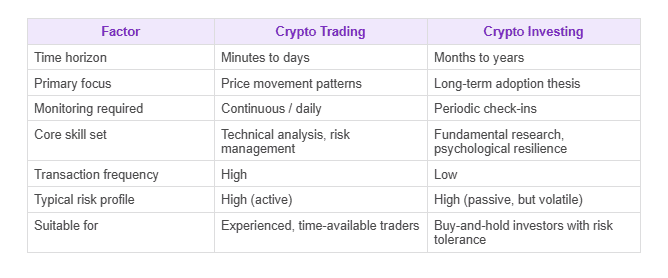
Trading in cryptocurrencies means buying and selling cryptocurrencies for a profit based on how fast prices move, on a basis of days, hours, or minutes – not months or years. A crypto trader does not consider the long-term benefits of owning Bitcoin or the technology being used to create Ethereum. Instead, they are looking to see if the price was higher or lower from what it is at this moment.
Crypto trading needs constant attention, knowledge of technical analysis, understanding of market microstructure (bid-ask spreads, order types, liquidity) and a strict regimen of risk management. Classifying crypto trading as a high skill, highly involved activity, it can produce significant losses if mismanaged, and can provide cash returns regardless of what the overall direction of the stock market might otherwise be if performed correctly.
Key characteristics of crypto trading: The principal characteristics of trading in the cryptocurrency market include short-term trading (typically one day or less), technical analysis using price patterns, consistent observation and quick decisions, a very high volume/number of transactions, an exposure both long and short to price movements, and cataloging high-transaction fees associated with trading at a high volume/number of transactions.
What Is Crypto Investing?
In the cryptocurrency world, one of the commonly used phrases is to “HODL” which comes from a deliberate misspelling of the term “hold.” This means buying cryptocurrencies and then holding onto that coin for a long period (most often measured in months or years), with the view that the price of the coin will rise due to mass adoption, the scarcity implications of that coin (with Bitcoin having a fixed supply of 21 million coins), the integration into institutions and the changing nature of the crypto ecosystem's maturity over time.
Crypto investing requires strong beliefs about an asset’s long-term value, the willingness to remain invested during periods of extreme price volatility, and a portfolio that is appropriately sized for a volatile, high-risk asset class. It requires less day-to-day focus than trading but requires greater psychological resilience when holding onto Bitcoin during 40% to 60% price declines while one is still confident in their multi-year investment thesis.
Key characteristics of crypto investing: Long time horizons (months to years), based on fundamental adoption thesis, lower transaction frequency, resilience to short-term volatility required, and potentially lower total transaction costs due to fewer trades.
Bitcoin and Ethereum: Which Approach Have Most GCC Investors Taken?
Both Bitcoin (the largest crypto by market cap) and Ethereum (the second-largest crypto by market cap) continue to dominate the blockchain and crypto asset ecosystem globally based on overall market capitalisation, institutional adoption, and GCC investor interest. As of January 2026, Bitcoin has a market capitalisation of approximately $1.8 trillion, giving it both the largest cryptocurrency and one of the largest assets (by market cap) across the entire global financial system. The current market cap for Ethereum is approximately $373 billion.
Bitcoin is primarily held as a long-term store of value by institutional investors, sovereign wealth funds, and individuals with a multi-year investment thesis. The combination of its fixed supply, post-2024 halving supply reduction, and continued spot ETF inflows has reinforced its position as 'digital gold' an asset held predominantly as a long-term investment rather than actively traded.
Although Ethereum is often seen as a long-term holding, its utility as a smart contract platform and integration into the DeFi space make it an attractive option for active trading, as well as being impacted by overall developments in the crypto market. The completion of the Pectra upgrade has enhanced the staking mechanics for Ethereum, establishing Ethereum as the premier platform for decentralized finance by 2026.
Related: Stocks AND Crypto in One App: Which GCC Platforms Support Both?
The Risks Differ — But Both Are Significant
A common misconception is that crypto investing is 'safe' because you are holding for the long term, while crypto trading is 'risky.' In reality, both approaches carry substantial risk, but the nature of the risk differs.
In crypto trading, risk is acute and fast-moving. A position entered on Monday morning can be a significant loss by Monday afternoon if the market moves against you. The speed of the loss, and the emotional pressure that comes with it, is the defining challenge of trading.
In crypto investing, risk is drawn out and psychological. Bitcoin has experienced multiple drawdowns of 50% or more from its previous high at various points in its history. An investor who bought at the 2021 peak experienced a 70%+ decline before recovering to new all-time highs in 2024–2025. Holding through this requires either a very long time horizon or a very high risk tolerance, ideally both.
Important: Whether you are trading or investing in crypto, never allocate more capital than you can afford to lose entirely. Cryptocurrency is a highly volatile asset class and capital loss, including total loss, is a real possibility in adverse scenarios.
Which Approach Is Right for You?
The answer depends on three honest assessments of yourself. First, time availability: do you have time to monitor positions actively and make trading decisions daily? If not, a buy-and-hold investing approach is more realistic than trading. Second, risk tolerance: can you hold a position that drops 40% without selling in panic? If not, either crypto exposure should be very small or avoided entirely. Third, experience level: do you understand technical analysis, order types, and position sizing? If not, investing is a better starting point than active trading.
Most GCC investors new to cryptocurrency find that starting with a small, long-term allocation to Bitcoin and/or Ethereum treated as a portfolio diversification position rather than a trading vehicle, is a more sustainable entry point than attempting to trade crypto actively without prior experience.
Related: Is Raseed Safe? Regulation, Security & Fund Protection
Frequently Asked Questions: Trading vs Investing in Crypto
Can I do both trading and investing in crypto at the same time?
Many seasoned investors have a 'tactical' investment strategy where they have a small amount of money allocated to short-term trades (and often may not have had any success in the past, or don't have a lot of experience trading). The reason to separate your investments in this way is to help prevent you from panicking and selling your 'core' position based on a short-term trade loss, and vice versa.
Does Raseed support both approaches?
Yes. You can hold crypto positions on Raseed for as long as you choose (long-term investing) or enter and exit positions based on shorter-term views (trading). The platform supports both approaches with real-time data, advanced charting, and straightforward order execution.
Is there a minimum holding period for crypto on Raseed?
No. There is no minimum holding period. You can hold crypto for a single trading session or for multiple years.
Cryptocurrency trading involves significant risk, including the potential loss of all invested capital. Crypto markets are highly volatile and unregulated in many jurisdictions. Not all cryptocurrencies are available in all regions. Securities brokerage services are provided by Fullerverse (SC) Limited, a security broker dealer licensed and regulated by the Financial Services Authority Seychelles (Licence No. SD152). Fullerverse is a wholly-owned subsidiary of Raseed Invest Inc. All investing involves risk. Past performance does not guarantee future results. Capital is at risk.