Which Is Better for GCC Investors in 2026?
Quick Answer: ETF vs Mutual Fund — Which Should GCC Investors Choose?
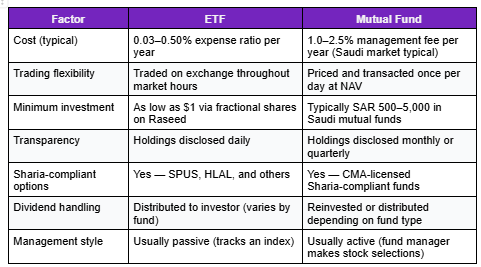
ETFs are cheaper than mutual funds on average — typical ETF expense ratio 0.03–0.50% vs mutual fund management fees of 1–2%+ in Saudi Arabia
ETFs trade on stock exchanges throughout the day like individual stocks — mutual funds can only be bought or redeemed at the daily end-of-day price
Mutual funds in Saudi Arabia require higher minimum investments, often SAR 500–5,000; ETFs can be bought in fractional amounts from $1 on Raseed
Both have Sharia-compliant options — Sharia-screened ETFs include SPUS and HLAL; several Saudi-regulated mutual funds are CMA-licensed as Sharia-compliant
For most GCC retail investors starting out, low-cost index ETFs may be a suitable starting point for many retail investors, over actively managed mutual funds
What you will learn in this article
The exact structural difference between an ETF and a mutual fund
A side-by-side cost comparison with SAR and USD examples
Liquidity and trading flexibility differences
Which Sharia-compliant options exist in each category
When a mutual fund makes more sense than an ETF
An ETF (Exchange-Traded Fund) and a mutual fund both pool investor money into a diversified portfolio of assets — the critical differences are in cost, trading flexibility, and minimum investment.
Both products give you instant diversification across many stocks or bonds in a single purchase. Both are regulated investment vehicles. But ETFs trade like stocks on an exchange during market hours, while mutual funds are priced and transacted once per day after market close. This structural difference has implications for cost, liquidity, and the type of investor each suits.
Side-by-Side Comparison: ETF vs Mutual Fund
Why ETF Costs Matter More Than They Seem
A 1.5% annual fee difference between an ETF and a mutual fund costs you more than you think over a decade.
Imagine two investors each investing SAR 10,000 for 10 years with a 7% annual return before fees. The ETF investor paying 0.25% per year ends with approximately SAR 18,700. The mutual fund investor paying 1.75% per year ends with approximately SAR 16,300. The SAR 2,400 difference is entirely attributable to fees, not to any difference in investment strategy or skill. This compounding fee drag is the primary reason low-cost ETFs have consistently outperformed actively managed mutual funds in global academic research.
Key fact: S&P's SPIVA report (Standard & Poor's Index Versus Active) consistently shows that over 15-year periods, approximately 85–90% of active mutual funds underperform their benchmark index after fees. This is the most cited evidence in the ETF vs active debate, sourced from S&P Global research published annually.
Access Sharia-screened ETFs including SPUS and HLAL on Raseed from $1, fees capped at $3 per trade. → Start building your ETF portfolio on Raseed →
When a Mutual Fund Makes Sense Over an ETF
For Saudi-market-specific exposure or actively managed Sharia-compliant strategies, a CMA-licensed Saudi mutual fund may offer capabilities an ETF cannot.
No liquid ETF exists for that specific exposure (for example, a Saudi small-cap strategy)
The mutual fund offers SAR-denominated operation without currency conversion
Automatic dividend reinvestment is a required feature
A specific Sharia board certification from a named scholar is required by the investor
For Sharia-compliant ETF options available to Saudi investors, see our best halal ETFs for 2026 guide.
Frequently Asked Questions
Q: What is the minimum investment for an ETF on Raseed?
ETFs on Raseed are available via fractional shares from as little as $1. You do not need to purchase a full share unit to invest in an ETF through Raseed.
Q: Is there a Saudi Arabian-specific ETF?
Yes. The iShares MSCI Saudi Arabia ETF (ticker: KSA) is listed on the NYSE and gives international investors exposure to Saudi-listed companies. It includes Aramco, Al Rajhi Bank, and other major TASI constituents. This ETF is available to Saudi and GCC investors through Raseed.
Q: Can a Saudi beginner start with ETFs instead of individual stocks?
Yes, and for many beginners ETFs are the better starting point. A single S&P 500 ETF gives you exposure to 500 companies in one purchase, eliminating the single-stock research requirement and the risk of concentrating in one name.
Related Articles on Raseed Learn
Best Halal ETFs for Saudi Investors 2026
Passive Investing vs Active Trading
5 Steps to Diversify Your Portfolio
This article is for educational and informational purposes only and does not constitute investment advice. All investing involves risk including the potential loss of principal. Data is from publicly available sources as of June 2026. Past performance does not guarantee future results. Securities brokerage services are provided by Fullerverse (SC) Limited, licensed and regulated by the Financial Services Authority Seychelles (Licence No. SD152), a wholly-owned subsidiary of Raseed Invest Inc. Raseed Invest Limited is regulated by the DFSA. Capital is at risk.