


What Every TASI Investor Must Understand About Saudi Arabia's Largest Company
⚡Quick Answer: How Does Aramco Affect TASI?
✓ Saudi Aramco holds approximately 16% of TASI's total weight by market capitalisation
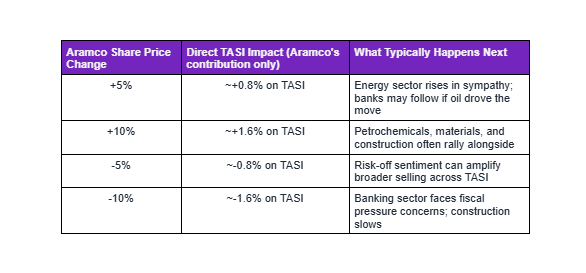
✓ A 5% move in Aramco's share price shifts TASI by approximately 0.8% from Aramco alone
✓ Aramco is roughly 15 times larger than the next biggest TASI company (Al Rajhi Bank)
✓ When Aramco dropped in 2025, it pulled 176 points off the TASI index single-handedly
✓ Oil prices are the primary driver of Aramco's share price and therefore TASI's direction
What you will learn in this article
How TASI's market-cap weighting system works — explained simply
The exact mathematical relationship between Aramco and TASI
What drives Aramco's share price, 4 key factors
Which TASI sectors move most when Aramco moves
Real 2025 and 2026 examples with verified data
What this means for how you build your Saudi portfolio
Saudi Aramco holds approximately 16% of the Tadawul All Share Index (TASI) — making it by far the single most influential company in Saudi Arabia's stock market.
Here’s why that matters: when Aramco's share price moves, 16% of that move flows directly into TASI's overall level, even if every other company in the 230-stock index stays completely flat. No other single company in any major global stock market index has this level of influence over its benchmark.
For every Saudi investor, whether you actively trade TASI or hold a long-term diversified portfolio, this is the single most important structural fact about the Saudi stock market. Understanding the Aramco-TASI relationship helps you interpret market movements, anticipate direction, and build a more resilient portfolio.
How Does TASI's Weighting System Work?
TASI uses free-float market capitalisation weighting, the same method as the S&P 500.
This means each company's influence on the index is proportional to the total market value of its publicly tradeable (free-float) shares. Companies with larger market values have more influence. Aramco's total market capitalization is approximately SAR 6.42 trillion, roughly 15 times larger than the second-biggest company, Al Rajhi Bank (SAR 376 billion). Even after adjusting for the government's approximately 98.5% ownership (which limits the free-float), Aramco still represents around 16% of the index.
Simple comparison: Apple represents approximately 7% of the S&P 500. Aramco represents approximately 16% of TASI, more than double the concentration. This makes TASI more sensitive to a single company than almost any major index in the world.
For investors comparing the two markets, our TASI vs US stocks guide explains how this concentration risk affects long-term returns and why holding both markets reduces portfolio volatility.
The Direct Mechanism: What Happens to TASI When Aramco Moves?
The maths is straightforward: multiply Aramco's percentage move by 16% to get its direct contribution to TASI.
What Drives Aramco's Share Price? The 4 Key Factors
Understanding what moves Aramco gives you a head start on anticipating where TASI is heading.
1. Global crude oil prices — the primary driver
Aramco's revenue and earnings are directly tied to Brent crude. When Brent rises above $80–85 per barrel, above the Saudi fiscal breakeven price, Aramco's earnings outlook improves, its share price rises, and TASI benefits. When oil falls below the fiscal breakeven (approximately $80–96 per barrel), Aramco comes under pressure and TASI typically follows.
2. OPEC+ production decisions
Saudi Arabia leads OPEC+, the alliance of oil-producing nations. Production cut decisions support Aramco's price; unexpected production increases hurt it. In April 2025, when OPEC+ announced a surprise 411,000 barrels-per-day production increase alongside US tariff pressure, Brent fell below $60 per barrel and Saudi Aramco temporarily lost approximately $90 billion in market capitalization. (Source: AGSI Gulf Economies Analysis, March 2026.)
3. Saudi government policy and dividend commitments
The government owns approximately 98.5% of Aramco's total shares. Aramco pays approximately $124 billion in annual dividends, one of the largest dividend payments of any company globally. Any signal that this dividend might be reduced triggers sharp share price reactions, since dividend income is a major reason many Saudi investors and institutions hold the stock.
4. Global economic growth expectations
Strong global GDP growth means higher oil demand, which benefits Aramco. Slowdowns in major oil consumers, particularly China (Aramco's largest customer), Europe, and the US depress oil demand forecasts and weigh on Aramco's price and, through the weighting mechanism, on TASI.
Trade Saudi stocks, US stocks, and diversify across both markets, all from one DFSA-regulated account. → Open your free Raseed account →
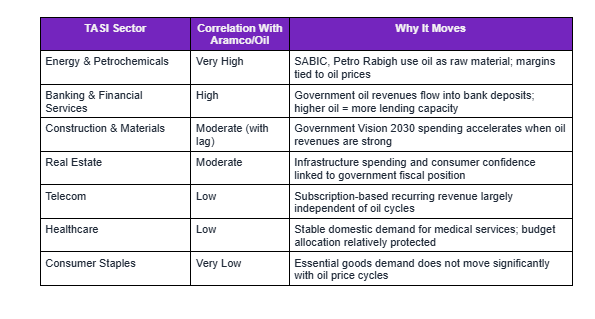
Which TASI Sectors Are Most Affected When Aramco Moves?
Aramco's move does not stay isolated — it ripples through connected sectors.
Real Examples: Aramco's Impact on TASI in 2025 and 2026
These events show the Aramco-TASI relationship working in both directions.
2025 full year — Aramco was TASI's biggest drag
TASI fell approximately 13% in 2025, making it one of the GCC's worst-performing markets. Argaam data shows Aramco was the single largest negative contributor, pulling 176 index points off TASI. Meanwhile, ACWA Power added 295 points and Al Rajhi Bank added 207 points, partially offsetting the damage. The lesson: even when other sectors perform well, Aramco's weight can override them. (Source: Argaam TASI Visual Journey 2024-2025.)
March 2026 — Aramco capped TASI's losses during the Iran conflict
When US and Israeli strikes on Iran in early March 2026 triggered market panic, TASI fell nearly 5% at open, hitting 10,214 points, its lowest level since March 2023. However, oil prices surged simultaneously on Strait of Hormuz disruption fears. Aramco's share price stabilised, which helped prevent deeper losses in TASI further. By March 5, TASI recovered to 10,776. "Aramco's weighting played a key role in capping losses," confirmed BBNTimes (March 9, 2026). By April 9, 2026, TASI had recovered to 11,343. (Source: Trading Economics.)
For more on how to manage your portfolio through volatile market events, see our guide to protecting your portfolio during geopolitical events.
What Does This Mean for Your Saudi Stock Portfolio?
Here are four practical implications every TASI investor should act on.
Concentration risk is automatic — even without owning Aramco: Any TASI-tracking investment implicitly has 16% tied to Aramco. This is not a choice; it is built into the index. Knowing this helps you decide whether to reduce or increase your overall TASI allocation.
Sector diversification within TASI matters: Deliberately overweighting healthcare, telecom, and consumer stocks reduces your portfolio's oil sensitivity without leaving Saudi markets entirely.
US stocks provide a natural hedge: Apple, NVIDIA, and Microsoft have very low correlation with oil prices. Combining TASI exposure with US technology holdings creates a balanced portfolio where different assets react differently to the same macro events.
Watch Aramco as a TASI leading indicator: Oil price movements over the weekend often provide a useful signal for TASI’s direction at the Sunday open. Checking Brent crude and Aramco pre-market before Sunday's open gives you a useful read on likely market direction.
Frequently Asked Questions
Q: What percentage of TASI is Saudi Aramco?
Saudi Aramco represents approximately 16% of TASI by free-float market capitalization, weighting by far the largest single component of the index. The second-largest company, Al Rajhi Bank, is approximately 15 times smaller by market cap.
Q: If Aramco falls, should I sell all my Saudi stocks?
Not necessarily. Aramco can fall for reasons that do not affect other sectors, a temporary oil oversupply, for example, may hurt Aramco without affecting Al Rajhi Bank or healthcare companies. Evaluate each holding on its own fundamentals rather than making blanket decisions based on one company's movement.
Q: Does Saudi Aramco pay dividends to retail investors?
Yes. Aramco paid about $124.2 billion in dividends in 2024, making it one of the world’s largest dividend payers. For Saudi retail investors, the dividend yield typically ranges between 4.5% and 5.7%. Saudi Arabia has no personal capital gains tax, making this dividend income fully accessible to Saudi individual investors.
Related Articles on Raseed Learn
TASI vs US Stocks — Where Should Saudi Investors Invest? · 5 Steps to Diversify Your Portfolio
Understanding Risk in Stock Trading · What Is Market Volatility?
This article is for educational and informational purposes only and does not constitute investment advice. All investing involves risk including the potential loss of principal. Data is from publicly available sources as of June 2026. Past performance does not guarantee future results. Securities brokerage services are provided by Fullerverse (SC) Limited, licensed and regulated by the Financial Services Authority Seychelles (Licence No. SD152), a wholly-owned subsidiary of Raseed Invest Inc. Raseed Invest Limited is regulated by the DFSA. Capital is at risk.