SAR 1,000 Is Enough to Start Investing in US Stocks — Here's How
One of the most persistent misconceptions about investing in US stocks from Saudi Arabia is that you need a large sum of money to get started. In reality, SAR 1,000, approximately $267 at current exchange rates, is sufficient to build a properly diversified, thoughtfully constructed first portfolio on Raseed. The availability of fractional shares means that stocks like Apple, Microsoft, Nvidia, and Amazon which trade at prices between $100 and $250 per full share are accessible to investors regardless of starting capital.
This guide walks through exactly how to allocate SAR 1,000 across US stocks and ETFs as a beginner. It covers the principles behind portfolio construction, a specific model allocation you can use as a starting framework, how fractional shares make every stock accessible from small amounts, and the steps to place your first trade on Raseed.
Related: How to Invest in the S&P 500 from Saudi Arabia
Before You Invest: Three Questions to Answer First
Before allocating any capital, every investor, regardless of starting amount should be clear on three things:
1. What is your investment duration? 6 months, 3 years or 10 years? The longer you're investing - the greater amount of short-term fluctuations you're willing to accept in lieu of a better chance of obtaining long-term results. Holding SAR 1,000 worth in an S&P 500 Index ETF will look much different if held for 10 years as opposed to 6 months.
2. What is your risk tolerance? Individual US stocks can decline 30–50% in a correction and recover over time. Are you comfortable seeing your SAR 1,000 portfolio drop to SAR 600–700 temporarily? If not, a more conservative allocation is appropriate.
3. Is this money you can leave invested? Never invest money you will need within 6–12 months. Short-term market movements can work against you at any time, and being forced to sell at a loss because you need the funds removed is the most important advantage an investor has: time.
How Fractional Shares Make SAR 1,000 Go Further
Fractional shares allow you to buy a proportion of a single share rather than needing to purchase a complete share. Without fractional shares, a single share of Nvidia at $105 would consume 39% of your SAR 1,000 in one position. With fractional shares, you can invest SAR 100 in Nvidia, SAR 100 in Apple, SAR 200 in an S&P 500 ETF, and so on, distributing your capital meaningfully across multiple positions regardless of individual share prices.
Raseed supports fractional shares on US-listed stocks and ETFs, making every company in the market accessible to Saudi investors starting with as little as $1. This is one of the platform features that makes a SAR 1,000 starting investment genuinely viable for building a diversified portfolio.
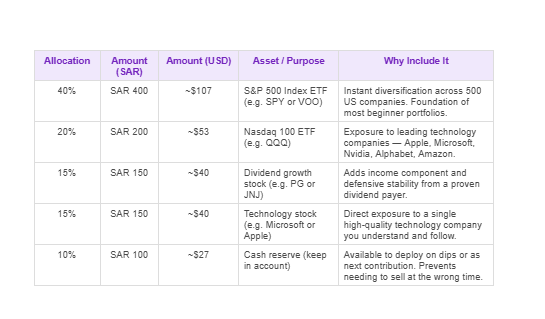
A Model SAR 1,000 Portfolio for Beginner Saudi Investors
The following is an illustrative allocation framework for a SAR 1,000 starting portfolio. This is not personalised financial advice, it is a structured example to demonstrate diversification principles. Adjust based on your own research, risk tolerance, and goals.
Educational note: This model portfolio is provided for educational illustration only and does not constitute a buy recommendation for any specific security. All figures are approximate.
Why Start With Index ETFs Rather Than Individual Stocks?
Many first-time investors are drawn to individual stock picking, choosing specific companies they believe will outperform. This is a natural impulse, but it carries a specific risk at small portfolio sizes: concentration. If SAR 1,000 is invested in two or three individual stocks and one company reports disappointing earnings, a significant portion of the portfolio can decline sharply.
Index ETFs solve this problem by providing immediate diversification across hundreds of companies for a single investment. An S&P 500 ETF like VOO or SPY gives you proportional exposure to Apple, Microsoft, Amazon, Alphabet, Nvidia, and 495 other companies simultaneously. No individual company's performance can devastate your portfolio.
The evidence for index investing at the portfolio level is also compelling: over the long term, the majority of actively managed funds underperform simple index strategies after fees. For a beginner investor, starting with index ETFs provides a sound foundation that can be supplemented with individual stock positions as experience and portfolio size grow.
Related: How to Invest in the S&P 500 from Saudi Arabia
Related: Best Halal ETFs for Saudi Investors in 2026
Step-by-Step: Placing Your First Trade on Raseed
Step 1 — Open your account: Account opening on Raseed takes approximately 2 minutes. You will need to verify your identity (standard KYC requirements) and link a payment method.
Step 2 — Fund your account: Deposit your starting amount. Raseed supports instant deposits so your funds are available for trading immediately upon clearing, with no waiting period.
Step 3 — Search for your chosen asset: Use the search function to find your ETF or stock by ticker symbol (e.g., VOO for Vanguard S&P 500 ETF, SPY for SPDR S&P 500 ETF, QQQ for Invesco Nasdaq 100 ETF).
Step 4 — Select 'fractional shares' or set a dollar amount: Rather than buying a whole number of shares, enter the dollar amount you want to invest. Raseed's interface allows you to specify 'invest $50' rather than 'buy 0.17 shares,' making the process intuitive.
Step 5 — Review the fee: Raseed charges a maximum of $3 per trade regardless of trade size. On a $107 S&P 500 ETF purchase, the fee is 0.5%, well below industry norms.
Step 6 — Confirm and monitor: Once your trade is executed, you can monitor your position's performance, enable price alerts, and review your portfolio analytics in the Raseed app at any time.
Related: Deposits & Withdrawals on Raseed: Everything You Need to Know
Related: Deposit and Trade Instantly — No Waiting, No Friction
Related: Lowest Trading Fees in Saudi Arabia: Full Platform Comparison 2026
Building the Habit: Dollar-Cost Averaging From SAR 1,000
While the initial amount of a SAR 1,000 investment is powerful in terms of the application itself, even more significant is the habit of regularly putting money into a savings plan. Regularly investing a fixed sum, or dollar-cost averaging (DCA), on a set timetable, no matter how good or bad the economy is at the time, is by far the most widely supported strategy for creating substantial wealth over the long term, according to academic and professional sources alike.
Investing SAR 1,000 today along with SAR 500 in monthly contributions will produce a much larger portfolio than if you had put all of that money into the S&P 500 at once. While your total investment amount will be the same in both cases, it will be larger in the case of the cumulative contributions due to dividends being reinvested. The primary takeaway is that building long-term wealth normally happens through regularly contributing and reinvesting every dollar, as opposed to trying to find the best time to invest in the market.
Related: Dividend Reinvestment (DRIP): Turning Cash Payouts into Long-Term Growth
Related: How to Build a Passive Income Portfolio in Saudi Arabia: 2026 Guide
Frequently Asked Questions: Investing SAR 1,000 in US Stocks
Is SAR 1,000 really enough to start investing seriously?
Yes. With fractional shares available on Raseed, SAR 1,000 (approximately $267) is sufficient to build a properly diversified portfolio across index ETFs and individual stocks. The more important factor than the starting amount is the consistency of your contributions over time.
How long should I hold my first investment?
It’s usually recommended for beginners to have at least 3–5 years of experience building their portfolio with Index ETFs and Dividend stocks. With at least a 3-5 year time horizon you’ll be able to go through at least one market correction and recovery which is very educational, and gives enough time for compounding returns from index products to take hold.
What if the market drops after I invest?
Market Corrections are part of a normal cycle of an investment and occur roughly once every 1 to 2 years. If you have funds that can be continue to be invested for many years, a short term correction should not create a crisis but rather present a good opportunity to purchase additional investments at lower cost through your ongoing contributions. Typically the worst returns an investor can incur are selling a well-diversified portfolio in a panic during a market correction.
Can I invest in Shariah-compliant assets through Raseed?
Yes. Raseed offers access to Shariah-compliant ETFs and has a dedicated guide to Halal ETFs and Halal stocks for Saudi investors who want to ensure their portfolio aligns with Islamic finance principles.
Related: Best Halal Stocks to Buy in 2026: Top Shariah-Compliant Picks
Related: Best Halal ETFs for Saudi Investors in 2026
Important Disclaimer: The stocks, ETFs, and assets mentioned in this article are for informational and educational purposes only and do not constitute financial advice, a recommendation to buy or sell, or a solicitation. All investing involves risk, including the possible loss of principal. Always conduct your own research and consider your personal financial situation before making any investment decision. Securities brokerage services are provided by Fullerverse (SC) Limited, a security broker dealer licensed and regulated by the Financial Services Authority Seychelles (Licence No. SD152). Fullerverse is a wholly-owned subsidiary of Raseed Invest Inc. All investing involves risk. Past performance does not guarantee future results. Capital is at risk.