


A Step-by-Step Fundamental Analysis Guide for Saudi Investors
Quick Answer: How Do You Research a GCC Stock Before Investing?
Start with the business: understand exactly what the company does and how it makes money before looking at any numbers
Check the financial statements: revenue growth, profit margin, return on equity, and debt-to-equity ratio are the four most important metrics
Compare valuation: look at the P/E ratio relative to sector peers and TASI's overall forward P/E (approximately 15x in 2026)
Review management and ownership: check if company leadership has a track record and whether government or institutional ownership adds stability
Apply Sharia screening if relevant: use Musaffa, Zoya, or HalalScreener to verify AAOIFI compliance before investing
What you will learn in this article
Why business understanding comes before financial numbers
The 4 financial metrics that matter most for TASI stock research
How to read a P/E ratio in the Saudi market context
What to look for in dividend history and sustainability
How to complete a Sharia compliance check for any stock
The first step in researching any GCC stock is to describe the business in one sentence. If you cannot, you may need to research further before investing.
Fundamental analysis is the process of evaluating a company's actual business performance, financial health, and valuation to determine whether it represents a good investment at the current price. It is the opposite of technical analysis, which studies only price and volume patterns. For long-term Saudi and GCC investors, fundamental analysis is the foundation of every sound investment decision.
This guide applies to TASI-listed Saudi stocks and international stocks accessible through Raseed. For Sharia compliance screening specifically, see our halal stocks guide for full AAOIFI methodology.
Step 1: Understand the Business
Write one sentence that explains how this company makes money. If you cannot write that sentence, stop and research more.
Before opening any financial statement, answer three questions about the company: What product or service does it sell? Who are its customers? What prevents a competitor from replacing it? For Saudi stocks, a fourth question is critical: How directly is this business tied to oil prices? Companies like SABIC and Aramco are deeply oil-linked. Companies like STC and Al Rajhi Bank are less directly oil-dependent.
Step 2: Analyse Revenue and Earnings Growth
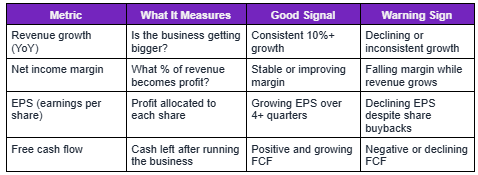
Revenue growth tells you if the business is expanding. Earnings growth tells you if it is becoming more or less profitable as it expands.
Find the company's last four to eight quarters of financial results on the Saudi Exchange website (saudiexchange.sa) under the company's investor relations page. Look for: Is revenue growing year-on-year? Is net income growing faster, slower, or in line with revenue? If revenue is growing but profits are flat or falling, costs are rising faster than sales, a warning sign.
Step 3: Check the Balance Sheet
The balance sheet tells you if the company can survive bad years — a question that matters especially for oil-linked Saudi stocks.
Look at two things: How much debt does the company carry relative to its equity (debt-to-equity ratio)? And does it have enough current assets to cover short-term liabilities (current ratio)? For TASI stocks, a debt-to-equity ratio above 1.5x requires specific justification, such as a capital-intensive infrastructure business. Banks are a special case because they inherently carry high leverage and should be analysed on different metrics like return on equity and non-performing loan ratios.
Step 4: Evaluate Valuation Using P/E Ratio
The P/E ratio tells you how expensive a stock is relative to its earnings but it is only meaningful when compared to peers and to the market average.
The price-to-earnings (P/E) ratio is calculated by dividing the share price by earnings per share. TASI's forward 12-month P/E was approximately 14.89x in early 2026, near its 10-year average of 15.17x, per Argaam analysis. This means a TASI stock with a P/E of 20x or above is trading at a premium to the market average and requires a clear growth justification.
Saudi context: For Islamic banks like Al Rajhi Bank, standard P/E comparisons work well but supplement with price-to-book (P/B) ratio, which is more widely used for banking sector comparisons across Saudi Arabia. Al Rajhi's P/E of approximately 17.4x (below the SA market average of 20.4x) makes it cheaper than the market on this measure, per analyst consensus data.
Research and invest in TASI stocks on Raseed → Start investing in Saudi stocks →
Step 5: Review Dividend History and Sustainability
A strong dividend history signals financial stability but only if the dividend is covered by earnings, not funded by debt.
Divide the annual dividend per share by earnings per share to get the payout ratio. A payout ratio below 70% is generally sustainable. A payout ratio above 100% means the company is paying out more than it earns, which may put the dividend at risk. For Saudi investors, dividends also carry Zakat implications: dividends received by Saudi nationals are included in the Zakat base for the year they are received.
Step 6: Assess Management and Ownership Structure
Who runs the company and who owns it matters as much as the numbers, especially in Saudi Arabia.
Government-Related Entity (GRE) ownership accounts for 64.97% of total TASI ownership, per Argaam 2024 data. This means most large TASI stocks have government backing, which reduces bankruptcy risk but can also mean decisions are made for strategic rather than purely financial reasons. Check: Has management delivered on its own financial guidance in previous quarters? Is there a recent CEO change? Has insider ownership changed significantly?
Step 7: Complete a Sharia Compliance Check
For Muslim investors, a stock that fails AAOIFI screening is not investable regardless of its financial metrics.
Go to Musaffa (musaffa.com), Zoya, or HalalScreener and search the ticker
Check business activity: does the company derive primary revenue from prohibited industries?
Check financial ratios: interest-bearing debt <30% of market cap, impermissible income <5% of revenue
Verify the screening date — ratios change quarterly
If a stock passes with residual impure income, calculate and purify that portion from any dividends received
Frequently Asked Questions
Q: Where can I find Saudi company financial statements?
All Saudi Exchange listed companies must publish quarterly and annual financial statements on the Saudi Exchange website at saudiexchange.sa under the company's investor relations section. The CMA (cma.org.sa) also maintains a disclosure database.
Q: What is a good P/E ratio for a Saudi stock?
TASI's overall forward P/E was approximately 14.89x in early 2026, near its 10-year average of 15.17x. A stock trading at 12–18x P/E in line with the market average is fairly valued. Below 12x suggests undervaluation or a struggling business — investigate which. Above 20x requires strong growth justification.
Q: How do I research a stock if I cannot read Arabic financial statements?
Saudi Exchange listed companies publish financial statements in both Arabic and English. Major company results are also covered in English on Argaam, Arab News, and Reuters. Many brokerage platforms including Raseed provide English-language summaries of key company metrics.
Q: Is fundamental analysis or technical analysis better for Saudi stocks?
Fundamental analysis is better suited for long-term investing in TASI stocks where company earnings, dividends, and balance sheet health drive returns over one to five years. Technical analysis is used more by short-term traders. Most professional Saudi market investors combine both — fundamental analysis to select which stock to buy, technical analysis to select when to buy it.
Related Articles on Raseed Learn
Best TASI Sectors to Invest In
Understanding Risk in Stock Trading
Is Investing in US Stocks Halal?
This article is for educational and informational purposes only and does not constitute investment advice. All investing involves risk including the potential loss of principal. Data is from publicly available sources as of June 2026. Past performance does not guarantee future results. Securities brokerage services are provided by Fullerverse (SC) Limited, licensed and regulated by the Financial Services Authority Seychelles (Licence No. SD152), a wholly-owned subsidiary of Raseed Invest Inc. Raseed Invest Limited is regulated by the DFSA. Capital is at risk.