


One of the Most-Asked Questions in Islamic Finance — and Why There Is No Simple Answer
Across the globe, over 1.8 billion Muslims with particular emphasis placed on the large and expanding population of Saudi Arabian and GCC (Gulf Cooperation Council) investors engaged in the world’s financial markets are currently grappling with one of the most challenging and important questions of contemporary Islamic finance: Is cryptocurrency halal (permissible) or haram (prohibited) by Islamic law? As such, the issue has been raised within GCC financial communities with increasing frequency and intensity than any other issue to date. Therefore, this is an issue that deserves a complete, thorough, honest, and balanced examination.
The answer in 2026 is not a simple yes or no. Scholarly opinions on this topic are genuinely divided across some of the most respected Islamic finance authorities in the world. The type of crypto activity buying and holding versus leveraged trading, spot trading versus futures, established assets versus speculative memecoins matters enormously. And the specific platform and structure used can also influence the Islamic permissibility of an activity.
This guide aims to summarize the main ideas surrounding Islamic finance, describe where leading academics and Shari'ah scholars agree or disagree on whether specific crypto-related activities would not be permitted under Islamic law, and provide a recommended list of those cryptocurrencies and associated activities that are likely to be considered acceptable according to Shari'ah.
Important note: This article is for educational purposes and does not constitute a fatwa or a formal religious ruling. Muslim investors are strongly encouraged to consult qualified Islamic scholars for guidance specific to their circumstances.
Related: Best Halal Stocks to Buy in 2026: Top Shariah-Compliant Picks
The Islamic Finance Principles Central to the Crypto Debate
Islamic finance is governed by a set of principles derived from the Quran and Sunnah that establish ethical standards for financial transactions. Three core concepts are at the heart of the crypto halal debate:
Riba (Interest/Usury): Islamic law strictly prohibits earning or paying interest. Any financial instrument that generates interest-like returns without a genuine underlying exchange of value is haram. For crypto, this concern applies most directly to lending products, staking where rewards function like interest, and margin trading which involves borrowing with interest charges.
Gharar (Uncertainty/Speculation): Gharar means that there is an excessive amount of unknowns (uncertainty) in terms of how a transaction will occur, what it will involve (type), and how it will turn out (outcome). The extreme price fluctuations seen in many cryptocurrencies are frequently used to justify gharar when it appears that price speculation, rather than actual economic usefulness, has been the primary factor in driving price. Maysir (gambling) also represents excessive speculative behavior and is treated as a separate prohibited category under Islamic law.
Mal (Valuable Asset): To fulfill the requirements of being capable of trade under Islamic law, an item must constitute 'mal,' which means it has tangible value and can be owned; it meets an economic function that is widely recognised. Those scholars that permit some cryptocurrencies typically base their conclusions on the social acceptance of Bitcoin and Ethereum as stores of wallet / value and as mediums of exchange.
Scholarly Opinions That Lean Toward Permissibility
A significant number of respected Islamic scholars and institutions have issued opinions that certain forms of cryptocurrency participation are permissible under Islam, subject to conditions:
Mufti Muhammad Abu-Bakar (ex-Blossom Finance Shariah Advisor): issued a comprehensive study which concluded that Bitcoin constitutes a currency and can be utilized to facilitate exchanges (through its widespread use) to determine value according to the principles of Islamic Monetary Practices.
Islamic Finance Guru (IFG): The Islamic Finance Guru (IFG) is an Islamic finance reference point operated by Oxford-educated Ibrahim Khan. The IFG believes that cryptocurrency is permissible at least from a position 2 of 3 in their fiqhi (jurisprudential) framework. The IFG states that long-term holding and spot trading of established coins are more defensible than short-term speculative trading.
Mufti Faraz Adam (Amanah Advisors): Takes the position that cryptocurrencies can qualify as Mal if they meet certain utility criteria, and that spot trading of Bitcoin and Ethereum, where you genuinely own the asset is more defensible than derivatives or leveraged products.
Country-level frameworks: By 2026, about 60% of countries with a majority-Muslim population will have legalised cryptocurrency trading, either explicitly or via the absence of any legal restriction. For example, Bahrain has a very comprehensive regulatory framework for cryptocurrencies. In addition to that, both Abu Dhabi and Dubai (both in the UAE) have extensive regulations for cryptocurrencies, including additional ethical components relating to Shari’ah-compliant finance.
Scholarly Opinions That Lean Toward Impermissibility
An equally significant body of scholarly opinion cautions against or prohibits cryptocurrency trading:
Grand Mufti of Egypt, Sheikh Shawki Allam: Has issued rulings classifying Bitcoin as haram, citing high uncertainty (gharar), lack of backing by any regulatory authority, price instability, and its association with illicit activities.
Mufti Taqi Usmani (one of the most respected living Islamic economists): Mufti Taqi Usmani one of leading Islamic economists states that trading in crypto is haram (i.e. prohibited) because cryptocurrencies must have been created and endorsed by legitimate states in order to be valid mediums of exchange. Furthermore, he argues that trading in cryptos constitutes a speculative instrument which is against Islamic economic principles.
Turkish Religious Authority (Diyanet): Declared that cryptocurrency trading is not valid as it is open to speculation (gharar) and can facilitate money laundering.
The Syrian Islamic Council: Issued a formal fatwa in 2019 declaring most cryptocurrencies haram, citing their digital-only nature, lack of regulatory oversight, extreme volatility, and potential for misuse.
A Practical Framework: Which Crypto Activities Are More vs Less Defensible?
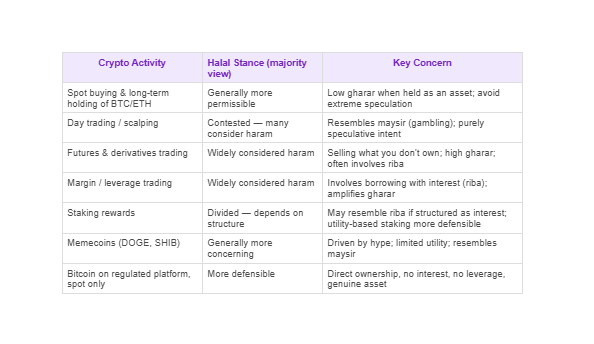
Given the genuine scholarly disagreement, many Muslim investors take a practical approach of distinguishing between specific crypto activities by their alignment with Islamic principles, rather than applying a blanket ruling to all crypto:
The Importance of the Platform and Its Structure
Beyond the asset itself, the platform you use to access cryptocurrency can greatly affect how closely your activity conforms to Islamic law. A Sharia-compliant crypto interaction should include: an actual asset, rather than a derivative or CFD; no interest-bearing components related to custody or margin; full transparency and knowledge about transaction costs in advance; and a secure, audited platform.
Raseed's brokerage services are provided through Fullerverse (SC) Limited, licensed and regulated by the Financial Services Authority Seychelles (Licence No. SD152). Raseed does not offer leveraged crypto trading or crypto derivatives, access is to the underlying assets directly, without the interest-based structures that most Islamic scholars identify as the primary sources of impermissibility in crypto.
Related: Is Raseed Safe? Regulation, Security & Fund Protection
Related: Stocks AND Crypto in One App: Which GCC Platforms Support Both?
The GCC Regulatory Reality in 2026
The cryptocurrency regulations in Saudi Arabia are varied. Although the SAMA (Saudi Arabian Monetary Authority) has warned against using cryptocurrencies as a means of payment and does not allow Saudi banks to process direct transactions with cryptocurrencies, the government has not prohibited individual investors from owning or using cryptocurrency. As such, many Saudi investors are taking advantage of the numerous regulated international exchanges where they can purchase cryptocurrencies. Investors in the GCC can expect the regulatory landscape to continue to evolve, so it is advisable to stay up to date on the current rules issued by SAMA and CMA.
The UAE, specifically Dubai and Abu Dhabi, are known for having much more relaxed regulatory environment. There have been multiple regulations established by the Dubai Virtual Assets Regulatory Agency and Abu Dhabi Global Market to create legal protections for traditional and Islamic (Sharia-compliant) investors.
Related: How to Verify If a Trading App Is Legitimate in Saudi Arabia
Frequently Asked Questions: Crypto Halal Status for GCC Investors
Is there a consensus fatwa on Bitcoin being halal or haram?
No. There is no unified global Islamic scholarly consensus on Bitcoin or cryptocurrency in 2026. Opinions range from full permissibility (with conditions) to full prohibition. The level of disaggrement among respected scholars is genuine, not superficial. Muslim investors should consult a qualified scholar they trust rather than relying on a single online opinion.
Is spot trading of Bitcoin more halal than futures trading?
According to most scholarly analyses, yes. Spot trading involves directly purchasing and owning the underlying asset. Futures and derivatives trading involves speculation on future prices without necessarily owning the asset, introduces significant gharar, and often involves interest-like fees. The contrast between spot and derivatives is one of the clearest distinctions in the scholarly debate.
What about Zakat on crypto holdings?
Most scholars who allow for the use of cryptocurrency as investment have stated that if the currency has reached the nisab level (the minimum amount needed for Zakat to be due) and has been in your possession for one lunar year (hawl), then Zakat will be due at the standard rate of 2.5% on current market value. Because this is a rapidly growing field, please check with your local Islamic scholar to find out what their position on this topic is specifically!
Cryptocurrency trading involves significant risk, including the potential loss of all invested capital. Crypto markets are highly volatile. The regulatory status of cryptocurrency varies by jurisdiction and is evolving. GCC investors should verify the applicable rules in their country of residence before investing. Securities brokerage services are provided by Fullerverse (SC) Limited, a security broker dealer licensed and regulated by the Financial Services Authority Seychelles (Licence No. SD152). Fullerverse is a wholly-owned subsidiary of Raseed Invest Inc. All investing involves risk. Past performance does not guarantee future results. Capital is at risk.