Why Trading Fees Matter More Than Most Saudi Investors Realise
Every time you buy or sell a stock, you pay a fee. On most platforms available to investors in Saudi Arabia, that fee ranges from $7.99 to $25 per transaction. It looks manageable on a single trade. Across a year of consistent investing, however, these costs accumulate into hundreds or thousands of riyals that could otherwise be growing inside your portfolio.
Understanding exactly how much you pay and how that compares to the alternatives is one of the most valuable things a Saudi investor can do before choosing a trading platform. This guide breaks down the true cost of trading across the major platforms accessible from the Kingdom in 2026.
How Trading Fees Are Structured
Most platforms charge a per-trade commission, which is either a flat fee (e.g. $9.99 per trade regardless of size) or a percentage of the trade value (e.g. 0.1%). Some platforms combine both, applying a percentage with a minimum charge. A small number of platforms now cap their fees so that large trades do not become disproportionately expensive and this cap is one of the most meaningful features for active investors.
Beyond the commission, investors should also consider market data fees, currency conversion spreads, deposit and withdrawal charges, and inactivity fees all of which can significantly increase the true cost of a platform that looks cheap on commission alone.
Related Reading: Hidden Fees in Stock Trading Apps: What Saudi Investors Need to Watch Out
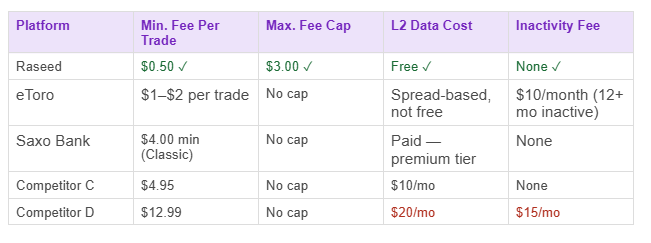
Full Fee Comparison: Major Platforms Available in Saudi Arabia (2026)
The Real Maths: What a $3 Maximum Fee Cap Means for Your Returns
Consider a practical scenario: buying 4,000 shares of a stock priced at $0.25 — a total trade value of $1,000. On a platform charging 1.5% with no cap, this costs $15. On platforms charging a flat $25, the cost is even higher. On Raseed, the same trade costs $3, a saving of $12 to $22 on a single transaction.
An investor making 100 trades per year saves between $1,200 and $2,200 annually by using Raseed versus traditional platforms. Over five years at 8% annual return, compounding savings becomes a meaningful addition to portfolio value.
This is not a marginal difference. For investors who trade regularly, fee structure is among the most significant variables determining long-term portfolio outcomes, more significant than many investors recognise until they calculate it directly.
Related Reading: How to Build a Passive Income Portfolio in Saudi Arabia
What Else Affects the Total Cost of Trading?
Commission is the headline number, but sophisticated investors evaluate the full cost picture. Currency conversion spreads, the markup applied when converting SAR to USD, can add 0.5% to 1.5% on every deposit. Monthly data subscriptions for real-time prices and order book depth cost $10 to $30 per month on most platforms. Raseed includes Level 2 market data free of charge and processes deposits at minimal cost with full transparency.
How to Calculate Your Current Annual Trading Cost
Take the number of trades you make per month and multiply by your average fee per trade. Multiply by 12. Add any monthly data or subscription fees. Add annual withdrawal fees. The resulting number represents what you are currently paying to access markets and comparing it to what you would pay on Raseed will show exactly how much you are leaving on the table.
For most active Saudi investors making 10 or more trades per month on traditional platforms, the annual saving of switching to Raseed exceeds SAR 3,000, money that can be reinvested immediately into the assets you choose.
Related Reading: Stock Trading Without Limits on Raseed
Bottom Line
Raseed's $0.50 minimum and $3 maximum fee per trade is the lowest cap structure available to investors in Saudi Arabia and the GCC in 2026. Combined with zero inactivity fees and free Level 2 market data, it represents a total cost of ownership that no comparable platform currently matches. For investors serious about protecting their returns, fees are not a secondary consideration, they are a first-order decision.