


What It Is and Why Most GCC Beginners Should Avoid It
Quick Answer: What Is Margin Investing and Is It Right for GCC Beginners?
Margin investing means borrowing money from your broker to buy more stocks than you could with your own capital alone
It amplifies both gains and losses — a 20% gain on a margin trade can become 40%, but a 20% loss can become 40% or more
If your portfolio falls below a certain threshold, your broker issues a margin call requiring you to add funds or sell positions immediately
For most GCC beginners, margin investing significantly increases the risk of losing more money than you deposited
Conventional margin loans involve interest payments — which makes them not permissible under most Islamic finance interpretations
What you will learn in this article
Exactly how margin investing works with a simple SAR example
The three ways margin can destroy a portfolio faster than you expect
What a margin call is and what happens if you cannot meet it
Whether margin financing is halal under Islamic finance principles
The specific circumstances when experienced investors use margin responsibly
Margin investing means borrowing money from your broker to invest, amplifying both your potential gains and your potential losses.
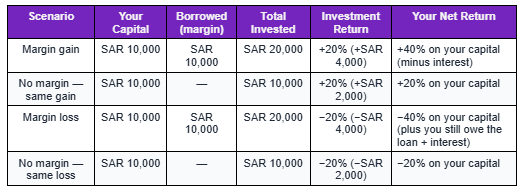
When you open a margin account, your broker lends you additional funds beyond your own deposit, typically allowing you to invest 1.5x to 2x your own capital. If you deposit SAR 10,000, you might borrow another SAR 10,000 and invest SAR 20,000 in total. If your investment rises 20%, your portfolio gains SAR 4,000, a 40% return on your original SAR 10,000. But if your investment falls 20%, you lose SAR 4,000, a 40% loss on your own capital, and you still owe the borrowed SAR 10,000 plus interest.
Margin investing is a more advanced topic than most beginner guides cover. Before considering margin, read our understanding risk in stock trading guide to ensure you understand the basics of position sizing and portfolio risk.
How Margin Investing Works — A Simple SAR Example
The math is straightforward, the problem is that losses amplify faster than most investors intuitively expect.
The Three Specific Risks of Margin Investing in GCC Markets
GCC markets have specific characteristics that make margin particularly risky for beginners.
Risk 1: Margin Calls During Oil-Price Shocks
TASI is highly sensitive to oil price movements. When Brent fell below $60 in April 2025, TASI reached a 15-month low of 11,270. An investor using margin on TASI stocks during this period would likely have received a margin call — meaning they may have been required to sell their positions, or the broker could have sold them automatically in accordance with the margin account terms, at the worst possible prices, unless they injected additional capital immediately. The problem is that oil shocks are sudden and severe, leaving very little time to react.
Risk 2: Interest Costs Erode Returns Over Time
Margin loans charge interest on the borrowed amount — typically at rates of 5–10% per annum depending on the broker and market conditions. For your margin position to be profitable, your investment must outperform the margin interest rate. In a flat or moderately positive year for TASI, margin interest can eliminate your gains entirely.
Risk 3: Forced Selling at the Worst Time
A margin call requires immediate action. You either inject cash or your broker sells your positions at the current market price to repay the loan. This forced selling happens precisely when markets are falling — locking in losses that a non-margin investor could simply hold through. Forced selling at the bottom is one of the most financially destructive events for a retail investor.
Important: You can lose more than your initial deposit on a margin account if markets move sharply against your positions. This is a regulatory disclosure made by all licensed margin lenders. Ensure you fully understand this before opening a margin account.
Is Margin Investing Halal?
Conventional margin loans involve interest (riba), which is prohibited under Islamic finance principles.
A conventional margin account charges interest on the borrowed funds, which many Islamic finance scholars consider impermissible because it involves riba. Some brokers offer Sharia-compliant margin alternatives using murabaha (cost-plus financing) or commodity murabaha structures that avoid riba. Some brokers may offer Sharia-compliant alternatives, but investors should verify the structure with a qualified Islamic finance adviser.
When Experienced Investors Use Margin — and How
Experienced investors who use margin do so with strict rules, small position sizes, and clear exit plans.
Margin-to-equity ratio kept below 20–30% of total portfolio (not the 100%+ that beginners sometimes attempt)
Stop-loss orders placed immediately on every margin position to limit maximum loss
Margin used only on highly liquid positions that can be sold quickly if needed
Never used on volatile small-cap or penny stocks
Margin interest rate treated as a minimum hurdle rate for any position
Build a non-margin portfolio with real stock ownership on Raseed from $1, no leverage required. → Open your Raseed account today →
Frequently Asked Questions
Q: Can I lose more than I invest using margin?
Yes. If the value of your investments falls below the margin loan amount, you will owe the broker money beyond your initial deposit. This is why margin is classified as a higher-risk investment strategy by all financial regulators.
Q: What is a margin call and what happens if I can't meet it?
A margin call is a broker's demand that you either deposit additional funds or sell positions to reduce your margin ratio. If you cannot meet it within the required time within the timeframe specified by the broker, your broker will sell your positions automatically to recover the loan — regardless of the market price at that moment.
Q: Does Raseed offer margin investing?
Raseed is a direct stock ownership platform — you own the underlying securities without leverage by default. This is fundamentally different from margin accounts and from CFD platforms that use leverage on derivative contracts.
Q: Is margin investing suitable for a Saudi beginner?
No. For investors with fewer than three to five years of experience and less than SAR 100,000 in investable assets, the financial education required to manage margin safely significantly exceeds what most beginners possess. Build a non-margin portfolio first, understand your risk tolerance through real market experience, then reconsider after gaining significant experience.
Related Articles on Raseed Learn
Understanding Risk in Stock Trading
5 Steps to Diversify Your Portfolio
ETF vs Mutual Fund for GCC Investors
Is Investing in US Stocks Halal?
This article is for educational and informational purposes only and does not constitute investment advice.All investing involves risk, including the potential loss of principal.. Data is from publicly available sources as of June 2026. Past performance does not guarantee future results. Securities brokerage services are provided by Fullerverse (SC) Limited, licensed and regulated by the Financial Services Authority Seychelles (Licence No. SD152), a wholly-owned subsidiary of Raseed Invest Inc. Raseed Invest Limited is regulated by the DFSA. Capital is at risk.