For investors across Saudi Arabia and the GCC, US stocks remain one of the most attractive ways to build long-term wealth. Many of the world's largest companies including Apple, Microsoft, Coca-Cola, Johnson & Johnson, and Procter & Gamble, reward shareholders through regular dividend payments.
However, before building a dividend-focused portfolio, it is important to understand one often-overlooked factor: US dividend withholding tax.
Many investors discover their dividend payments are lower than expected because a portion has already been deducted before reaching their brokerage account. This is not a platform fee or a hidden charge. It is a tax withheld by the US government on dividend income paid to foreign investors.
Understanding how this works can help Saudi and GCC investors evaluate dividend yields more accurately, compare investment opportunities effectively, and build a more tax-efficient portfolio.
Quick Answer
If you are a Saudi or GCC investor holding US dividend-paying stocks:
US dividends are generally subject to a 30% withholding tax
Saudi Arabia currently does not have an income tax treaty with the United States
The UAE, Qatar, Bahrain, Kuwait, and Oman are subject to the same standard rate
Form W-8BEN confirms your foreign investor status but does not reduce the withholding rate for GCC residents
Capital gains from selling US stocks are generally not subject to US withholding tax for non-US investors
For long-term investors, understanding this distinction between dividend income and capital appreciation is critical when building a global investment portfolio.
What Is US Dividend Withholding Tax?
US dividend withholding tax is a tax deducted at source when a US company pays dividends to investors who are not US residents.
Instead of receiving the full dividend amount, foreign investors receive the dividend after the withholding tax has already been deducted.
This process is automatic and is handled through the US financial system before the payment reaches your brokerage account.
For example, if a US company pays a dividend of $100:
Gross dividend: $100
US withholding tax (30%): $30
Amount received: $70
The investor does not need to manually pay the tax because it is deducted automatically.
This applies to investors globally and is a standard feature of cross-border investing.
Why Saudi and GCC Investors Pay the Full 30%
The United States has tax treaties with many countries around the world.
These treaties often reduce dividend withholding tax rates from 30% to 15%, 10%, or even lower.
Countries such as the United Kingdom, Canada, Germany, France, Australia, and Japan benefit from reduced withholding rates through tax treaty agreements.
However, Saudi Arabia and other GCC countries currently do not have income tax treaties with the United States that reduce dividend withholding tax rates.
As a result, investors residing in:
Saudi Arabia
United Arab Emirates
Qatar
Kuwait
Bahrain
Oman
are generally subject to the standard 30% withholding tax rate on US-source dividend income.
This means GCC investors typically receive 70% of the dividend after withholding tax has been deducted.
US Dividend Tax Rates by Country
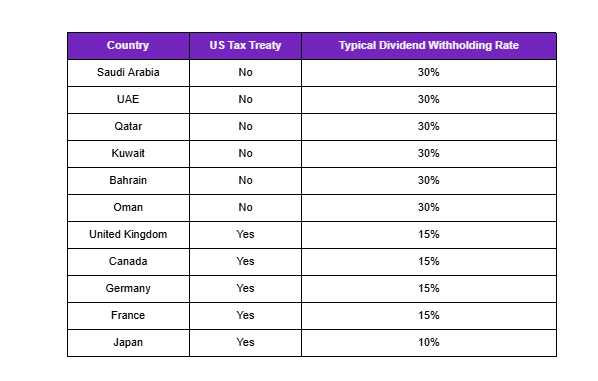
Investors should always verify treaty status through official tax and regulatory sources, as tax rules can change over time.
What the 30% Tax Means in Real Life
Many investors underestimate the long-term impact of withholding tax.
Let's consider a simple example.
Assume you own 100 shares of a US company paying a quarterly dividend of $0.25 per share.
Dividend Calculation
Shares owned: 100
Dividend per share: $0.25
Gross dividend: $25
US withholding tax:
30% of $25 = $7.50
Amount credited:
$17.50
While this may seem small initially, the impact becomes more noticeable for larger portfolios.
Long-Term Example
Suppose an investor holds a $50,000 portfolio of dividend-paying US stocks generating a 2.5% annual yield.
Annual dividend income:
$1,250
US withholding tax:
$375
Net dividend received:
$875
Over ten years, assuming stable yields, approximately $3,750 would be withheld before considering portfolio growth or reinvestment. This is why investors should evaluate dividend yields using after-tax figures rather than headline yields.
Already investing in US dividend stocks from Saudi Arabia? See exactly what you pay and what you keep — Start on Raseed with as little as $1 →
Understanding Form W-8BEN
One of the most common questions among GCC investors is:
"What is the W-8BEN form and do I need it?"
Form W-8BEN is an IRS document used by non-US investors to certify their foreign status.
It allows brokers and financial institutions to apply the correct tax treatment to your account.
What W-8BEN Does
Confirms you are not a US taxpayer
Establishes your country of residence
Allows the correct withholding rules to be applied
Helps ensure your account remains compliant
What W-8BEN Does Not Do
For Saudi and GCC investors, completing Form W-8BEN does not reduce the dividend withholding tax rate because there is currently no applicable tax treaty with the United States.
However, maintaining a valid W-8BEN remains an important account requirement for investing in US securities.
Most modern investment platforms, including Raseed, collect the required information during onboarding and account verification.
Dividends vs Capital Gains: A Critical Difference
Many investors mistakenly assume all investment profits are taxed the same way.
They are not.
The distinction between dividends and capital gains is one of the most important concepts in international investing.
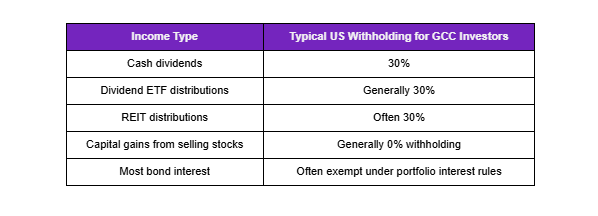
This difference explains why many long-term investors prioritize capital appreciation alongside dividend income. A company that reinvests earnings and grows in value may generate returns without creating dividend withholding events.
Trade US growth stocks and dividend stocks — all from one account. Raseed gives Saudi and GCC investors access to thousands of US stocks with no hidden fees and no spreads. Open your free account now →
Can Saudi Investors Avoid the 30% Dividend Tax?
This is one of the most searched questions related to US dividend investing.The short answer is:
In most cases, no. Because Saudi Arabia and other GCC countries currently do not have qualifying tax treaties with the United States, the standard 30% withholding rate generally applies.
However, investors can reduce the impact of withholding tax through portfolio construction and investment strategy.
The goal is not necessarily to avoid tax completely but to build a more efficient investment approach.
5 Smart Strategies for GCC Investors
1. Focus on Total Return, Not Just Dividend Yield
Many investors chase high dividend yields without considering the impact of withholding tax. A stock yielding 5% before tax may provide a substantially lower effective yield after withholding. Evaluating total return, including capital appreciation, often provides a clearer picture.
2. Consider Growth-Oriented Companies
Many leading technology and innovation companies pay little or no dividends. Because withholding tax generally applies to dividends rather than capital gains, growth-focused investing can reduce the impact of dividend taxation.
3. Use Dividend Reinvestment Strategies
Dividend reinvestment can help investors compound returns over time. Even after withholding tax, reinvesting net dividends allows investors to continue accumulating shares and benefit from long-term growth.
Explore our Dividend Reinvestment (DRIP) Guide to learn more.
4. Compare TASI and US Dividend Opportunities
Saudi-listed companies may offer dividend opportunities without US withholding tax considerations. Investors focused primarily on income may benefit from comparing local and international markets.
Explore: TASI vs US Stocks: Which Market Fits Your Strategy?
5. Diversify Across Markets and Asset Types
Diversification remains one of the most effective long-term investing principles.
Combining:
US stocks
ETFs
Saudi stocks
Growth investments
Dividend-paying companies
can help reduce concentration risk while supporting long-term portfolio objectives.
Why This Matters for Long-Term Investors
Dividend withholding tax should not automatically discourage investors from owning US stocks. The US remains home to many of the world's most valuable businesses, strongest balance sheets, and most consistent dividend payers.
The key is understanding the true after-tax return rather than focusing solely on advertised dividend yields. Investors who understand how withholding tax works can make more informed decisions regarding:
Dividend investing
Portfolio allocation
ETF selection
Long-term wealth building
Retirement planning
Financial literacy around taxation is an important part of becoming a more effective global investor.
Start Investing Globally with Confidence
Whether you are building a dividend portfolio, investing in growth stocks, or diversifying across international markets, understanding US dividend withholding tax helps you make more informed investment decisions.
Raseed gives investors across Saudi Arabia and the GCC access to:
US stocks and ETFs
Fractional investing from $1
Dividend reinvestment tools
Transparent pricing
Advanced investing features designed for long-term investors
Explore global markets, build diversified portfolios, and invest with greater clarity through one platform.
Ready to invest smarter? Thousands of Saudi and GCC investors already trade US stocks, ETFs, and more on Raseed — with no account maintenance fees, no hidden charges, and no minimum balance. Create your free Raseed account in minutes →
Frequently Asked Questions
Do Saudi investors pay tax on US dividends?
Yes. Saudi investors are generally subject to a 30% US withholding tax on dividends paid by US companies because Saudi Arabia currently does not have a tax treaty with the United States that reduces this rate.
Does the 30% withholding tax apply to ETFs?
Generally yes. If an ETF distributes dividend income generated from US securities, the distribution is typically subject to withholding tax for GCC investors.
Does withholding tax apply when I sell a stock?
In most cases, non-US investors are not subject to US withholding tax on capital gains from publicly traded US stocks. Investors should seek professional tax advice regarding their specific circumstances.
Do UAE, Qatar, Kuwait, Bahrain, and Oman investors pay the same rate?
Generally yes. Investors across GCC countries currently face the same standard 30% withholding rate on US-source dividend income.
Is dividend withholding tax a brokerage fee?
No. Dividend withholding tax is imposed by the US tax system and deducted before the dividend reaches your brokerage account. It is separate from brokerage commissions or platform fees.
Related Articles on Raseed Learn
How to Invest in the S&P 500 from Saudi Arabia | Dividend Reinvestment (DRIP) Guide
Best Halal ETFs for Saudi Investors 2026 | TASI vs US Stocks
Disclaimer: This article is provided for educational purposes only and should not be considered tax, legal, or financial advice. Tax laws and regulations may change, and individual circumstances vary. Investors should consult a qualified tax professional regarding their specific situation.