How Saudi and GCC Investors Are Affected — and What to Do About It
Quick Answer: How Do US Tariffs Affect Saudi and GCC Investors?
✓ GCC countries received a 10% universal tariff — relatively contained since the US receives only ~3.7% of GCC exports.
✓ Energy (oil) is exempted from US tariffs — protecting the GCC's primary export revenue.
✓ The bigger risk: tariffs slowing global growth and reducing oil demand — the indirect channel that hurts Saudi Arabia most.
✓ GCC currencies are pegged to the USD — so US tariff-driven inflation imports directly into GCC monetary policy.
✓ Saudi Arabia's growth forecast was cut by the IMF from 4.1% to 3.7% for 2026 due to tariff effects.
What you will learn in this article
What the 10% US tariff actually means for GCC countries specifically
Why the indirect effects matter far more than the direct tariff
How tariffs hit oil prices, the most critical channel for Saudi investors
Impact on TASI, the Saudi riyal, and GCC government budgets
What happened to US and Saudi stocks during the April 2025 tariff shock
5 practical strategies for GCC investors during trade war uncertainty
The direct impact of US tariffs on GCC countries is limited. The indirect impact — through oil prices, dollar policy, and global growth, is the real concern.
In April 2025, the United States imposed a 10% tariff on all imported goods from virtually every country. Saudi Arabia, the UAE, Qatar, Kuwait, Bahrain, and Oman all received this baseline 10% rate. That sounds significant but the US accounts for only approximately 3.7% of total GCC exports, and crucially, energy (crude oil and natural gas) is specifically exempted from tariffs. The direct trade impact is manageable. (Source: CNBC, April 2025, Arab News, April 2025.)
What matters far more for GCC investors is what tariffs do to global oil demand, US interest rates, and worldwide economic growth, all of which flow indirectly into Saudi stocks, government revenues, and long-term investment returns.
The Direct Impact: What GCC Countries Actually Face
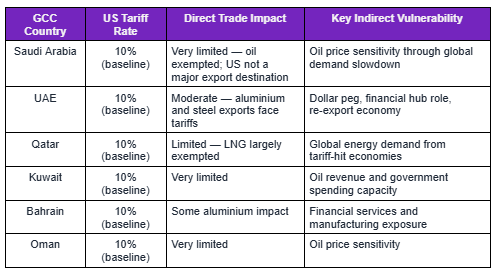
Source: Arab News, April 2025: "GCC nations will face a 10 percent US tariff under Donald Trump's new trade policy." PwC Middle East Tax Alert, April 2025: "Middle Eastern countries like UAE and KSA will face a 10% tariff." CNBC, April 2025: "the US is not a key destination for Gulf exports, averaging just c.3.7% of the GCC's total exports in 2024."
The Indirect Impact: 4 Channels That Matter More Than the 10% Tariff
These four channels explain why GCC investors should care about US tariffs even though the direct trade impact is small.
Channel 1 — Oil price collapse (the most important risk)
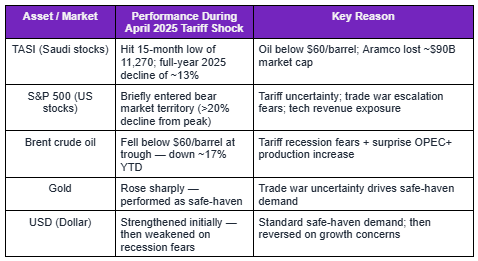
The greatest tariff risk for GCC countries is not the 10% rate itself — it is the risk that global tariffs trigger a recession in major oil-consuming economies, reducing oil demand and crashing prices. This is exactly what happened in April 2025. Trump's tariff announcements combined with a surprise OPEC+ production increase of 411,000 barrels per day pushed Brent below $60 per barrel. Saudi Aramco lost approximately $90 billion in market capitalisation. Saudi Arabia's fiscal breakeven of $80–96 per barrel was directly challenged. (Source: AGSI Gulf Economies and the Tariff Storm, March 2026.)
Channel 2 — Dollar peg and imported US inflation
Saudi Arabia, the UAE, Qatar, Oman, and Bahrain all peg their currencies to the US dollar. When US tariffs drive domestic inflation higher in America, the Federal Reserve keeps interest rates elevated. Because GCC central banks must mirror Fed policy to maintain the dollar peg, GCC countries effectively import the US's monetary tightening — even when their own economies do not need it. Higher rates slow GCC lending growth, real estate activity, and business investment. (Source: Gulf International Forum, April 2025; Atlantic Council, May 2025; S&P Global Market Intelligence, February 2025.)
This dollar peg dynamic is also relevant to understanding how TASI is affected by US financial conditions — covered in more detail in our TASI vs US stocks comparison.
Channel 3 — Global growth slowdown reduces oil demand
The IMF cut its global growth forecast from 3.3% to 2.8% for 2025 in response to tariffs and increased uncertainty. Saudi Arabia's own growth forecast was reduced from 3.3% to 3.0% for 2025 and from 4.1% to 3.7% for 2026. Slower global growth means lower oil demand, lower oil prices, and tighter Saudi government budgets — all of which flow through to TASI performance. (Source: Al Jazeera Centre for Studies, citing IMF forecasts.)
Channel 4 — Vision 2030 project costs
Saudi Arabia's mega-projects — NEOM, Red Sea development, Qiddiya — require enormous quantities of construction equipment, electronics, and machinery. Much of this is manufactured in tariff-affected countries or uses components from them. Higher import costs from tariff-driven supply chain disruption could increase project costs, potentially slowing timelines or requiring additional government funding beyond planned budgets.
Diversify your portfolio across Saudi and US stocks to reduce tariff-related concentration risk. → Open your free Raseed account →
What Actually Happened to TASI and US Stocks During the 2025 Tariff Shock?
The April 2025 tariff period tested every major asset class simultaneously — here is what the data shows.
5 Practical Strategies for GCC Investors During Trade War Uncertainty
Here is what experienced investors do, not just what they think about, during trade war periods.
Strategy 1 — Do not make dramatic portfolio changes on tariff headlines. The S&P 500 fell sharply in April 2025 and then recovered fully and went higher as ceasefire and tariff-pause signals emerged. Investors who sold at the bottom and missed the recovery permanently damaged their returns. Tariff headlines move faster than portfolios should.
Strategy 2 — Monitor oil price as the primary tariff indicator for Saudi investors. For GCC investors, the critical question is not "what are the tariff rates?" but "are tariffs reducing global oil demand?" Track Brent crude. If oil holds above $80 per barrel despite tariff pressure, Saudi government revenues remain healthy and TASI has structural support.
Strategy 3 — Hold USD-denominated assets. Because GCC currencies are pegged to the dollar, holding US stocks priced in USD gives you currency stability that European or emerging market investors do not have during dollar-strengthening periods. This is a structural advantage for GCC investors that is often overlooked.
Strategy 4 — Tilt toward non-oil sectors within TASI. Healthcare, consumer staples, and telecom companies on TASI have lower correlation with oil-price-driven tariff shocks. A deliberate sector tilt reduces your portfolio's sensitivity to the primary tariff transmission channel without leaving Saudi markets entirely.
Strategy 5 — Consider gold as a portfolio buffer. Research from the International Journal of Accounting and Economics Studies (2026) confirms gold's safe-haven role during GCC market shocks. A small gold allocation (5–10% of total portfolio) can reduce volatility during tariff uncertainty without significantly reducing long-term return potential.
For investors building a portfolio resilient to trade war uncertainty and other macro risks, our portfolio diversification guide and geopolitical portfolio protection guide both provide practical, actionable frameworks.
Frequently Asked Questions
Q: Do US tariffs directly affect Saudi Arabia's oil exports?
No. Crude oil and energy exports are specifically exempted from US tariffs. The direct impact on Saudi Arabia is limited, as the US accounts for only approximately 3.7% of total GCC exports. The indirect impact through oil demand, dollar policy, and global growth is far more significant.
Q: Why should Saudi investors care about US tariffs if they don't trade much with the US?
Because US tariffs affect three things that matter deeply to Saudi investors: global oil demand (if tariffs cause a global recession, oil falls and Saudi revenues drop), US monetary policy (higher US inflation from tariffs means higher Fed rates, which GCC countries must mirror through their dollar pegs), and global economic growth (slower growth reduces oil consumption worldwide).
Q: Should I sell my US stocks during a trade war?
Historically, no. The S&P 500's sharp drop and subsequent full recovery in 2025 showed how quickly sentiment reverses when tariff signals shift. Long-term investors who remained invested through the April 2025 tariff shock recovered fully. Panic selling during trade war episodes typically results in missing the recovery.
Q: Is Saudi Arabia's 10% tariff rate among the lowest globally?
Yes. Saudi Arabia received the baseline 10% universal rate. Countries with large trade deficits with the US faced much higher rates, China faced rates exceeding 100% at peak. The GCC's 10% rate, combined with the energy exemption, put it among the least tariff-impacted regions in the world.
Build a diversified, tariff-resilient portfolio across Saudi and US markets on regulated platform. → Start investing on Raseed today →
Related Articles on Raseed Learn
TASI vs US Stocks — Where Should Saudi Investors Invest?
Protect Your Portfolio During Geopolitical Events
5 Steps to Diversify Your Portfolio
This article is for educational and informational purposes only and does not constitute investment advice. All investing involves risk including the potential loss of principal. Data is from publicly available sources as of June 2026. Past performance does not guarantee future results. Securities brokerage services are provided by Fullerverse (SC) Limited, licensed and regulated by the Financial Services Authority Seychelles (Licence No. SD152), a wholly-owned subsidiary of Raseed Invest Inc.