


The Question Every Saudi Investor Should Have a Precise Answer To
Buying a share of Apple, Tesla, or Amazon from Saudi Arabia sounds straightforward — but the true cost of that purchase involves more variables than most investors realise. The commission, the currency conversion rate, the data fees, and the settlement costs all combine into a total cost of ownership that varies significantly between platforms.
This guide builds a complete picture of what Saudi investors actually pay to trade US stocks in 2026, using real scenarios and side-by-side platform comparisons so you can make an informed decision before opening an account.
Component 1: The Per-Trade Commission
This is the most visible cost and the one most platforms lead with in their marketing. For Saudi investors trading US stocks, commissions across the market range from $0.50 to $25 per transaction. The specific structure — flat fee, percentage of trade value, or a hybrid — determines how costs scale as your trade size increases.
Raseed charges a minimum of $0.50 and caps every trade at $3, regardless of trade size. For larger trades, this cap represents an enormous saving versus percentage-based competitors with no ceiling.
Related Reading: Lowest Trading Fees in Saudi Arabia: Full Platform Comparison 2026
Component 2: Currency Conversion
Every Saudi investor funding a USD-denominated trading account in SAR incurs a currency conversion cost. Platforms apply this conversion at their own rate, typically 0.5% to 1.5% above the mid-market rate. On a SAR 20,000 deposit, this adds $26 to $80 in immediate costs before trading begins.
Component 3: Market Data Subscriptions
To make informed buy and sell decisions on US stocks, investors need at minimum real-time quotes and ideally Level 2 order book depth. These data services are charged separately on most platforms: real-time quotes typically cost $5 to $10 per month, and Level 2 data adds $10 to $30 per month on top.
Related Reading: Free Level 2 Market Data: Why It Matters and Which Platforms Offer It in GCC
Full Cost Breakdown: Buying $1,000 of US Stocks
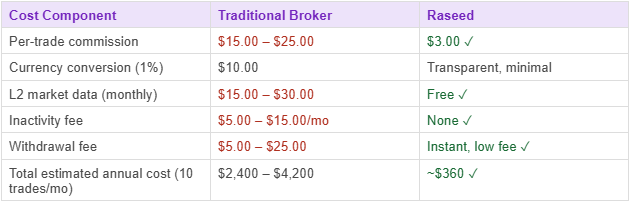
For a Saudi investor making 10 trades per month, the annual cost difference between a traditional $20-per-trade platform and Raseed is between $2,000 and $3,800. That is capital that should be invested, not paid in fees.
Real Stocks vs CFDs: Why the Asset Type Affects Cost
Some platforms available to Saudi investors do not actually sell stocks — they sell Contracts for Difference (CFDs) that track stock prices. CFDs carry additional costs including overnight financing fees (typically 0.02% to 0.03% per night for held positions) and wider spreads. For investors holding positions overnight or for longer periods, CFD costs can far exceed the stated commission on real stock platforms.
Related Reading: Stock Trading Without Limits on Raseed
Long-Term Impact: How Fee Differences Compound
The most powerful argument for low-fee trading is compounding. Every riyal saved on fees that is instead kept invested earns a return. A Saudi investor saving SAR 3,000 annually in trading fees, invested at 8% annual return over 10 years, accumulates approximately SAR 43,000 in additional portfolio value, purely from the compounding of money not paid in fees.
Fee efficiency is not a small consideration. For long-term investors, it is one of the highest-return decisions available, requiring no market timing, no stock picking, and no additional risk.
Related Reading: How to Invest in the S&P 500 from Saudi Arabia