What Level 2 Data Is and Why Most Investors Pay for It Separately
The standard stock quote shows one number: the last traded price. Level 2 market data shows the full order book, every active buy order and every active sell order, at every price level, in real time. This depth of market information is what serious traders and active investors use to understand the true supply and demand dynamics behind any stock's price.
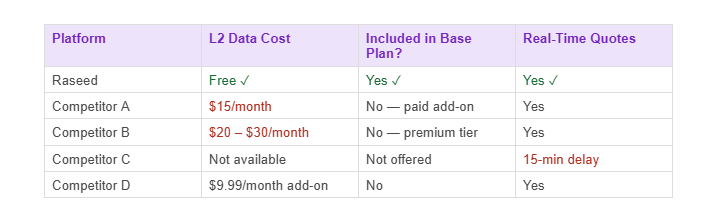
This data comes directly from the exchanges NYSE and NASDAQ charge subscription fees for real-time access, and most brokers pass these costs on to investors. Across the platforms available to Saudi and GCC investors, Level 2 data typically costs between $10 and $30 per month. Raseed is currently the only platform in the region that provides it free to all users.
Related Reading: Advanced Charts & Order Book on Raseed: Trading With Clarity, Not Guesswork
L2 Data Cost Comparison Across GCC Platforms
How Much Free L2 Access Saves Saudi Investors Annually
At $15 per month, L2 data costs $180 per year. At $30 per month, the annual cost is $360. For an active investor who has been paying for data access on another platform, switching to Raseed eliminates this cost entirely, adding $180 to $360 per year back to the amount available for investment, every year.
Over five years, $360 annually in saved data costs, invested at 8% return, becomes approximately $2,100 in additional portfolio value. The data that tells you how to trade better also costs you money on most platforms. On Raseed, it does not.
Related Reading: Lowest Trading Fees in Saudi Arabia: Full Platform Comparison 2026
Partial Free Alternatives and Why They Fall Short
Some financial websites, Yahoo Finance and Google Finance among them, display limited order book data for US stocks. However, this data is typically delayed by 15 to 20 minutes and shows only a fraction of the full order book depth. For research and general market awareness, delayed data may be sufficient. For making active buy and sell decisions, 15-minute delay is inadequate and can be actively misleading during fast-moving market conditions.
How to Use L2 Data on Raseed Step by Step
Open any stock on the Raseed app and select the order book or depth view
Review the bid side (left column, buyers) and ask side (right column, sellers)
Note the quantity available at each price level on both sides
Compare the total volume on the bid side versus the ask side to gauge buying vs selling pressure
Look at the spread between the best bid and best ask, a narrow spread indicates higher liquidity
Use this information alongside the price chart and recent news before placing any trade
Related Reading: Liquidity, Volume, and Volatility — What Day Traders in Saudi Arabia Watch First
Who Benefits Most from L2 Data?
Active traders who place multiple trades per week derive the most immediate benefit from order book data, it is central to their entry and exit decision-making. However, even investors who trade once or twice a month benefit from understanding the market structure before committing capital. Knowing whether strong buy support exists at current levels or whether thin order flow makes a position vulnerable is relevant at any trading frequency.