


A Complete Guide for Saudi Muslim Investors in 2026
Quick Answer: Is Investing in US Stocks Halal?
Yes, investing in US stocks can be halal, if the specific company passes AAOIFI Shariah screening criteria
Screening checks two things: business activity (no prohibited industries) and financial ratios (debt and interest income limits)
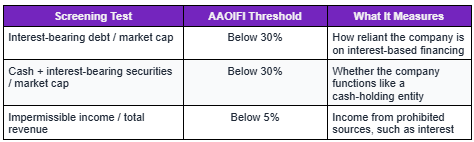
AAOIFI Standard 21 generally requires debt and interest-bearing securities to stay under 30% of market cap
Prohibited or impure income (such as interest) must generally stay under 5% of total revenue
Many individual US stocks and Shariah-screened ETFs pass these criteria and are available to trade on Raseed
What you will learn in this article
Why "US stocks" as a category is not simply halal or haram
The two-part AAOIFI screening process explained
What counts as prohibited business activity
The financial ratio thresholds that matter
How to check any specific stock’s compliance status
Investing in US stocks can be halal, but it depends entirely on whether the specific company passes Shariah screening, not on the market itself.
There is no blanket ruling that all US stocks are halal or haram. Islamic scholars and standard-setting bodies, primarily AAOIFI (the Accounting and Auditing Organization for Islamic Financial Institutions), apply a structured screening process to individual companies. A company passes or fails based on its business activities and specific financial ratios, not its country of listing. For Saudi and GCC Muslim investors building a US equity portfolio, understanding this screening process is the foundation of halal investing. See our best halal stocks guide for a list of stocks that currently pass AAOIFI screening.
How Does AAOIFI Shariah Screening Actually Work?
AAOIFI screening checks two things: what the business does, and how its finances are structured.
The first check is business activity screening: a company must not derive its primary revenue from prohibited industries. The second check is financial ratio screening, applied even to companies in permissible industries, since modern public companies often carry some interest-bearing debt or earn some interest income on cash holdings.
Business Activity Screening: What Disqualifies a Company?
Conventional banking and interest-based finance: Riba (interest) is prohibited under Islamic law.
Alcohol production or distribution
Gambling and gaming operations
Pork-related products
Adult entertainment
Conventional weapons manufacturing (specific scope varies by methodology)
Financial Ratio Screening: The Numbers That Matter
Even a company in a fully permissible industry must pass financial thresholds. AAOIFI generally applies a 30% ceiling, comparing interest-bearing debt and interest-bearing cash holdings each against market capitalization, alongside a 5% ceiling on impermissible income relative to total revenue.
Build a Shariah-screened US stock portfolio on Raseed, fractional shares from $1. → Start halal investing on Raseed →
What Happens If a Stock Has Some Impermissible Income?
A small amount of impure income, under the 5% threshold, does not disqualify a stock — but it should be purified.
Many companies that pass overall screening still earn a small percentage of impure income, often interest on cash holdings. The practice of purification (istibra) involves calculating that percentage and donating the equivalent portion of any dividends received to charity, without seeking religious reward for the donation, as a way of cleansing that specific portion of income.
Important: Screening results are not permanent. A company’s debt and interest income can shift each quarter, which is why compliance should be checked regularly, not assumed to be fixed.
How to Check Whether a Specific US Stock Is Halal
Use a dedicated screening tool rather than guessing based on the company’s general reputation.
Use a dedicated Shariah screening platform such as Musaffa, Zoya, or HalalScreener to check a specific ticker
Review both the business activity classification and the current financial ratios
Check the screening date, ratios are recalculated quarterly as financials change
If a stock passes with a small percentage of impure income, calculate and purify that portion from dividends received
For Sharia-compliant fund options that handle this screening for you, see our best halal ETFs guide.
Frequently Asked Questions
Q: Are all US stocks haram because the US market involves interest-based banking?
No. Individual companies are screened separately. A US-listed company with low debt, low interest income, and a permissible core business can pass Shariah screening regardless of the broader market it trades in.
Q: How often should I check if a stock is still halal?
At least quarterly. Financial ratios change as companies report new earnings, debt levels, and interest income, which can shift a stock from compliant to non-compliant or vice versa.
Q: What is purification and do I need to do it?
Purification is donating the small percentage of impure income (typically interest) embedded in a compliant stock’s dividends to charity. Many Muslim investors treat this as a standard part of halal investing rather than an optional step.
Related Articles on Raseed Learn
Best Tech Stocks for Saudi Investors
This article is for educational and informational purposes only and does not constitute investment advice. All investing involves risk, including the potential loss of principal. Data is from publicly available sources as of June 2026. Past performance does not guarantee future results. Securities brokerage services are provided by Fullerverse (SC) Limited, licensed and regulated by the Financial Services Authority Seychelles (Licence No. SD152), a wholly-owned subsidiary of Raseed Invest Inc. Raseed Invest Limited is regulated by the DFSA. Capital is at risk.