


Which Makes More Money for GCC Investors?
Quick Answer: Passive Investing vs Active Trading — Which Wins?
Over 15-year periods, passive index investing beats approximately 85–90% of active fund managers after fees — per S&P's annual SPIVA report
The average active retail trader significantly underperforms the market due to transaction costs, emotional decisions, and timing errors
Passive investing requires less time, less knowledge, lower fees, and produces better average results — making it the right default for most GCC investors
Active trading can produce higher returns, but only for a small minority of disciplined, experienced traders with robust risk management
The right answer is not one or the other — many successful investors use passive foundations and selective active positions
What you will learn in this article
What passive investing and active trading actually are
What 30 years of S&P data shows about active vs passive performance
Why most retail traders underperform even when they pick the right stocks
The specific costs that erode active trading returns
A practical framework for GCC investors to decide which suits them
Passive investing means buying and holding a diversified index fund or basket of stocks and doing nothing else. Active trading means regularly buying and selling securities in an attempt to outperform the market.
The debate between passive and active has produced more research than almost any other question in finance. The conclusion from decades of data is consistent: most active approaches underperform passive approaches over time, primarily due to fees, taxes, and the behavioural mistakes that come with frequent trading decisions.
For investors new to the core concepts, our understanding risk in stock trading guide covers the foundational principles before this comparison makes full sense.
What the 30-Year Data Shows
S&P's SPIVA Report is the most rigorous annual study of active vs passive performance and its findings are consistent every year.
S&P Dow Jones Indices publishes the SPIVA (S&P Indices Versus Active) report annually, comparing active fund managers against their relevant benchmarks after fees. The most recent available data shows that over 15-year periods, approximately 85–90% of active US equity funds underperform their benchmark index. For emerging markets including Saudi Arabia, the underperformance rate is similar.
Key fact: The DALBAR Quantitative Analysis of Investor Behaviour study (published annually since 1994) consistently shows that the average equity fund investor earns significantly less than the fund itself returns — due to buying after rises and selling after falls. The average investor's timing decisions typically cost 2–4% in annual returns versus simply holding.
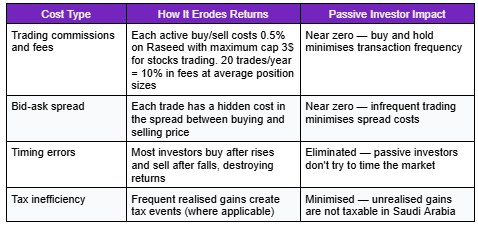
Why Active Trading Underperforms: 4 Cost Centres
Even when an active trader picks the right stocks, four invisible costs erode their outperformance.
The Case for Active Trading — When It Works
Active trading can outperform passive investing, but only under specific conditions that most retail investors cannot sustain.
The traders who consistently outperform passive benchmarks share common characteristics: they have specialised knowledge in a narrow sector or market, they apply rigid risk management rules consistently, they have enough capital to absorb losing streaks without being forced to exit, and they treat trading as a full-time professional pursuit with systematic processes.
For a Saudi investor with deep knowledge of the healthcare sector, concentrated active positions in Dr. Sulaiman Al Habib or Mouwasat Medical might genuinely outperform a passive TASI index. But this requires the sector knowledge to have a genuine edge, not just enthusiasm.
Start with a passive, diversified portfolio on Raseed — buy broad ETFs from $1 with fees capped at $3. → Build your passive portfolio on Raseed →
The Practical Framework for GCC Investors
The right answer is not passive OR active — it is passive as the foundation, selective active where you have genuine edge.
Allocate 70–80% of your portfolio to passive positions, diversified ETFs or index-like baskets you hold for 3–5 years minimum
Allocate 20–30% to selective active positions where you have specific knowledge or conviction — specific stocks you have researched deeply
Never actively trade more than you could afford to lose entirely
Track your actual returns against a simple benchmark (e.g. S&P 500 ETF) to verify whether your active approach is adding value
If your active returns consistently underperform the benchmark after fees, shift more to passive
Frequently Asked Questions
Q: Is passive investing or active trading better for Islamic investors?
Passive index ETFs can be Sharia-screened — SPUS and HLAL apply AAOIFI-based screening to all holdings. A passive Sharia-screened ETF approach eliminates the need for continuous individual stock screening and is generally considered a sound Islamic investing approach. Active trading in individual stocks requires ongoing screening of each position.
Q: How often should I check my passive portfolio?
For a long-term passive portfolio, monthly or quarterly reviews are sufficient. Daily checking encourages emotional reactions to short-term price moves, which undermines passive investing's core principle of ignoring short-term noise.
Q: Can a Saudi investor beat TASI through active stock picking?
Beating TASI consistently through active stock picking over a 10+ year period is extremely difficult, even for professional Saudi fund managers. The SPIVA data for GCC markets shows similar underperformance rates to global averages. It is possible, but requires genuine edge, not just research effort.
Related Articles on Raseed Learn
ETF vs Mutual Fund for GCC Investors
5 Steps to Diversify Your Portfolio
Dollar-Cost Averaging for Saudi Investors
Understanding Risk in Stock Trading
This article is for educational and informational purposes only and does not constitute investment advice. All investing involves risk including the potential loss of principal. Data is from publicly available sources as of June 2026. Past performance does not guarantee future results. Securities brokerage services are provided by Fullerverse (SC) Limited, licensed and regulated by the Financial Services Authority Seychelles (Licence No. SD152), a wholly-owned subsidiary of Raseed Invest Inc. Raseed Invest Limited is regulated by the DFSA. Capital is at risk.