The Saudi stock market (Tadawul/TASI) operates on a day-to-day basis, with hours of operation from 10 AM to 3 PM (Arabian Standard Time) on Sunday through Thursday. The US stock market (NYSE and NASDAQ) operates between 9:30 AM to 4 PM on Monday to Friday. The time of the US stock market is 4:30 PM - 11 PM (Saudi time) in the summer and 5:30 PM - midnight (Saudi time) in the winter.
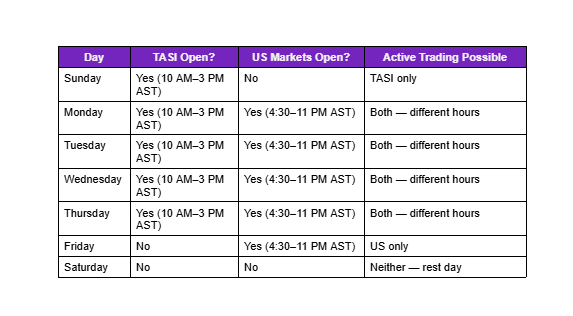
Three facts every Saudi investor needs to know immediately: TASI does not observe Daylight Saving Time (Saudi Arabia stays on GMT+3 year-round), while the US does shift by one hour in March and November. TASI trades on Sundays, when US markets are closed. US markets trade on Fridays, when TASI is closed. This means there is no single day when both markets are open simultaneously for the same investor.
Understanding these trading windows is the foundation of smart cross-market investing. Whether you are trading TASI stocks vs US stocks or exploring extended hours trading for US stocks from Saudi Arabia, knowing exactly when each market is active saves you from missed opportunities and frustrating "market closed" messages.
TASI Trading Hours — The Complete Schedule
The Saudi Exchange (formerly called the Tadawul) operates using the Arabian Standard Time (AST), which is GMT +3. Because Saudi Arabia does not utilize Daylight Saving Time, the opening and closing times of the Exchange and the hours of operation remain constant every day of the year, regardless of season or time of year.
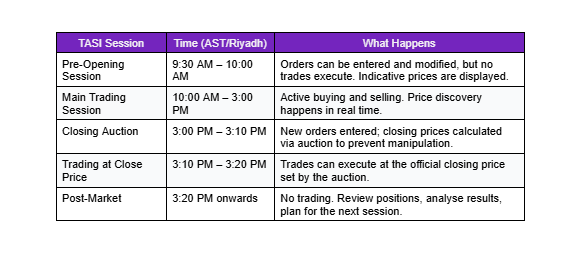
The pre-opening session (9:30–10:00 AM) is underused by most retail investors. During this window, you can see the accumulated buy and sell orders for major stocks like Saudi Aramco and Al Rajhi Bank before actual trading begins. Experienced traders use this indicative data to gauge market direction before placing their own orders at the 10:00 AM open.
US Stock Market Hours — Converted to Saudi Time
The NYSE and NASDAQ have the same regular trading hours, which are 9:30 AM to 4:00 PM ET from Monday to Friday. If you want to convert this from US eastern time zone (ET) to Saudi Arabian time, you will need to account for Daylight Savings Time as the United States does take into consideration Daylight Savings Time whereas Saudi Arabia does not.
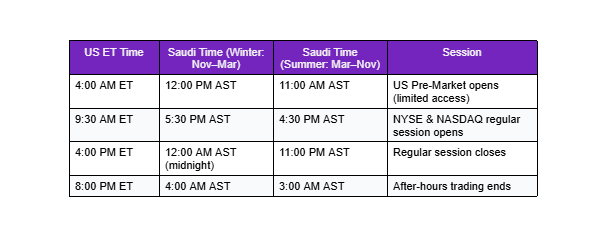
US Daylight Saving Time begins the second Sunday in March and ends the first Sunday in November. Saudi Arabia does not observe DST. This creates the 1-hour shift in conversion between summer and winter periods.
The practical implication: Saudi investors trading US stocks start their US session at around 4:30–5:30 PM Riyadh time and remain active until 11:00 PM–midnight. Plan your schedule accordingly, if you are an active US stock trader, evenings are your primary market window. The good news is that Saudi daytime hours are free for research, analysis, and placing pre-market orders.
Pre-Market and After-Hours Trading Hours
Beyond the regular 9:30 AM–4:00 PM ET session, US markets offer extended trading windows. These sessions have lower trading volume, wider bid-ask spreads, and more volatility but they are important because major company announcements often happen outside regular hours.
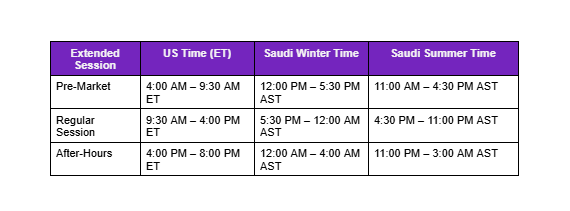
When does extended hours trading matter for Saudi investors?
Primarily around the US earnings season (January, April, July, October). Most large US companies Apple, NVIDIA, Microsoft, release quarterly earnings after 4:00 PM ET (11:00 PM AST in summer). Significant price moves happen in after-hours trading before the regular session opens the next day. Raseed supports extended hours trading, learn how it works in our extended hours trading guide.
TASI Official Holiday Schedule 2026
The Saudi Exchange closes for the following official holidays. Exact dates for Eid vary annually and are confirmed by Tadawul closer to the time. Always verify the current year's schedule on the official Saudi Exchange website.
Saudi National Day — 23 September (Founding of the Kingdom, 1932). Fixed date annually.
Saudi Founding Day — 22 February. Fixed date annually.
Eid Al-Fitr — Typically 3–4 trading days off. Dates follow the Hijri calendar and change each year.
Eid Al-Adha — Typically 4–5 trading days off. The largest holiday closure of the year.
Friday and Saturday are the Saudi weekend — TASI is closed both days every week. The TASI trading week runs Sunday through Thursday, which is why it operates when most Western markets are closed on Monday.
US Stock Market Holidays 2026
The NYSE and NASDAQ observe the following US federal holidays in 2026. On these days, Saudi investors cannot trade US stocks during regular market hours.
New Year's Day — January 1
Martin Luther King Jr. Day — January 19
Presidents' Day — February 16
Good Friday — April 3
Memorial Day — May 25
Juneteenth — June 19
Independence Day — July 4 (early close July 3 at 1:00 PM ET)
Labor Day — September 7
Thanksgiving Day — November 26 (early close November 27 at 1:00 PM ET)
Christmas Day — December 25 (early close December 24 at 1:00 PM ET)
TASI vs US Markets — Which Days Are Both Open?
Because TASI operates Sunday–Thursday and US markets operate Monday–Friday, there is no single day when both are simultaneously open. The overlap days — Monday through Thursday — are when TASI is trading during the morning and US markets open in the evening Saudi time. This is the window when a Saudi investor can actively manage positions in both markets on the same calendar day.
4 Practical Tips for Saudi Investors Managing Both Markets
Tip 1. Use your Sunday morning to prepare for the US week. Sunday is a TASI trading day but US markets are closed. Use the US markets's off day to research US stocks, set watchlists, and plan your entry and exit levels for the coming week. This advance preparation prevents reactive decision-making when markets are live.
Tip 2. Watch US earnings release times. Most major US earnings come out at 4:00–4:30 PM ET (11:00–11:30 PM AST in summer). Set calendar reminders for earnings dates of companies you hold. The price reaction in after-hours trading often sets the tone for the next day's regular session.
Tip 3. Be careful with GTC orders overnight. Good-Till-Cancelled orders on US stocks remain active while you are asleep. A stock that is halted in the evening Saudi time may open at a significantly different price the following day. Review your open orders before you sleep. Our stock halts guide explains exactly what happens to your orders during a halt.
Tip 4. Account for Daylight Saving Time shifts. The US shifts clocks forward in March (markets open 1 hour earlier in Saudi time) and back in November (markets open 1 hour later). Set a calendar reminder for these transitions so your trading routine adjusts correctly. Saudi Arabia's clocks never change.
Frequently Asked Questions
What time does the Saudi stock market open?
TASI opens at 10:00 AM Riyadh time (GMT+3/AST) every Sunday through Thursday. A pre-opening session begins at 9:30 AM where orders can be entered but not executed.
What time does the US stock market open in Saudi Arabia?
In summer (March–November), US markets open at 4:30 PM AST. In winter (November–March), US markets open at 5:30 PM AST. This 1-hour difference is due to US Daylight Saving Time, which Saudi Arabia does not observe.
Can I trade US stocks on a Sunday from Saudi Arabia?
No. NYSE and NASDAQ are closed on weekends (Saturday and Sunday). You can only trade US stocks Monday through Friday during their operating hours. Raseed gives you access to US stocks during all regular and extended trading hours.
Can I trade TASI stocks on a Friday?
No. The Saudi Exchange is closed on Friday and Saturday (the Saudi weekend). TASI operates only Sunday through Thursday.
Are there any times when both TASI and US markets are open simultaneously?
No. TASI's hours are 10 AM–3 PM AST. US markets open at 4:30 PM or 5:30 PM AST. By the time the US market opens, TASI has already closed for the day. On Monday through Thursday, you can trade each market during its own window, but not simultaneously.
Related Articles on Raseed Learn
TASI vs US Stocks — Where Should Saudi Investors Invest? | Extended Hours Trading for GCC Investors | Stock Halts Explained
How to Invest in the S&P 500 from Saudi Arabia | Understanding Risk in Stock Trading