What Is a Stock Halt?
A stock halt also called a trading halt is a temporary, legally enforced suspension of all buying and selling activity in a specific security. During a halt, no trades can execute anywhere in the US market: not on NYSE, not on NASDAQ, and not through any broker. The price freezes at the last executed trade.
Halts are not broker errors and are not signs a company is collapsing. They are deliberate mechanisms built into the US market system to ensure fair trading giving every investor, from the largest institution to a retail investor in Riyadh, equal access to the same information before the market moves.
Your broker cannot initiate, extend, or bypass a halt. Halts are declared by the listing exchange (NYSE or NASDAQ), by the SEC, or by FINRA for OTC stocks and every US trading venue must observe them simultaneously. For beginners starting with US stocks, our stock trading guide for Saudi investors covers the market fundamentals you need to know first.
Why Trading Halts Exist
The modern halt system was born from Black Monday, October 19, 1987 when the Dow Jones Industrial Average fell 22.6% in a single session with no mechanism to slow the spiral. After that crash, regulators built pause mechanisms directly into the market's operating system to prevent self-reinforcing panics.
Today, halts serve three purposes:
Equal information access, when a company is about to release material news, the halt freezes trading so no one can act on it before it is equally available to everyone
Breaking panic feedback loops, extreme price moves can become self-reinforcing. Algorithmic sell orders trigger more stop-losses, which trigger more selling. A pause interrupts the cycle.
Protecting price discovery, when prices are driven by manipulation or misinformation rather than genuine supply and demand, halts allow the market to reset and produce a reliable reopening price
Types of Stock Halts and Official Halt Codes
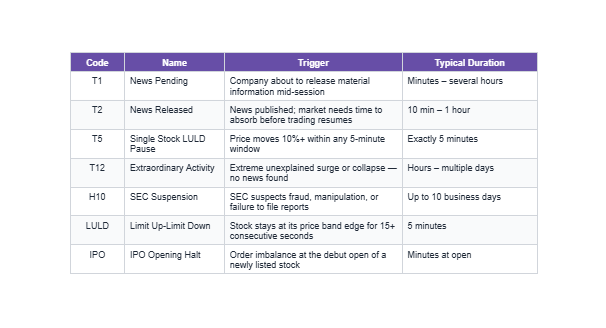
When a stock is halted, exchanges assign an official code explaining the reason. These are published in real time at nasdaqtrader.com/tradehalts and nyse.com/trade-halt. Here are the most important codes every investor should know:
T1 — News Pending (Most Common)
The most frequent type. A company notifies the exchange at least 10 minutes before releasing material news during market hours. The exchange halts the stock so the information reaches all investors simultaneously before trading can react. Common triggers: earnings announcements, FDA drug decisions, merger announcements, major regulatory actions. T1 halts are normal events that happen to large, high-quality companies regularly.
T12 — Extraordinary Activity (Most Dangerous)
Triggered when a stock makes an extreme price move with no identifiable news or fundamental catalyst. The exchange cannot find any explanation for the move. This is the halt most associated with pump-and-dump schemes: promoters drive a thinly traded stock up artificially, the exchange halts it, and when trading resumes with "no news confirmed," the stock typically collapses 50–80% below where it halted. Never buy into rapidly surging stocks without confirmed news, T12 halt risk is real.
H10 — SEC Suspension (Most Severe)
Directly imposed by the SEC for up to 10 business days. Reserved for serious concerns: companies failing to file required reports, suspected fraud, accounting manipulation, or coordinated market manipulation. H10 suspensions almost exclusively target penny stocks and OTC securities. When lifted, these stocks typically lose 50–90% of their value immediately as the market reassesses. Exchange-listed stocks on regulated platforms like Raseed face H10 suspensions extremely rarely. See how we protect your investments: Is Raseed safe? Regulation and fund protection explained.
LULD: How Automatic Volatility Pauses Work
The Limit Up-Limit Down (LULD) system creates a dynamic price band around every NMS stock. If the price touches the edge of that band and stays there for 15+ consecutive seconds, a 5-minute trading pause triggers automatically. Understanding LULD matters whether you are trading US tech stocks or holding halal ETFs any security can be affected during volatile sessions.
The reference price = rolling 5-minute volume-weighted average price (VWAP), updated every 30 seconds. Band width depends on the stock's tier and price:
Tier 1 stocks (S&P 500, Russell 1000, select ETPs) priced above $3: ±5% bands
Tier 2 stocks (all other NMS stocks) priced above $3: ±10% bands
Stocks between $0.75 and $3.00: ±20% bands
Stocks below $0.75: ±75% or $0.15, whichever is smaller
In the last 25 minutes of the trading session (3:35–4:00 PM ET), all bands are doubled to allow more natural end-of-day price discovery. If a LULD halt triggers after 3:50 PM ET, the exchange will not reopen that stock before market close, the halt carries to the next trading day.
Market-Wide Circuit Breakers: When the Entire Market Stops
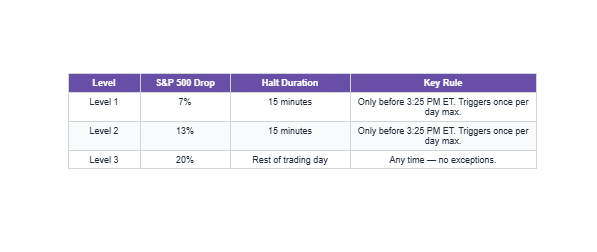
When the S&P 500 Index falls far enough in a single session, all US equity trading stops simultaneously, not just one stock, but every share, ETF, and option in the market. This is the market-wide circuit breaker, first introduced after Black Monday 1987. Understanding it matters especially if you are invested in S&P 500 index funds from Saudi Arabia or holding portfolios through volatile global events.
Three rules that most guides get wrong:
Level 1 and Level 2 each trigger a maximum of once per trading day. If the market falls 7%, resumes, then falls another 7%, the next trigger is Level 2 (13%), not another Level 1.
After 3:25 PM ET, Level 1 and Level 2 do not halt the market, too little time remains for a 15-minute pause to be useful. Level 3 (20%) has no time restriction.
During a 15-minute halt, you can still place, modify, and cancel orders, nothing executes, but the order book remains active.
Under the current rules (active since April 2013), market-wide circuit breakers have triggered four times all in March 2020 during the COVID-19 crash. The Level 3 (20%) trigger has never occurred. For context on how to protect your portfolio during extreme market events, see our guide on protecting investments during geopolitical crises.
What Happens to Your Orders During a Halt
This is the question most investors ask first and the answer determines whether you navigate a halt confidently or make a costly reactive mistake.
Order Types and Halt Behaviour
Market orders will not execute during the halt. They queue and execute at the reopening auction clearing price whatever that turns out to be. No price protection whatsoever. This is the highest-risk order type to have open during a halt.
Limit orders Stay pending and only execute if the post-halt reopening price meets your limit condition. They provide price protection, but may not fill if the market moves away from your level.
Good-Til-Cancelled (GTC) orders Remain active across the halt and into the next trading session.
Good-For-Day (GFD) orders Cancelled at 4:00 PM ET on the day they were placed, regardless of whether a halt is still in effect.
Stop-Loss Orders and Gap Risk
Stop-loss orders do not trigger during a trading halt. This is one of the most misunderstood facts about halts and it can lead to much larger losses than investors planned for.
Here is what actually happens: While the stock is halted, the price does not move, so your stop-loss is not triggered. When trading resumes via the reopening auction, if the auction price is below your stop level, your stop-loss triggers immediately at that auction price, not at your intended stop price.
Example: You own a stock at $50 with a stop-loss at $45. The stock halts at $47. During the halt, major negative news emerges. The stock reopens at $20. Your stop-loss triggers at $20, giving you a $30 loss instead of the $5 you planned for.
This is called gap risk, the stock skips over your stop price in a single move. There is no order type that fully eliminates gap risk in halt scenarios. The best protection is position sizing: never hold a single position so large that a worst-case halt outcome materially damages your overall portfolio.
Our article on risk management beyond stop-losses covers alternative strategies used by experienced traders to control downside without relying solely on stop orders.
The Reopening Auction
When a halt lifts, the stock does not simply resume where it stopped. The exchange runs a structured reopening auction to establish a single fair opening price based on all accumulated buy and sell orders during the halt. Throughout the halt, the exchange publishes an "indicative match price" a live estimate of where the stock would open if the auction ended now. Order imbalances (more buyers than sellers, or vice versa) are also published, allowing participants to submit offsetting orders.
At the auction close, all market orders execute at the clearing price. Limit orders only execute if the price meets their condition. The opening print can be dramatically different from the pre-halt price both to the upside and the downside.
The first 5 minutes after halt resumption are typically the most volatile. Unless you have a specific, deliberate reason to transact immediately, patience is usually the right strategy.
How Halts Affect Options and ETFs
Options During a Stock Halt
When a stock is halted, options market makers withdraw their quotes because they cannot hedge positions by buying or selling the underlying stock. The options chain typically appears empty or shows stale, unexecutable prices. Implied volatility the market's expectation of future uncertainty, spikes dramatically during halt periods as the market prepares for an uncertain reopening price. This elevated premium persists when trading resumes. Our options trading guide for GCC investors explains how implied volatility and halt scenarios interact.
Stop-losses on options positions face even more severe gap risk than stock positions, because options move as a multiple of the underlying stock move. An unexpected reopening price can make an options position worth zero in seconds.
ETFs During a Stock Halt
A halt on one stock within an ETF does not automatically halt the ETF itself. However, three effects occur:
The ETF can receive its own LULD halt if its price moves rapidly due to a major constituent being affected
Bid-ask spreads on the ETF widen significantly while a key holding is halted, because market makers cannot precisely value that component of the portfolio
Market-wide circuit breaker halts stop all ETF trading simultaneously, just like individual stocks
For broad market ETFs like those tracking the S&P 500 or NASDAQ 100, a single-stock halt has minimal practical impact. For halal ETFs concentrated in a few technology stocks, a halt on a major holding like Apple or NVIDIA can temporarily widen spreads meaningfully.
Stock Halts and T+1 Settlement
Since May 28, 2024, US markets operate on T+1 settlement: trades settle one business day after execution. (Before May 2024, the standard was T+2, two business days.) The key principle: a halt pauses new trades but does not delay the settlement of trades already executed.
If your trade executed before the halt: settlement proceeds normally on T+1. A halt starting after your trade is confirmed has no effect on when your cash or shares arrive.
If your order was pending when the halt hit: it executes at the reopening auction when the halt lifts. The T+1 settlement clock starts from that new execution date not from when you originally placed the order.
For GCC investors specifically: USD proceeds from a sale on Monday (US time) arrive in your account on Tuesday (US time). When converting to SAR, factor in this one-day transit window. Weekends and US public holidays are not counted as business days, a Friday sale settles Monday. See our deposits and withdrawals guide for how fund availability works on Raseed.
The Psychology of Trading Halts: Why Investors Make Costly Mistakes
Understanding the mechanics of trading halts is necessary but not sufficient. The investors who make the most costly mistakes during halts are not those who lack information, they are those who succumb to predictable psychological traps.
Trap 1: Panic at the First Sign of a Halt
A halt notification on your trading platform is alarming by nature, your position is frozen and you have lost control of your ability to exit. For new investors in particular, this loss of control triggers fight-or-flight responses: the urge to do something immediately.
The reality is that approximately 80% of all trading halts are T1 or LULD halts that resolve within an hour with no permanent damage to the underlying investment thesis. The first reaction to a halt should be to slow down, not to rush.
Trap 2: Assuming the Worst Without Verification
During a halt, in the absence of confirmed information, investors frequently fill the information vacuum with worst-case scenarios. Social media amplifies this rumours, speculation, and deliberate misinformation spread rapidly during halt periods, often causing investors to enter panic orders that execute at terrible prices the moment the halt lifts.
The antidote is always the same: read the source documents. SEC filings on EDGAR. Company press releases. Exchange halt notices. Not Twitter threads, not Reddit posts, not financial influencer speculation.
Trap 3: Averaging Down Into Confirmed Bad News
One of the most common and dangerous post-halt mistakes is averaging down into a position that has just had confirmed negative news. The psychology is understandable: "The stock was at $50 before the halt and now it is at $22, it must be cheap." But this logic ignores the fundamental question of whether $22 is appropriate given the new information, and whether the situation will improve or continue to deteriorate.
Averaging down should only be considered after thorough fundamental analysis of the new situation, not as a reflexive reaction to a lower price. Stocks that have halted under H10 SEC suspensions, for example, frequently continue to decline for months or years after the suspension lifts, because the underlying issues that triggered the suspension (fraud, misrepresentation, manipulation) require extensive time and resolution to clear.
Trap 4: Extrapolating Short-Term Momentum After Halt Resumption
When a stock resumes trading after a positive news halt and opens sharply higher, FOMO (fear of missing out) drives many investors to buy at the opening, often at the highest price of the day. Research on post-halt price behaviour consistently shows that the opening minutes after a halt tend to overshoot in both directions: stocks that open sharply higher frequently give back significant portions of those gains within the first hour, while stocks that open sharply lower frequently stabilise within the first 30 minutes.
Patient investors who wait for the initial frenzy to settle, who buy on confirmed strength rather than opening momentum, or who sell into opening strength rather than chasing it, consistently outperform reactive traders in post-halt environments.
What to Do If a Stock You Own Gets Halted: 7 Steps
Having a plan before a halt happens is what separates investors who navigate them calmly from those who make costly reactive decisions.
Step 1 — Confirm the halt and identify the code. Go directly to nasdaqtrader.com/tradehalts or nyse.com/trade-halt. The code tells you everything: T1 = news coming (stay calm), LULD = 5-minute volatility pause (usually resolves quickly), T12 = unexplained move (high alert), H10 = SEC suspension (very serious).
Step 2 — Find the actual news. For T1 halts, the announcement is published on the company's investor relations page, filed as an 8-K with the SEC on EDGAR (sec.gov), or broadcast through financial news services. Read the source document, not social media speculation.
Step 3 — Assess your total exposure. What percentage of your total portfolio does this position represent? If it is more than 10%, a worst-case halt outcome can be genuinely damaging. Honest position sizing assessment belongs here, not after the market reopens.
Step 4 — Make a plan before trading resumes. Options: hold and observe the opening price before deciding; place a limit sell order at an acceptable exit price; or add to the position if positive news justifies it. The worst outcome is having no plan and reacting emotionally in the first seconds of resumed trading.
Step 5 — Use limit orders, not market orders, at the reopen. A market order at reopening executes at whatever the auction clearing price is with zero price protection. A limit order gives you control, even if it means you may not fill immediately.
Step 6 — Monitor the indicative match price. During the halt's final minutes, exchanges publish the live indicative auction price. Watch it, if it is far from your limit, you can still modify your order before the auction closes.
Step 7 — Exercise patience after the reopening. The first 5 minutes after a halt lifts are the most volatile. Let the market establish a level before making decisions. Buying or selling into the immediate opening frenzy rarely produces the best outcomes.
What GCC and Saudi Investors Need to Know About Stock Halts
US Market Hours in Your Time Zone
Saudi Arabia (AST, UTC+3): US markets run approximately 4:30 PM – 11:00 PM in summer (US daylight saving, March–November) and 5:30 PM – midnight in winter
UAE (GST, UTC+4): approximately 5:30 PM – midnight in summer and 6:30 PM – 1:00 AM in winter
Halts can occur at any point in this window, including late at night KSA time. If you hold volatile US stock positions, check them before sleeping
Major earnings releases often happen at US market open (4:30–5:30 PM your time), the most frequent window for opening delays and T1 halts
Halal Stock Investors and Halt Exposure
Shariah-compliant stocks are subject to the same halt rules as any other US-listed security. Most halal-screened portfolios are heavily concentrated in large-cap technology companies, Apple, NVIDIA, Microsoft, Broadcom, which appear in most AAOIFI-screened universes. A halt on a major technology stock during earnings season directly affects these portfolios. Diversifying within Shariah-compliant constraints is an important risk management step. See our guides on best halal stocks for 2026 and best halal ETFs for Saudi investors.
Where to Monitor Live Halts From the GCC
NASDAQ: nasdaqtrader.com/tradehalts, updates in real time, shows halt code and timestamp
NYSE: nyse.com/trade-halt, equivalent for NYSE-listed stocks
Both are free, publicly accessible worldwide with no login required
Key Takeaways: Everything You Need to Remember About Stock Halts
A stock halt is a legally enforced temporary pause in all trading for a security not a broker error, not a collapse signal, not something your broker controls
Halts are triggered by the exchange (news, volatility) or the SEC (fraud, regulatory concerns) and apply simultaneously across every US venue
T1 = news coming (normal), T12 = unexplained move (high risk), H10 = SEC suspension (most serious). The code tells you everything about what to expect
LULD creates dynamic price bands and triggers automatic 5-minute pauses when a stock breaches them, the most common halt type in modern markets
Market-wide circuit breakers trigger at 7%, 13%, and 20% S&P 500 declines halting all markets simultaneously for 15 minutes (Level 1 & 2) or the rest of the day (Level 3)
Stop-loss orders do not trigger during halts and are subject to gap risk at reopening, position sizing, not stop-losses, is your real protection in halt scenarios
Use limit orders around halts, not market orders. A reopening auction clearing price can be 40–70% away from the pre-halt price
T+1 settlement means already-executed trades settle normally regardless of a subsequent halt. A halt only affects pending orders
GCC investors: US markets run from approximately 4:30 PM to midnight. Monitor nasdaqtrader.com/tradehalts for live halt data
Continue Learning on Raseed
What Is Implied Volatility? | Risk Management Beyond Stop-Losses | Market Volatility Explained
TASI vs US Stocks: Where Should Saudi Investors Invest? | Diversify Your Portfolio: 5 Steps | Options Trading — Common Mistakes to Avoid | Raseed Learn Library
Raseed Invest Limited is regulated by the DFSA (Dubai) and FSA Seychelles (Licence No. SD152 via Fullerverse SC Limited). This article is for educational purposes only and does not constitute financial or investment advice. All trading involves risk. Regulatory information is current as of April 2026. Verify rules at sec.gov, finra.org, nasdaqtrader.com, and nyse.com.