For investors looking to build wealth while managing risk, diversification is one of the most important principles in investing. While stocks often receive the most attention because of their growth potential, many experienced investors also allocate part of their portfolio to income-generating investments that can provide stability during periods of market volatility.
For Muslim investors in Saudi Arabia and across the GCC, this often leads to an important question:
What is the difference between sukuk and conventional bonds, and which one is better suited for a Shariah-compliant investment portfolio?
Although sukuk are often referred to as "Islamic bonds," they differ significantly from conventional bonds in their structure, ownership model, and method of generating returns.
Today, Saudi Arabia is one of the world's largest sukuk markets, with sovereign and corporate issuances playing a major role in financing infrastructure projects, economic development, and Vision 2030 initiatives. As demand for Shariah-compliant investments continues to grow, understanding sukuk has become increasingly important for both new and experienced investors.
In this guide, you'll learn:
What sukuk are and how they work
The key differences between sukuk and conventional bonds
The most common types of sukuk
Benefits and risks of sukuk investing
How Saudi investors can access sukuk investments
When sukuk may be appropriate within a diversified portfolio
Whether you're exploring Islamic fixed-income investments, comparing sukuk versus bonds, or building a long-term investment strategy, this guide will help you make more informed decisions.
What Are Sukuk?
Sukuk are Shariah-compliant financial certificates that represent a proportional ownership interest in an underlying asset, project, business venture, or investment activity.
Unlike conventional bonds, which create a debt obligation where investors lend money and receive interest payments, sukuk are structured around asset ownership and profit-sharing principles that comply with Islamic finance requirements.
In simple terms:
Bond investors are lenders.
Sukuk investors are owners or beneficial owners of underlying assets.
The returns generated by sukuk come from legitimate economic activities such as:
Rental income
Asset leasing
Business profits
Infrastructure projects
Trade financing
Revenue-generating assets
Because returns are linked to real economic activity rather than interest payments, sukuk are widely accepted as a Shariah-compliant alternative to conventional fixed-income investments.
Today, sukuk are issued by:
Governments
Banks
Corporations
Sovereign wealth funds
Infrastructure projects
Multilateral development institutions
Saudi Arabia, Malaysia, Indonesia, and the UAE remain among the most active sukuk markets globally.
Why Sukuk Exist in Islamic Finance
To understand the importance of sukuk, it is helpful to first understand why conventional bonds create challenges under Islamic finance principles.
Traditional bonds operate through lending and borrowing. Investors provide capital to an issuer and receive predetermined interest payments over time. This interest component is considered riba, which is prohibited under Islamic law.
Islamic finance instead emphasizes:
Asset-backed transactions
Risk sharing
Profit-and-loss participation
Real economic activity
Ethical investing
Sukuk were developed to allow governments and businesses to raise capital while adhering to these principles. Rather than earning interest on a loan, investors earn returns generated by assets or commercial activities that create genuine economic value. This distinction is one of the primary reasons many Saudi investors choose sukuk when seeking income-generating investments.
Sukuk vs Bonds: The Key Differences
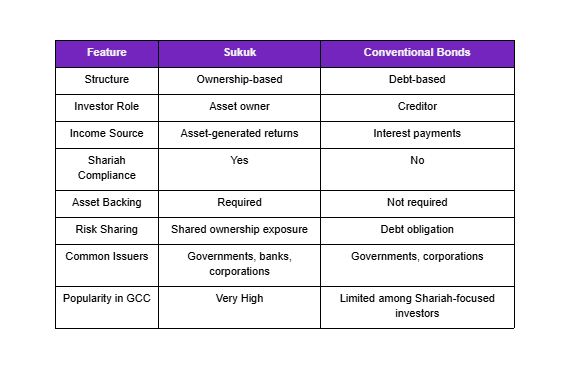
Although both investments may provide regular distributions and capital preservation benefits, the underlying legal and financial structures are fundamentally different.
How Sukuk Work: A Simple Example
Imagine a government wants to raise SAR 1 billion to develop transportation infrastructure. Instead of issuing a conventional bond and paying interest, a sukuk structure may work as follows:
A special-purpose vehicle (SPV) is created.
The SPV acquires rights to the infrastructure asset.
Investors purchase sukuk certificates.
The infrastructure project generates income.
Income is distributed to sukuk holders.
At maturity, the asset is repurchased and proceeds are returned to investors.
The investor's return comes from the economic activity generated by the underlying asset rather than interest payments. This asset-backed structure forms the foundation of most sukuk issuances.
The Four Most Common Types of Sukuk
Sukuk Ijara
Ijara is the most widely used sukuk structure globally. It is based on leasing. Investors own an asset that is leased to a government or company, generating rental income distributed to sukuk holders.
Common examples include:
Airports
Hospitals
Government buildings
Infrastructure projects
Sukuk Murabaha
Murabaha is based on trade financing.
An asset is purchased and resold at an agreed profit margin.
Returns come from trade profits rather than interest.
Sukuk Musharakah
Musharakah represents a partnership arrangement.
Investors participate in the profits generated by a business venture.
Returns vary based on actual performance.
Sukuk Mudarabah
Mudarabah involves an investment partnership where one party provides capital while another manages operations.
Profits are shared according to agreed ratios.
Returns depend on the performance of the underlying investment.
Why Saudi Investors Consider Sukuk
For many Saudi investors, sukuk provide several advantages:
Shariah Compliance
Sukuk are structured to comply with Islamic finance principles and are often reviewed by dedicated Shariah supervisory boards.
Portfolio Diversification
Markets do not always move in the same direction.
Holding sukuk alongside stocks can help reduce overall portfolio volatility.
→ Related Reading: Diversifying Your Investment Portfolio
Income Generation
Many sukuk provide periodic distributions that can appeal to investors seeking regular cash flow.
Lower Volatility Than Stocks
While sukuk are not risk-free, they typically experience less price volatility than equities.
This can be particularly attractive during periods of market uncertainty.
Exposure to Saudi Economic Growth
Many Saudi sukuk issuances support major national projects linked to Vision 2030, infrastructure development, transportation, healthcare, and economic diversification initiatives.
Interested in building a Shariah-compliant portfolio that goes beyond sukuk? Raseed gives Saudi investors access to halal-screened stocks, ETFs, and global markets — all from one regulated platform. Explore halal investing on Raseed →
Risks of Investing in Sukuk
Despite their benefits, sukuk carry investment risks that investors should understand.
Credit Risk
If the issuer experiences financial difficulties, distributions may be affected.
Market Risk
Sukuk prices can fluctuate based on:
Economic conditions
Interest rate expectations
Credit quality
Market sentiment
Liquidity Risk
Some sukuk trade less actively than major stocks, making them less liquid.
Structure Risk
Different sukuk structures carry different risk profiles.
Investors should understand how returns are generated before investing.
Shariah compliance does not eliminate investment risk.
It simply changes how the investment is structured.
Sukuk vs Stocks: Which Is Better?
This is one of the most common questions among Saudi investors.
The answer depends on your goals.
Sukuk May Be Better If You:
Prioritize capital preservation
Want lower volatility
Need regular income
Prefer a conservative investment approach
Stocks May Be Better If You:
Seek long-term capital growth
Have a higher risk tolerance
Can withstand market volatility
Have a long investment horizon
Many experienced investors combine both asset classes. Stocks provide growth potential. Sukuk provide stability and income. Together, they can help create a more balanced portfolio.
→ Related Reading: TASI vs US Stocks for Saudi Investors
Not sure where to start — stocks, ETFs, or Shariah-compliant funds? On Raseed, you can invest in all of them from a single account. No minimum balance. No hidden fees. Just smart investing built for Saudi and GCC investors. Open your free account now →
How to Invest in Sukuk in Saudi Arabia
Saudi investors have several ways to access sukuk investments.
1. Saudi Government Sukuk
The Saudi government regularly issues sukuk through approved channels. These issuances are among the most widely followed fixed-income investments in the Kingdom.
2. Corporate Sukuk
Major Saudi corporations and financial institutions issue sukuk to raise capital. Examples include issuances from banks, infrastructure companies, and large corporates.
3. Sukuk Funds
Investment funds provide diversified exposure to multiple sukuk securities. This can reduce concentration risk.
4. Global Sukuk ETFs
Certain ETFs provide access to diversified portfolios of international sukuk. These can help investors gain exposure beyond local markets. Through Raseed, investors can access global investment opportunities while building diversified portfolios aligned with their financial goals.
Common Mistakes New Sukuk Investors Make
Assuming Sukuk Are Risk-Free
No investment is completely risk-free. Sukuk carry market and credit risks just like other financial instruments.
Focusing Only on Yield
Higher yields often indicate higher risk. Always evaluate the issuer and underlying structure.
Ignoring Diversification
Concentrating all investments in one asset class increases risk. Diversification remains essential.
Not Understanding the Structure
Different sukuk structures generate returns differently. Always understand how the investment works before investing.
Frequently Asked Questions
Are sukuk halal?
Generally, sukuk approved by recognized Shariah supervisory boards are considered Shariah-compliant because they avoid interest-based structures and are linked to real economic activity.
Can Saudi investors buy sukuk directly?
Yes. Saudi investors can access government sukuk, corporate sukuk, sukuk funds, and certain international sukuk investments through licensed investment platforms and brokers.
Do sukuk guarantee returns?
No. While some sukuk structures may provide relatively predictable income, returns are not guaranteed and depend on the underlying asset and issuer.
Are sukuk safer than stocks?
Sukuk generally experience lower volatility than equities, but they still carry risks. Whether they are suitable depends on an investor's objectives and risk tolerance.
Should sukuk be part of a diversified portfolio?
For many investors, sukuk can play an important role in diversification by providing stability and income alongside growth-focused investments such as stocks and ETFs.
Build a More Balanced Investment Portfolio
Successful investing is not simply about maximizing returns. It is about balancing growth, income, and risk in a way that supports your long-term financial goals.
For investors seeking Shariah-compliant investment opportunities, sukuk can provide an effective way to diversify beyond stocks while maintaining exposure to income-generating assets.
Whether you're investing in Saudi stocks, global equities, ETFs, or sukuk, understanding how each asset class works can help you make more informed decisions and build a stronger portfolio over time.
Ready to start investing?
Open your Raseed account today and access global markets, ETFs, stocks, and investment tools designed for investors across Saudi Arabia and the GCC.
Thousands of Saudi and GCC investors are already building Shariah-compliant portfolios on Raseed. Halal-screened stocks, global ETFs, US markets, and more — all in one place, starting from just $1. Don't wait to start building yours. Create your free Raseed account in minutes →
Related Articles on Raseed Learn
Best Halal ETFs for Saudi Investors 2026 | Is Crypto Halal? What GCC Investors Need to Know
5 Steps to Diversify Your Portfolio | Understanding Risk in Stock Trading