


A Complete Guide for Saudi and GCC Investors
Quick Answer: What Is a Stock Split and How Does It Affect You?
A stock split divides existing shares into more shares (forward split) or combines shares into fewer shares (reverse split), your total investment value does not change
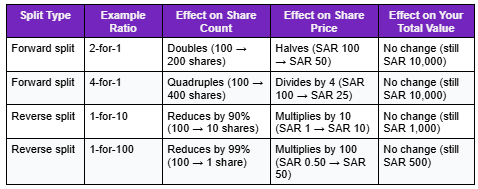
A 2-for-1 forward split doubles your share count but halves the price per share, the total value of your holding stays the same immediately after the split
A 1-for-10 reverse split reduces your share count by 90% but multiplies the price by 10, companies use reverse splits to raise their share price and maintain Nasdaq or exchange listing requirements
In 2026, several stocks that appeared among Raseed’s most traded names, including WOK, PAVS, and CIIT, underwent reverse splits during different periods of the year, these events often trigger temporary trading volume spikes as investors react to price changes
Stock splits do not change the fundamental value of a business, only the packaging of its shares
A stock split is a corporate action that changes the number of shares outstanding without changing the total market value of the company.
If a company has 1 million shares worth SAR 100 each, its market cap is SAR 100 million. A 2-for-1 forward split gives every shareholder 2 shares for every 1 they owned, and adjusts the price to SAR 50 per share. The company still has a market cap of SAR 100 million. The investor who owned 100 shares worth SAR 10,000 now owns 200 shares worth SAR 50 each, still SAR 10,000. Nothing fundamental has changed. But splits matter because they affect accessibility, trading volume, and in the case of reverse splits, listing compliance, all of which affect real-world trading behavior.
Forward Splits: How They Work and Why Companies Do Them
Companies execute forward stock splits when their share price has risen so high that it becomes less accessible to retail investors.
Apple's famous 4-for-1 split in August 2020 divided each share (then trading around $500) into four shares at approximately $125. Shareholders received no additional value but the lower price made the stock more accessible for small investors and improved daily trading liquidity. Amazon executed a 20-for-1 split in June 2022 for the same reason, dropping its share price from over $2,400 to approximately $125.
On TASI, forward splits are less common than in US markets because Saudi Exchange shares are typically already priced in a range accessible to retail investors. However, high-growth companies whose share prices have risen substantially will sometimes split to maintain broad investor accessibility.
Invest in fundamentally sound companies on Raseed — US stocks and Saudi stocks from $1, no speculation required. → Start investing with confidence on Raseed →
Reverse Splits: What They Signal and Why They Trigger Trading Activity
Reverse splits are almost always a sign of a struggling company trying to maintain its stock exchange listing, not a positive development.
Exchanges like Nasdaq require listed stocks to maintain a minimum share price, typically $1 for continued listing. When a company's share price falls below this threshold for 30 consecutive business days, Nasdaq issues a deficiency notice. To regain compliance, the company executes a reverse split: combining multiple shares into one to raise the per-share price mechanically, without changing the underlying business.
In 2026, three of the most heavily traded stocks on Raseed, WOK (1-for-100 reverse split effective June 18), PAVS (1-for-100), and CIIT (1-for-7) — all underwent reverse splits around the same period. This is why they appeared in Raseed's top 10 most traded stocks list: the corporate actions triggered significant short-term trading volume as investors reacted to the price changes. HUBC (Hub Cyber Security) received a Nasdaq deficiency notice in May 2026 related to a delayed Form 20-F filing and completed a 1-for-20 reverse split effective June 8, 2026.
Important for GCC investors: When a stock undergoes a reverse split to maintain listing compliance, it is almost always a sign of business distress, not a reason to buy. High trading volumes around reverse splits reflect speculative activity and temporary price movements — not fundamental investment value. These stocks carry significantly higher risk than stable large-caps.
For investors who want to understand how to evaluate a company's financial health before investing, including how to spot companies at risk of delisting see our fundamental analysis guide for GCC investors.
Does a Stock Split Affect Your Investment Strategy?
For long-term investors, stock splits are administrative events — they require no action and do not change your investment thesis.
If you own shares in a company that announces a forward split, your brokerage will automatically adjust your share count and price on the effective date. Your investment value, cost basis (adjusted proportionally), and your ownership percentage in the company are unchanged. A stock split is generally not treated as a taxable event by itself, but tax treatment can vary by jurisdiction, account type, and how fractional shares are handled.
For reverse splits, the same mechanical process applies, your shares are combined automatically. However, the question to ask is not "what do I do about the split?" but "why is this company doing a reverse split?" If the answer is Nasdaq listing compliance after a sustained price decline, that is important investment information about the company's business trajectory.
Frequently Asked Questions
Q: Do stock splits make shares more valuable?
No. A stock split does not create or destroy value. The total market capitalisation of the company is unchanged immediately after a split. However, forward splits can improve long-term trading liquidity and accessibility, which can support price over time, but this is a secondary effect, not an immediate value creation.
Q: What happens to fractional shares in a stock split?
In a forward split, fractional shares are multiplied proportionally, your 0.5 shares become 1 share in a 2-for-1 split. In a reverse split, fractional shares that result from the consolidation are typically converted to cash at the current market price. On Raseed, fractional share positions are handled automatically according to the corporate action terms.
Q: Can I still buy a stock after it has split?
Yes. You can buy a stock before or after any type of split. The split does not affect the ability to trade, invest, or hold the stock going forward.
Q: Why do so many small-cap stocks on Nasdaq do reverse splits?
Small-cap and micro-cap companies often have highly volatile share prices. When a company's business struggles or market sentiment turns negative, its share price can fall below $1 — triggering Nasdaq's minimum bid price rule. Reverse splits are the fastest mechanism to regain compliance without needing to improve the underlying business. This is why reverse splits are heavily concentrated in micro-cap names.
Related Articles on Raseed Learn
How to Research GCC Stocks: Fundamental Analysis Guide
Understanding Risk in Stock Trading
The Most Common Investing Mistakes GCC Beginners Make
5 Steps to Diversify Your Portfolio
This article is for educational and informational purposes only and does not constitute investment advice. All investing involves risk, including the potential loss of principal. Data sourced from publicly available primary sources as of June 2026. Past performance does not guarantee future results. Securities brokerage services are provided by Fullerverse (SC) Limited, licensed and regulated by the Financial Services Authority Seychelles (Licence No. SD152), a wholly-owned subsidiary of Raseed Invest Inc. Raseed Invest Limited is regulated by the DFSA. Capital is at risk.