


What Is Bitcoin? A Brief Foundation
Bitcoin is a decentralised cryptocurrency established in 2009 by an unknown person or company with the pen name Satoshi Nakamoto. It operates through blockchain technology ; Blockchain creates a public distributed Digital Ledger that stores all Bitcoin transactions on every computer in the worldwide network at the same time so no one person, organisation or government controls Bitcoin.
The core value behind Bitcoin is based on three key factors, including a capped total supply of 21 million coins (therefore creating deflation), decentralisation and being popularly acknowledged as a digital gold. The approximate total market capitalisation of Bitcoin as of March 2026 is $1.8 trillion, which exceeds all but a small number of companies and any country's total currency value.
What Is Bitcoin Halving? The Precise Mechanism
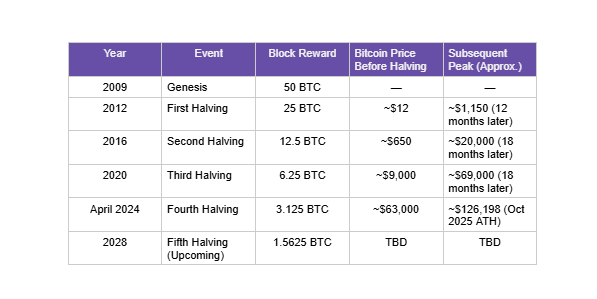
Bitcoin halving happens every four years (around 210,000 blocks) when the reward given to miners decreases by half. This occurs automatically based on Bitcoin's source code - it is not determined by governments, businesses, or people. Halving is part of how Bitcoin's software functions; it is programmed to happen and will not change.
Bitcoin Miners utilize their computers to approve and confirm new transactions. When they do this (and add them to the blockchain), they are rewarded with newly created Bitcoin through what is known as a block reward. Halving (the process of reducing the block reward by half) limits the number of new Bitcoins issued at any one time, therefore cutting down forever on the speed at which new Bitcoins are mined.
Bitcoin's Complete Halving History
Related: Is Crypto Halal? What GCC Investors Need to Know
Why Halving Has Historically Affected Bitcoin's Price
The economic logic is straightforward supply-demand dynamics. Each halving cuts the new daily supply of Bitcoin by half. If demand remains constant or increases while new supply is reduced, basic economic theory predicts upward price pressure. For the first three halvings, this supply shock mechanism worked with remarkable historical consistency, each preceded a significant bull market 12-18 months later.
The April 2024 halving reduced daily new supply from approximately 900 BTC to 450 BTC, worth roughly $40 million per day at $90,000 per BTC. This supply reduction is historically significant but is now dwarfed by institutional capital flows through Bitcoin ETFs.
How the 2024 Halving Is Different: The Institutional Revolution
The 2024 halving occurred in a fundamentally different market environment than all previous halvings, one now dominated by institutional adoption. The January 2024 launch of US spot Bitcoin ETFs, led by BlackRock's IBIT fund, which accumulated over $50 billion in assets within its first year, transformed Bitcoin's demand dynamics permanently.
By 2025, Bitcoin spot ETFs were regularly recording daily inflows exceeding $500 million, more than 12 times the daily mining supply that the 2024 halving reduced. On April 6, 2026, US spot Bitcoin ETFs recorded approximately $471 million in net inflows in a single day, led by BlackRock's IBIT at $181.9 million and Fidelity's FBTC at $147.3 million. Analysis from Amberdata's 2026 market research is precise: the marginal price driver for Bitcoin is no longer the trickle of new mining supply but the institutional capital flows through ETF vehicles. When ETFs are buying, prices rise regardless of mining output.
The alteration of structure gives an explanation for the different behaviour of the post-halving cycle of 2024 as compared to previous ones. Bitcoin reached its high price of 126198 dollars in October, 2025, earlier than the historical 12-18 month lagged prediction for halving and then fell approximately by 46% from that high by early 2026. Structural evolution is at work and changing the original four year halving cycle price prediction method, proving that bitcoin's maturation is changing its structure as a reliable price forecasting method.
Bitcoin in 2026: From Speculation to Strategic Asset
After the halving in early 2024, Bitcoin has rapidly moved from being a speculation-based asset to a key component of many institutional portfolios. By 2025, Bitcoin had become so uncorrelated from its previous price behaviour that its volatility was less than 33 of the individual stocks included in the S&P 500. As of 2026, more than 681,000 BTC is held by institutional investors (companies, ETFs or other funds). At least 172 publicly traded companies were holding BTC on their balance sheets at the end of 2025 - a nearly 40% growth rate from the prior quarter; much of this growth in BTC holdings (and institutional participation) can be attributed to the Trump administration's push towards regulatory clarity in 2025.
What the 2024 Halving Means for GCC Investors
The Gulf Cooperation Council has the sixth-largest crypto economy globally, with approximately $390 billion in on-chain transaction value received in a recent 12-month analysis period. Saudi Arabia's crypto adoption is growing rapidly — particularly among young investors aged 18-35. The UAE's comprehensive VARA and ADGM regulatory frameworks have established the Gulf as a global hub for regulated digital asset activity.
For Saudi investors who hold Bitcoin or are considering it: the 2024 halving's reduced supply creates a long-term structural tailwind. The institutional adoption driven by ETF inflows creates new demand that previous retail-dominated cycles did not have. However, Bitcoin's correction from its $126,198 October 2025 ATH to approximately $55,000-70,000 in early 2026 — approximately 46% from peak — illustrates that volatility remains a fundamental characteristic of this asset class.
Related: Crypto Trading vs Crypto Investing: What's the Difference for GCC Investors?
Is Bitcoin Halving a Reliable Investment Signal in 2026?
The answer is more nuanced than in previous cycles. The historical pattern, buy before halving, sell 12-18 months post-peak, produced extraordinary returns for early Bitcoin adopters. The 2020 halving followed this pattern almost perfectly. The 2024 halving has challenged this framework: Bitcoin's all-time high arrived earlier than historical timing would predict, and the subsequent correction was sharper.
Analysts across Amberdata, FXEmpire, and Caleb & Brown have published 2026 analyses suggesting the four-year cycle has mutated — becoming more correlated with global liquidity conditions and Federal Reserve monetary policy than with mining supply dynamics. Bitcoin should be evaluated as a portfolio asset, a high-risk, asymmetric-return component — rather than a mechanical trade timing signal.
How to Approach Bitcoin in a Saudi Portfolio
Most professional financial planners who include cryptocurrency in diversified portfolios recommend limiting Bitcoin and total crypto exposure to 5-10% of total portfolio value. This is large enough to provide meaningful upside participation in bull markets while limiting total portfolio impact if Bitcoin experiences a severe drawdown.
Never invest more than you could afford to lose entirely — Bitcoin's asymmetric return profile comes with genuine risk of very large losses.
Dollar-cost average into Bitcoin rather than lump sum investing — given extreme volatility, regular periodic purchases reduce the risk of buying at local peaks.
Use regulated, secure platforms — FTX's 2022 collapse resulting in billions in client fund losses demonstrated conclusively that platform risk is real and serious.
The core portfolio remains equities — for Saudi investors, Shariah-compliant US stocks and index funds through Raseed form the primary wealth-building vehicle. Bitcoin is a supplemental, higher-risk component.
Cryptocurrency trading involves significant risk, including the potential loss of all invested capital. Crypto markets are highly volatile. The regulatory status of cryptocurrency varies by jurisdiction and is evolving. GCC investors should verify applicable rules in their country of residence before investing. Securities brokerage services are provided by Fullerverse (SC) Limited, licensed and regulated by the Financial Services Authority Seychelles (Licence No. SD152), a wholly-owned subsidiary of Raseed Invest Inc. All investing involves risk. Past performance does not guarantee future results. Capital is at risk.