

There is a significant difference between how a first-time investor chooses a safe stock trading app In Saudi Arabia and how an experienced one does. The beginner evaluates the surface, the interface design, the brand name, the 'zero fees' headline. The professional goes deeper. They evaluate execution quality, data infrastructure, the full cost architecture, the regulatory framework, and how the platform behaves during market stress, before they deposit a single riyal.
This guide explains that professional framework. It is not about finding the 'best' platform in an abstract sense. It is about understanding what rigorous, systematic platform evaluation actually looks like and why applying it matters for any investor who takes their capital seriously.
Raseed: real-time Level 2 data, $3 fee cap, SFSA-regulated. Open your account in 2 minutes.
Related Article - Why US Stock Trading Is Gaining Popularity Among Investors in Saudi Arabia
Why Experienced Investors Evaluate Platforms Differently
A professional investor understands something that takes beginners time to learn: the platform is not neutral. Every element of how a platform works, its data quality, its fee structure, its order execution speed, its available order types directly influences the outcomes of every trade. A platform that shows you data 15 minutes delayed does not give you information; it gives you history. A platform that charges a percentage fee without a cap makes your costs grow with every trade. A platform that limits you to market orders removes your most basic tool for managing risk.
The cumulative effect of these differences across months and years of investing is substantial. Experienced investors evaluate platforms not just for access but for structural advantage.
Related Article - Lowest Trading Fees in Saudi Arabia: A Full Platform Comparison 2026
Professional Check 1: Regulatory Accountability — The Foundation of Trust
The first thing a professional investor verifies is not the fee structure or the interface. It is the regulatory status. Regulation is the legal and operational foundation on which every other platform feature either has meaning or does not.
What professionals verify: The regulating body, specific license type (and whether it is applicable to retail investors specifically), the duration of validity of the license and whether there have been any regulatory actions taken. Their approach involves examining the public list of the appropriate authority, rather than checking the platform's own 'About' page to ensure the licence is active and current.
Why this level of scrutiny? Because the regulatory licence determines what an investor can do when things go wrong. A platform regulated by a Tier-1 authority (DFSA, FCA, SEC) is subject to regular audits, client fund segregation requirements, mandatory transparency standards, and enforceable investor protection mechanisms. A platform regulated by a weaker offshore authority may offer none of those things in practice.
Professionals also distinguish between a platform that is merely 'registered' in a jurisdiction and one that is actively 'regulated' under financial services law. These are not the same thing, and the difference is significant.
Related Article - Is Raseed Safe? A Full Review of Regulation, Security and Fund Protection
Professional Check 2: Execution Quality — The Factor No Beginner Asks About
Experienced investors know that the price shown on screen at the moment they click 'buy' is not necessarily the price at which their trade executes. The gap between the two known as slippage, is the invisible cost of poor execution. On platforms with slow or poorly optimised execution infrastructure, slippage compounds into a meaningful drag on returns, particularly for active traders.
What professionals look for in execution quality:
Fill rates: What percentage of limit orders get filled at the requested price? A platform with low fill rates on limit orders forces investors either to use market orders (accepting slippage) or to miss trades entirely.
Order routing transparency: Where does the platform route orders? Is it routing to the best available price (best execution) or to its own internal books or payment-for-order-flow arrangements? Professionals want to know their orders are competing in genuine market conditions.
Execution speed: In fast-moving markets, the difference between a trade executing in 50 milliseconds and 500 milliseconds can be the difference between the intended price and a significantly different one.
For Saudi investors trading US markets, where the regular session runs from 4:30 PM to 11:00 PM Saudi Arabia Standard Time, execution quality during peak market hours matters most. Earnings releases and major economic data frequently move stocks 5% or more in the first seconds after publication. On a platform with slow execution, those seconds cost money.
Related Article - Saudi Stock Market Climbs Amid Global Trends: Insights for Today's Traders
Professional Check 3: Data Infrastructure — The Analytical Edge
Professional investors do not make decisions on incomplete information. They require a specific data infrastructure that many retail platforms do not provide — and when they do, often only behind additional paywalls.
The data stack professionals require:
Real-time quotes (not delayed): Fifteen-minute delayed data is appropriate for general research but inadequate for active decision-making. Any platform without live, real-time quotes forces investors to trade on outdated information.
Level 2 market depth (order book): The order book, which is the second level of market depth data, provides the most comprehensive information for any given stock. Every pending bid and ask is presented at every price level, including the size of each order. A professional can immediately assess the order book to determine whether there is genuine buying pressure below the current price, whether a significant sell wall will limit upside, and whether the stock has genuine liquidity or if there's lenticular liquidity that will move strongly on their own order. The cost of this data is between $10 and $30 per month for many platforms. The cost, which is free and funded by Raseed, can provide a material benefit, especially for active investors.
Advanced charting with technical indicators: Moving averages, RSI, MACD, Bollinger Bands, volume analysis, support and resistance visualisation — these are not optional extras for a professional. They are the vocabulary of technical analysis that translates raw price data into actionable information.
Integrated news and earnings calendars: Real-time news linked to positions held, upcoming earnings dates highlighted in the portfolio view, and economic calendar integration reduce the friction between information and decision.
Related Article - Free Level 2 Market Data: Why It Matters and Which Platforms Offer It in GCC
Professional Check 4: Full Fee Architecture — Every Cost, Not Just the Headline
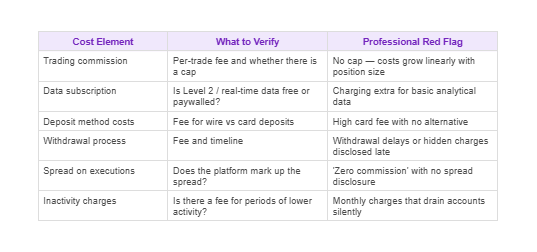
When an experienced investor calculates the true cost of a platform, they do not stop at the trading commission. They construct the full fee architecture, every cost that will be incurred across the entire lifecycle of their investment activity.
The complete cost calculation includes trading commissions (with caps verified), deposit fees by method, withdrawal fees by method, the cost of any data subscriptions, currency conversion charges if applicable, and any subscription fees for premium features. They calculate what a year of typical activity, a defined number of trades, deposits, and withdrawals at typical sizes, actually costs on the platform. They do the same calculation for competing platforms and compare the totals, not the headlines.
Professionals are particularly alert to spread markups. A platform advertising 'zero commission' that builds its revenue into a spread markup between the buy and sell price is not free to use, it is charging you differently. The total cost comparison must account for this structure.
Related Article - Hidden Fees in Stock Trading Apps: What Saudi Investors Need to Watch Out For
Professional Check 5: Order Type Flexibility — The Mechanics of Risk Control
The ability to control how and when a trade executes is fundamental to risk management. A platform that only offers market orders which execute at whatever the current price happens to be removes the investor's ability to set price limits, manage downside risk systematically, or automate position management.
Order types professionals expect as a minimum:
Limit orders: Execute only at a specified price or better. The most basic tool for controlling the price at which you enter or exit a position.
Stop-loss orders: Automatically close a position when it falls to a specified price, limiting downside without requiring constant monitoring.
Stop-limit orders: Combine a stop trigger with a limit execution price, preventing fills at unexpectedly bad prices during fast market moves.
Good-till-cancelled (GTC) orders: Remain active across multiple trading sessions, allowing investors to set a target entry price without needing to resubmit the order each day.
The availability of these order types also directly impacts how investors interact with extended hours trading which in Saudi Arabia time covers the most consequential market-moving events, including earnings releases that happen after the regular US session closes.
Professional Check 6: Asset Class Coverage — Future-Proofing Your Platform Choice
Experienced investors do not evaluate a platform only for what they plan to trade today. They evaluate it for what they may need to access in 12 or 36 months. Choosing a platform that can grow with your investing sophistication is more valuable than choosing one that perfectly serves only your current needs.
The asset class progression for most serious Saudi investors moves from stocks and ETFs to include options (for income generation and hedging), then potentially crypto (for diversification and exposure to new asset classes). A platform that starts you on stocks but requires you to open a separate account with separate onboarding, funding, and fee structures, for each additional asset class creates operational friction and duplicated costs.
The professional standard: a single account that covers US and Saudi stocks, ETFs, options, and crypto, with a consistent fee structure and unified portfolio view across all positions. This is what makes portfolio-level risk management actually manageable.
Professional Check 7: Platform Stress Testing — What Happens When the Market Moves?
Experienced investors know that the worst time to discover a platform has reliability problems is during a fast-moving market. If a platform's servers become overloaded during high-volume events, a major earnings release, a Federal Reserve decision, a geopolitical development that moves markets, the result is failed logins, delayed data, and trade execution errors at exactly the moments when precision matters most.
Before committing significant capital, professionals look for evidence of platform reliability during stress events. They read published reviews from other investors specifically about how the platform performed during volatile market periods, check whether the platform publishes historical uptime data, and evaluate whether the support infrastructure includes 24/7 availability during US market hours (which extend into Saudi evening and overnight time).
Professional Check 8: Educational Resources — Respecting the Learning Curve
Professional investors never stop learning. They respect platforms that support continuous education not because they need it personally, but because it signals how the platform thinks about its users. A platform that invests in structured, genuinely useful educational content, not marketing material disguised as education, but real explanations of how options work, how to read an order book, what a limit order does, how dividends are processed, is a platform that is building for long-term user success rather than short-term account opens.
For Saudi investors who are themselves still building expertise, the quality of educational resources is doubly important. The difference between a platform with a comprehensive, well-organised learning library and one with a basic FAQ is the difference between an environment that makes you more capable over time and one that leaves you to figure everything out independently.
Every professional framework for evaluating trading platforms comes down to one principle: does this platform serve my interests as an investor, or does it simply give me access to a market while optimising for its own revenue at my expense? The difference is visible in every criterion described above — if you know where to look.
The Professional Platform Evaluation Checklist
Regulatory licence verified directly on the regulator's public register — not just accepted from the platform's own claims
Execution quality assessed — including fill rate reputation, order routing transparency, and speed during fast markets
Real-time Level 2 market data (order book) available and free of additional charge
Advanced charting suite with full technical indicator library included
Full fee architecture calculated — trading commission, data fees, deposit fees, withdrawal fees, spread markup
Full range of order types available — limit, stop-loss, stop-limit, GTC minimum
Multi-asset class coverage in a single account — stocks, ETFs, options, crypto
Platform reliability during market stress events — uptime data or user evidence reviewed
Educational resource quality assessed — structured, substantive, not marketing
Support response quality tested before committing capital
Frequently Asked Questions: What Pros Look for in a safe stock trading app In Saudi Arabia
Do professional investors in Saudi Arabia use local or international platforms?
Many experienced investors use internationally regulated platforms for US market access alongside locally licensed platforms for Saudi Exchange (Tadawul) trading. The key requirement in both cases is genuine regulatory oversight, not just jurisdiction of registration.
Is Level 2 market data really worth paying extra for?
For active traders, Level 2 data is not an optional extra, it is the difference between trading with a complete picture of the market and trading with partial information. Platforms that provide it free, like Raseed, offer a structural advantage to users who know how to read it.
What is the single most common mistake Saudi investors make when choosing a platform?
Accepting the advertised commission rate as the complete picture of fees without investigating deposit costs, withdrawal fees, data subscription costs, and whether 'zero commission' is subsidised by a spread markup. The headline fee is almost never the total cost.
Securities brokerage services are provided by Fullerverse (SC) Limited, a security broker dealer licensed and regulated by the Financial Services Authority Seychelles (Licence No. SD152). Fullerverse is a wholly-owned subsidiary of Raseed Invest Inc. All investing involves risk. Capital is at risk.