


What Every TASI Investor Needs to Know in 2026
Quick Answer: How Do Oil Prices Affect Saudi Stocks?
Higher oil prices generally push TASI up through government spending, Aramco earnings, and bank revenues
Saudi Arabia's fiscal breakeven oil price is approximately $80-96/barrel below this, budget pressure builds
TASI has delivered 43% growth over 5 years while Brent crude rose only 9%, the relationship is real but imperfect
In April 2025, Brent fell below $60/barrel, TASI hit a 15-month low; Aramco lost ~$90 billion in market cap
Non-oil sectors (healthcare, telecom, consumer) have the lowest correlation with oil price movements
What you will learn in this article
The 4 channels through which oil prices flow into TASI
Which oil price levels support or threaten the Saudi budget
TASI sectors that benefit most and least from rising oil prices
Real data from the April 2025 tariff oil shock and March 2026 Iran conflict
4 practical strategies for TASI investors in different oil environments
Saudi Arabia's stock market (TASI) has a meaningful but imperfect positive correlation with global crude oil prices.
When Brent crude rises, government revenues increase, fiscal spending accelerates, corporate earnings improve, and investor confidence strengthens — all of which push TASI higher. When oil falls sharply, the reverse happens. But "imperfect" is the key word here. Over five years, TASI delivered 43% total growth while Brent crude rose only 9%, showing Saudi stocks can significantly outperform oil over time. Conversely, in 2025, TASI fell 13% despite periods of relatively stable oil prices, driven by interest rate pressure and geopolitical events. The relationship is real and important but it is not a simple one-to-one connection.
The 4 Channels Through Which Oil Prices Reach TASI
Oil does not just affect energy stocks — it flows into almost every part of the Saudi economy through four distinct channels.
Channel 1 — Government revenues and fiscal spending (most important)
The Saudi government generates approximately 60–70% of its revenue from oil and gas. When Brent is above the fiscal breakeven price (approximately $80–96 per barrel), the government runs a surplus and accelerates spending on infrastructure, Vision 2030 projects, and salaries. This spending flows directly into the earnings of construction companies, banks, consumer businesses, and real estate developers listed on TASI. When oil falls below breakeven, as it did briefly below $60 per barrel in April 2025, budget pressures tighten and growth expectations across TASI moderate.
Channel 2 — Saudi Aramco and the energy sector (direct index impact)
Aramco represents approximately 16% of TASI by market capitalization. Its earnings and share price are directly tied to oil prices. A 10% rise or fall in Brent crude has a near-immediate effect on Aramco's share price, which flows mathematically into TASI. Petrochemical companies such as SABIC, Advanced Petrochemical, and Petro Rabigh amplify this effect because their margins are also tied to oil and gas feedstock pricing.
See our dedicated article on how Aramco's share price affects the entire Saudi stock market for a deep dive into this specific relationship.
Channel 3 — Banking sector (significant indirect impact)
Saudi banks benefit from strong oil revenues through government deposit flows, higher lending activity, and consumer confidence. Research published in Sage Journals confirmed a statistically significant positive relationship between Brent crude oil prices and Saudi banking sector stock prices. (Source: Amin & Rehman, 2022.) This channel matters especially because banking and financial services represent approximately 46% of TASI's total sector weighting, making it the largest sector by far.
Channel 4 — Foreign investor sentiment and capital flows
TASI's inclusion in the MSCI Emerging Markets Index and FTSE Russell Index means international institutional investors hold Saudi equities as part of global portfolios. When oil falls sharply, global funds often reduce emerging market allocations broadly, creating selling pressure on TASI independent of Saudi fundamentals. Net foreign purchases on TASI reached SAR 3.2 billion in Q1 2026, down from SAR 5.8 billion in Q1 2025, partly reflecting global caution during oil volatility. (Source: Middle East Insider TASI Analysis, March 2026.)
Trade TASI stocks, US stocks, and diversify across both markets, one regulated account. → Open your free Raseed account →
What Oil Price Level Does Saudi Arabia Need?
The Saudi fiscal breakeven price determines whether the government is running surpluses or deficits and therefore whether Vision 2030 spending accelerates or slows.
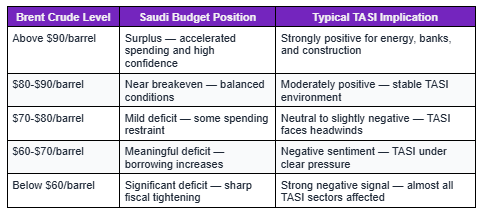
Source: Gulf International Forum (April 2025): Saudi Arabia needs oil near $96/barrel for 2024 budget balance. Middle East Insider (March 2026): Saudi budget requires price near $80 for fiscal breakeven. Brent was trading above $85/barrel in March 2026, supporting TASI's fiscal position.
Which TASI Sectors Benefit Most — and Least — From Rising Oil Prices?
Not all Saudi stocks move the same way when oil prices change.
Highest oil correlation — energy and petrochemicals
Saudi Aramco, SABIC, Petro Rabigh, and Advanced Petrochemical all benefit directly from higher oil and gas prices. These companies either produce hydrocarbons or use them as raw materials with pricing tied to oil markets.
High correlation — banking and financial services
Higher oil revenues mean more government deposits in Saudi banks, more infrastructure lending, and stronger consumer confidence. Saudi National Bank, Al Rajhi Bank, and Riyad Bank have historically performed well during extended periods of elevated oil prices.
Moderate correlation — construction and real estate
Government capital expenditure on Vision 2030 projects accelerates during periods of strong oil revenues. Construction and cement producers benefit but with a 6–12 month lag relative to the initial oil price movement, since contracts and project timelines take time to reflect the fiscal change.
Lowest correlation — healthcare, telecom, and consumer staples
Healthcare demand is driven by demographics, not oil cycles. Telecom generates recurring subscription revenue from consumers and businesses regardless of oil prices. Consumer staples (food, household goods) have stable demand independent of fiscal conditions. These sectors are where TASI investors go for natural oil-price insulation within the Saudi market.
Portfolio insight: A deliberate tilt toward healthcare, telecom, and consumer stocks within your Saudi allocation reduces oil price sensitivity without leaving TASI entirely. This is one of the most practical risk management tools available to Saudi equity investors.
Real Events: Oil Price Shocks and TASI in 2025 and 2026
These two events illustrate both sides of the oil-TASI relationship within 12 months.
April 2025 — tariff shock and OPEC+ surprise
Trump's 10% tariff announcements combined with a surprise OPEC+ production increase of 411,000 barrels per day created what AGSI described as a "toxic cocktail" for oil markets (March 2026). Brent fell below $60 per barrel. Saudi Aramco lost approximately $90 billion in market capitalisation. TASI hit a 15-month low of 11,270 in April 2025. The Saudi fiscal position, requiring $80–96 oil for budget balance was seriously challenged. (Source: AGSI Gulf Economies; Arab News; Trading Economics.)
March 2026 — Iran conflict drives oil above $85, TASI recovers
When US and Israeli strikes on Iran raised fears of Strait of Hormuz disruption, Brent surged above $85 per barrel and briefly hit $102.71. TASI, initially down 5% at open, recovered sharply, reaching 11,343 by April 9, 2026. Higher oil prices restored Aramco's support role in the index and improved Saudi fiscal expectations. (Source: Middle East Insider TASI Analysis, March 2026; Trading Economics April 2026.)
For strategies specific to volatile geopolitical-driven market events, see our guide to protecting your portfolio during geopolitical events.
4 Practical Strategies for TASI Investors in Different Oil Environments
Here is exactly what to do — not just what to know.
1. Use oil price as your Sunday morning leading indicator. Watch Brent crude before TASI opens Sunday at 10:00 AM Riyadh time. A significant weekend oil price move often signals TASI's direction for the day. This can give Saudi investors an early read on market sentiment before the session begins.
2. Tilt toward non-oil sectors when oil is weak. Healthcare, telecom (stc), and consumer staples have much lower oil correlation. A portfolio that overweights these sectors during sustained low-oil periods experiences less downside than one concentrated in energy and banking.
3. Balance TASI with US stocks. US technology stocks Apple, NVIDIA, Microsoft have very low correlation with global oil prices. Holding both Saudi equities and US growth stocks creates a portfolio where different assets react differently to oil price cycles. For a full comparison, see our TASI vs US stocks analysis.
4. Apply DCA through oil price cycles. Oil is cyclical and notoriously difficult to time even for professional commodity traders. Regular monthly investing through oil cycles historically produces better outcomes than tactical entry-and-exit attempts. See our dollar-cost averaging guide for how to set this up.
Frequently Asked Questions
Q: Does TASI always go up when oil prices rise?
No. Oil price is the most important single variable for TASI, but it is not the only one. TASI delivered 43% growth over five years while Brent rose only 9%. Conversely, TASI fell 13% in 2025 despite periods of relatively stable oil. Interest rates, geopolitical events, and domestic economic conditions all play independent roles.
Q: What oil price does Saudi Arabia need to balance its budget?
Saudi Arabia's fiscal breakeven oil price is approximately $80–96 per barrel depending on the year's planned spending. Brent crude above this level supports budget surpluses and stronger government spending on Vision 2030 projects — both of which benefit TASI broadly.
Q: Which Saudi stocks are most protected from falling oil prices?
Healthcare companies, telecom providers (stc), and consumer staples businesses have the lowest correlation with oil prices on TASI. These sectors serve stable domestic demand that is largely independent of oil cycles — making them the natural defensive positions within a Saudi equity allocation.
Related Articles on Raseed Learn
How Aramco's Share Price Affects TASI
Protect Your Portfolio During Geopolitical Events
Dollar-Cost Averaging for Saudi Investors
This article is for educational and informational purposes only and does not constitute investment advice. All investing involves risk including the potential loss of principal. Data is from publicly available sources as of June 2026. Past performance does not guarantee future results. Securities brokerage services are provided by Fullerverse (SC) Limited, licensed and regulated by the Financial Services Authority Seychelles (Licence No. SD152), a wholly-owned subsidiary of Raseed Invest Inc. Raseed Invest Limited is regulated by the DFSA. Capital is at risk.