Does It Work for GCC Investors in 2026?
Quick Answer: Does the 60/40 Portfolio Work for GCC Investors?
The 60/40 portfolio (60% stocks, 40% bonds) is a classic balanced strategy designed to reduce volatility while maintaining growth
In 2022, the 60/40 portfolio had its worst year in decades — both stocks AND bonds fell sharply as the Fed raised rates aggressively
The SAR-USD peg means GCC investors can access US bonds without currency risk, making the 60/40 structure more directly applicable than for other emerging market investors
For Muslim investors, many Islamic finance scholars consider conventional bonds unsuitable for Sharia-conscious investors because they involve interest. — Sukuk (Islamic bonds) are the Sharia-compliant equivalent
In 2026, with rates at elevated levels, bonds offer their best return potential in 15 years — making the 60/40 structure more attractive than it was in 2020–2021
What you will learn in this article
What the 60/40 portfolio is and why it was designed this way
Why 2022 was the worst year for 60/40 in modern history
What the 2026 interest rate environment means for bonds now
A Sharia-compliant alternative to the 60/40 structure using Sukuk
Whether GCC investors should use 60/40 or a different allocation
The 60/40 portfolio allocates 60% to equities for long-term growth and 40% to bonds for stability, the theory being that when stocks fall, bonds rise, smoothing overall portfolio returns.
For most of the 20th century, this negative correlation between stocks and bonds held reliably. When equity markets sold off, investors fled to government bonds, pushing bond prices up and offsetting stock losses. This made 60/40 the dominant institutional portfolio structure globally for decades.
For GCC investors managing allocation between Saudi and US assets specifically, see our TASI vs US Stocks guide for a market-comparison framework.
Why 2022 Was the Worst Year for 60/40 in Decades
In 2022, stocks and bonds fell simultaneously — breaking the correlation that makes 60/40 work.
The Federal Reserve raised interest rates from near zero to 4.5% in 2022 in response to 40-year high US inflation. This caused bonds to fall sharply in price (bond prices move inversely to interest rates). At the same time, rising rates made equity valuations compress, particularly for high-growth tech stocks. The S&P 500 fell 19%. A global government bond index fell approximately 18%. The 60/40 portfolio delivered approximately -16% in 2022 — its worst single-year return since the 1970s.
Key fact: The failure of the 60/40 portfolio in 2022 was specifically a high-inflation, rate-hiking scenario. In all other market environments since 1990 — recessions, market crashes, deflation — the 60/40 structure performed as designed, with bonds offsetting equity losses.
What the 2026 Rate Environment Means for 60/40
With interest rates now elevated, bonds in 2026 offer their best yields in 15 years, changing the calculus for 60/40 investors.
US 10-year Treasury yields, which were near 0% in 2021, rose to 4–5% range through 2024–2026. This means the bond component of a 60/40 portfolio now generates meaningful income, approximately 4–5% per year, rather than the near-zero income of the low-rate era. JP Morgan's 2026 Long-Term Capital Market Assumptions project that a global 60/40 portfolio should deliver approximately 7–8% annualised returns over the next 10–15 years, compared to approximately 4% projected in their 2021 analysis.
The Sharia-Compliant Version: 60/40 With Sukuk
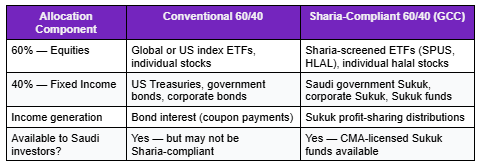
For Muslim GCC investors, conventional bonds (which pay interest) are replaced with Sukuk, Islamic bonds that pay profit-sharing returns rather than interest.
Sukuk are asset-backed Islamic instruments that comply with the prohibition on riba by structuring returns as profit-sharing or lease income rather than interest. Saudi Arabia is the world's largest Sukuk market by issuance, with the Saudi government and major corporates regularly issuing SAR-denominated Sukuk. For GCC investors, a Sharia-compliant 60/40 structure might allocate 60% to Sharia-screened equities and 40% to SAR or USD-denominated Sukuk.
Is 60/40 Right for GCC Investors in 2026?
The 60/40 structure makes more sense in 2026 than it did in 2020 but GCC investors should consider a modified allocation.
A suggested starting framework for a Saudi investor in 2026: 40% Saudi TASI stocks (banking and non-energy sectors for diversification), 20% US/global equities via Sharia-screened ETFs, 30% Sukuk (SAR-denominated for income), and 10% gold or commodity exposure as an additional hedge. This is not investment advice — but this allocation addresses the specific risk factors GCC investors face: oil price concentration, USD peg dynamics, and Islamic compliance requirements.
Build a diversified equity portfolio with US stocks and ETFs on Raseed — from $1 per position. → Start building your portfolio on Raseed →
Frequently Asked Questions
Q: What is the 60/40 portfolio rule?
The 60/40 portfolio allocates 60% of investments to equities (stocks) for long-term growth and 40% to bonds for stability and income. The theory is that stocks and bonds move in opposite directions during market stress, smoothing overall portfolio returns.
Q: Did the 60/40 portfolio recover after 2022?
Yes. After its worst year in decades in 2022, a global 60/40 portfolio recovered significantly in 2023 as equities rallied strongly. By end-2023, the cumulative losses from 2022 were largely recovered for investors who stayed invested.
Q: Can Saudi investors buy US bonds through Raseed?
Raseed focuses on equity securities (stocks and ETFs). For bond access, Saudi investors typically use bond ETFs (such as TLT for US Treasuries or BND for a broad bond index) which are available as equity securities on US exchanges and can be bought through Raseed.
Q: What is Sukuk and how is it different from a conventional bond?
Sukuk is an Islamic financial instrument structured to comply with the prohibition on riba (interest). Rather than paying interest, Sukuk generates returns through profit-sharing from an underlying real asset or through lease income. Saudi Arabia is the world's largest Sukuk issuer. Sukuk returns are not guaranteed in the same way as bond coupons — they depend on the performance of the underlying asset.
Related Articles on Raseed Learn
ETF vs Mutual Fund for GCC Investors
5 Steps to Diversify Your Portfolio
Passive Investing vs Active Trading
This article is for educational and informational purposes only and does not constitute investment advice. All investing involves risk including the potential loss of principal. Data is from publicly available sources as of June 2026. Past performance does not guarantee future results. Securities brokerage services are provided by Fullerverse (SC) Limited, licensed and regulated by the Financial Services Authority Seychelles (Licence No. SD152), a wholly-owned subsidiary of Raseed Invest Inc. Raseed Invest Limited is regulated by the DFSA. Capital is at risk.