


Why 2026 Is a Defining Year for Crypto — and for GCC Investors
There is a huge difference in the cryptocurrency market in 2026 compared to just two years ago. For example, there is now a US spot - bitcoin and ethereum ETF; they had hundreds of millions of dollars in daily inflows from regulated financial institutions. There are also a lot of large banks doing crypto infrastructure such as BlackRock, Fidelity, and JP Morgan Chase. The regulatory environment is now like structured engagement compared to all the major markets 2-3 years ago that prohibited crypto 100%.
The evolution of the major global cryptocurrencies is critical to investors in Saudi Arabia and the Gulf Cooperation Council (GCC) countries. The best-known and most actively traded digital currencies can be accessed by these investors through regulated trading platforms that have clear fee structures, robust data analytics tools, and established custodial standards for institutional investments. This guide discusses the five most important digital currencies that every GCC investor tracking this emerging digital asset class should understand by 2026, what their current market positions are, the technical and fundamental developments affecting their future potential, and the specific factors associated with investing in the kingdom and the rest of the GCC.
All market data referenced reflects conditions as of early April 2026. Cryptocurrency prices are highly volatile and change continuously.
Related: Stocks AND Crypto in One App: Which GCC Platforms Support Both?
1. Bitcoin (BTC) — The Institutional Anchor of the Crypto Market
Current Market Position
In early April 2026, Bitcoin was being traded and valued between $68,000 and $71,000, giving it an approximate $1.35 - $1.43 trillion market cap. Bitcoin dominance, which measures Bitcoin's market cap as a percentage of the total crypto market cap, was approximately 56% - 58%; this indicates that Bitcoin is still considered to be the primary method of holding value and represents the default allocation of institutions investing in digital assets.
Bitcoin reached a record high near $125,000 in 2025, as the supply of Bitcoin dropped due to the halving and the inflow of U.S.-based spot Bitcoin ETFs starting the first year after their launch. Prices are now significantly below that peak with continuing market uncertainties as well as the impacts from global geopolitical issues creating continued overall consolidation of general equities.
What Makes Bitcoin Compelling in 2026
US spot Bitcoin ETFs are still being funded with institutional investments. On April 6, 2026, US spot Bitcoin ETFs experienced $471 million in net inflows, the highest daily amount of inflows since late February. The largest inflows were from BlackRock's iShares Bitcoin Trust (IBIT) with $181.9 million and Fidelity's FBTC with $147.3 million. The total net inflows into US Bitcoin ETFs in March 2026 amounted to $1.32 billion, marking the end of a four-month period of continued outflows.
The halving of Bitcoin which occurred in May of 2024, resulted in the cut of the new issuance of Bitcoins by half while the long-term supply constraint, 21 million coins have a set and fixed supply, remains the underlying premise of the long-term holders investing. Also, at the period of mid-2025 more than 172 publicly traded companies had Bitcoin as a total asset appearing on their books, this is a 40% increase (quarter-over-quarter) at that time, as larger corporations continue to utilise Bitcoin as part of their treasury management.
The SEC's scheduled April 16 roundtable on the CLARITY Act, legislation that would provide clearer regulatory frameworks for digital assets in the US is widely seen as a constructive development for the long-term institutional adoption thesis.
Key Risk Factors
As of now, prediction markets are giving a good chance that bitcoin will trade at or around its lower support levels in the near future due to ongoing macro uncertainty. While bitcoin's tendency to trade in conjunction with risk assets has been declining structurally, bitcoin will continue to decline alongside equities during periods of global risk aversion until this trend has been reversed. Investors in GCC should size their bitcoin allocation according to whether they can afford to experience 30%–50% of losses without the need to sell.
Related: Crypto Trading Risks Every GCC User Should Understand in 2026
2. Ethereum (ETH) — The Platform for Decentralised Applications
Current Market Position
As of early April 2026, Ethereum's market capitalization was between $215 billion and $265 billion, with prices ranging from $1,800 to $2,200.
What Makes Ethereum Relevant in 2026
In 2025, an upgrade known as the Pectra brought a significant increase in both Ethereum's use case and usability through improvements to its efficiency and staking characteristics, cementing Ethereum's role as the primary layer for settling decentralised applications. After launching several Ethereum ETFs shortly after Bitcoin's, these products are starting to receive some institutional inflows but at a smaller volume compared to Bitcoin-based ETFs.
Ethereum's ecosystem's scale as well as the liquidity in the DeFi space, the activity of developers and developers working on Layer 2 solutions are collectively much larger than those of any other platform competing against Ethereum. The institutional presence of the Ethereum blockchain occurs as a financial settlement layer and is evidenced by two tokenised money market funds (BUIDL) from BlackRock and Franklin Templeton with a combined 900 million dollars in assets both operating using the Ethereum blockchain technology.
Considerations for GCC Investors
In early 2026, short-seller firm Culper Research published a negative report on Ethereum, claiming that its recent upgrades reduced the token's economics because the value of fee revenues has dropped greatly. Although Ethereum proponents disagree with Culper Research's conclusions, they both agree on one thing: Cryptocurrency investing in general, and Ethereum investing specifically, is considerably more complex and technically nuanced than cryptocurrency investing in Bitcoin, whose primary investment thesis is based on supply scarcity. GCC investors looking at Ethereum should be aware of this distinction.
3. Solana (SOL) — High-Performance Layer-1 with Institutional Momentum
Current Market Position
Solana (SOL) has been trading for about $85 to $100 since early April 2026, a decline from its peak of nearly $250 in late 2025. Between $38 billion and $45 billion is the market cap.. Solana's ability to maintain high throughput architecture and low fees allowed it to generate the most Layer 1 on-chain revenue for Q1 of 2026, despite SOL's price decline.
What Makes Solana Compelling in 2026
During the late hours of April 1st, 2025, Spot Solana ETFs were introduced, garnering roughly $476 million in net purchases over 19 days, signaling a significant shift towards blockchain technology that was rejected by many after the failure of FTX in 2022. The governance process is currently in progress, with the Alpenglow consensus upgrading to 100-150 millisecond block finality and launching the mainnet by 2026. A second upgrade is still being considered. Firedancer, a new validator client, was introduced on mainnet in January 2026 and has already made significant improvements in network resilience.
The growing ecosystem of Solana, including apps for consumers, DeFi protocols, transfers of stablecoins and various types of games, has created a vibrant developer community that makes this blockchain a viable long-term competitor to Ethereum for applications needing speed and low fees.
Key Risk Factors
In April 2026, the Drift Protocol on Solana suffered a $285 million exploit, the second-largest hack in Solana's history raising serious questions about DeFi security on the network and temporarily damaging confidence in Solana's ecosystem. Security incidents remain a recurring risk factor for Solana specifically. Its higher volatility relative to Bitcoin and Ethereum (it is a high-beta asset) also means it can amplify both gains and losses in shifting market conditions.
4. XRP — Regulatory Clarity Meets Cross-Border Payment Utility
Current Market Position
As of early April 2026, XRP has experienced a significant decline, with the price moving down from its peak of roughly $2.40 in January to $1.30-$1.40 since then (though up to March 2017).
Why XRP Is Relevant for GCC Investors
Ripple emerged victorious from a lengthy legal battle with XRP, which successfully bypassed securing the shares' value after years of regulatory backlash. Multiple markets have approved Spot XRP ETFs, and Ripple's cross-border payment network is becoming more popular with financial institutions in Asia and the Middle East, including Singapore'S central bank.
XRP's cross-border payment use case has direct regional consequences for investors in Saudi and GCC. The Gulf region experiences substantial cross-border remittance flows, while Saudi Arabia only receives workers from South Asia, Southeast Asian nations, and Africa with significant influxes. Speculative interest alone would not be enough to generate utility-driven demand if XRP's payment network is adopted in these corridors.
Risk Factors
XRP's price has historically been more volatile than Bitcoin and more susceptible to sharp reversals. Its utility thesis depends on real-world adoption of Ripple's payment network by banks and financial institutions, adoption that has been slower and more limited than early projections suggested. GCC investors should treat XRP as a higher-risk allocation than Bitcoin or Ethereum.
5. BNB (Binance Coin) — Ecosystem Utility with Exchange Dependency
Current Market Position
Binance Coin (BNB) was trading between $550-$620 by early April 2026. As the native cryptocurrency of the Binance ecosystem, BNB facilitates transactions through the BNB Smart Chain network as well as gives users discounted transaction fees on the Binance cryptocurrency exchange, provides support for Dapps (Decentralised Applications) being built on the Binance ecosystem using BNB, and provides incentives to develop and use DeFi (Decentralised Finance), NFT (Non-Fungible Tokens) and/or GameFi (Blockchain based gaming) applications that operate on the basis of smart contracts using BNB.
Why BNB Remains in the Top 5
Major regulations against Binance were settled in 2024 and there is less uncertainty regarding the future value of BNB than there used to be. The current value of BNB is reflective of the current use of the BNB ecosystem, including daily trading volume, daily smart chain usage, and the overall expansion of Binance’s product line, instead of from the previous regulatory risk threatening Japanese companies. The upgraded Maxwell Upgrade of the BNB chain has addressed the scalability of the BNB chain for continued future growth.
BNB occupies a different investment category from the other four assets in this list. It is fundamentally a utility and ecosystem token rather than a monetary asset (Bitcoin) or a general-purpose platform (Ethereum, Solana). Its performance is closely tied to Binance's overall health and market position, which provides a more specific and concentrated risk exposure than BTC or ETH.
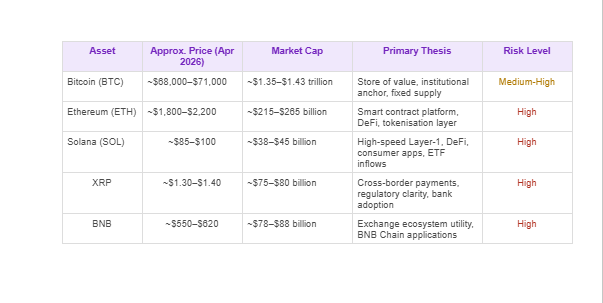
Comparison Table: Top 5 Cryptos for GCC Investors in 2026
Related: Crypto Trading vs Crypto Investing: What's the Difference?
Related: Crypto Trading Risks Every GCC User Should Understand in 2026
Frequently Asked Questions: Top Cryptos for GCC Investors in 2026
Should I diversify across all five cryptocurrencies?
Although the diversification of crypto assets reduces single-asset risk, it does not eliminate the high levels of risk associated with each asset class. In general, when the markets are down, most major cryptocurrencies go into separate declines. While it may be advantageous to have a portfolio spread out among the top five assets, it should still make up only 0.15% of accumulated assets in an investment portfolio.
Which cryptocurrency is best for a Saudi Arabia investor new to crypto?
Most financial education professionals suggest starting with Bitcoin for first-time crypto investors, it has the longest track record, the most institutional adoption, the best liquidity, and the simplest investment thesis. Ethereum is a reasonable second consideration for those who want broader exposure to the DeFi ecosystem. Solana, XRP, and BNB carry higher risk and are more appropriate for investors who have already established a position in the two largest assets.
Are these cryptocurrencies available on Raseed?
Raseed offers access to a curated selection of established cryptocurrencies alongside stocks and ETFs in a single account. Check the current asset availability in the Raseed app for the most up-to-date list of supported cryptocurrencies, as offerings may vary by jurisdiction.
Cryptocurrency trading involves significant risk, including the potential loss of all invested capital. Crypto markets are highly volatile. The regulatory status of cryptocurrency varies by jurisdiction and is evolving. GCC investors should verify the applicable rules in their country of residence before investing. Securities brokerage services are provided by Fullerverse (SC) Limited, a security broker dealer licensed and regulated by the Financial Services Authority Seychelles (Licence No. SD152). Fullerverse is a wholly-owned subsidiary of Raseed Invest Inc. All investing involves risk. Past performance does not guarantee future results. Capital is at risk.