Understanding Fear of Missing Out — A Behavioral Finance Guide for Saudi Investors
Quick Answer: What Is FOMO in Investing?
FOMO (Fear of Missing Out) in investing means buying an asset primarily because its price has recently risen and you fear missing further gains, not because of fundamental value
FOMO is linked to recency bias and herd behavior, and can lead investors to buy after prices have already risen and sell after prices fall, the opposite of sound strategy
In 2024, DALBAR's "Guess Right Ratio", how often investors correctly timed market entry and exit, fell to 25%, meaning FOMO-driven timing decisions were wrong 75% of the time
GCC investors are particularly exposed to FOMO through WhatsApp investment groups, social media stock tips, and rapid information spread in tight community networks
The antidote to FOMO is a written investment plan with predetermined entry criteria, so buying decisions are made before the excitement, not during it
FOMO — Fear of Missing Out, is the impulse to buy an asset because its price is rising rapidly and you fear being left behind if you do not act immediately.
It is not a strategy. It is an emotional response that bypasses fundamental analysis, ignores valuation, and prioritises the fear of regret over the logic of value. FOMO drives investors to buy at the peak of trends, whether that is Bitcoin in December 2017, US tech stocks in late 2021, or a highly volatile small-cap stock promoted through social media or messaging groups. In every case, the psychological pattern is the same: price rises attract attention, attention creates excitement, excitement overrides analysis, and the investor buys high.
For GCC investors, FOMO is amplified by the speed and intimacy of information sharing in Saudi Arabia, UAE, Kuwait, and across the Gulf. Investment tips spread instantly through WhatsApp family groups and Twitter. The urgency this creates, the sense that everyone else is getting rich while you are watching, is precisely the emotional state that leads to the worst investment decisions.
How FOMO Destroys Returns — The Numbers
The pattern of buying after prices rise and selling after they fall is the single largest driver of the gap between market returns and investor returns.
DALBAR's 2025 QAIB report revealed that in 2024, the average equity investor earned 16.54%, while the S&P 500 returned 25.02%, a gap of 8.48 percentage points. This was the second-largest underperformance gap in a decade, driven primarily by poor timing: buying after markets had risen (FOMO) and selling after they had fallen (panic). Separately, DALBAR's 2026 QAIB report showed that in 2025, the investor gap narrowed to 0.72 percentage points, but only because markets were broadly positive throughout the year, reducing the FOMO effect.
Over 20 years, the compound effect of FOMO-driven timing decisions is devastating. The S&P 500 produced an annualised return of 10.35% from 2005 to 2024. The average investor produced 9.24%, a gap of 1.11 percentage points per year. On a SAR 100,000 starting portfolio, that difference compounds to approximately SAR 33,000 less after 20 years. Not from bad stocks. From bad timing driven by emotion.
GCC context: Saudi Arabia and the GCC have high social media penetration rates. Twitter/X is the primary platform for financial discussion in Saudi Arabia. The speed at which investment tips spread through these networks — combined with the cultural tendency to act quickly on trusted community recommendations — makes GCC investors particularly vulnerable to FOMO-driven decisions.
FOMO in Crypto and Penny Stocks — A Special Warning for GCC Investors
FOMO is most dangerous in high-volatility, low-information environments, which describes both crypto and penny stocks perfectly.
Cryptocurrency markets are purpose-built to trigger FOMO. Prices can double in days. Social media is flooded with gains screenshots. The fear of missing a 500% return is visceral and immediate. But the investors who bought Bitcoin at $68,000 in November 2021, driven by FOMO at the peak, waited more than two years to recover their capital. The people sharing those gains screenshots had bought years earlier; they were selling to the FOMO buyers.
The same dynamic plays out in Raseed's most-traded stocks list. In June 2026, several micro-cap names topped the list following reverse stock splits that created dramatic short-term price moves. These events are classic FOMO triggers, sudden price action, WhatsApp buzz, and the fear of missing a trend. The investors who bought on that FOMO typically found prices normalising within days or weeks.
Understanding the difference between FOMO-driven trading and disciplined investing is the foundation of our passive investing vs active trading guide, which covers how systematic investment approaches outperform reactive ones over time.
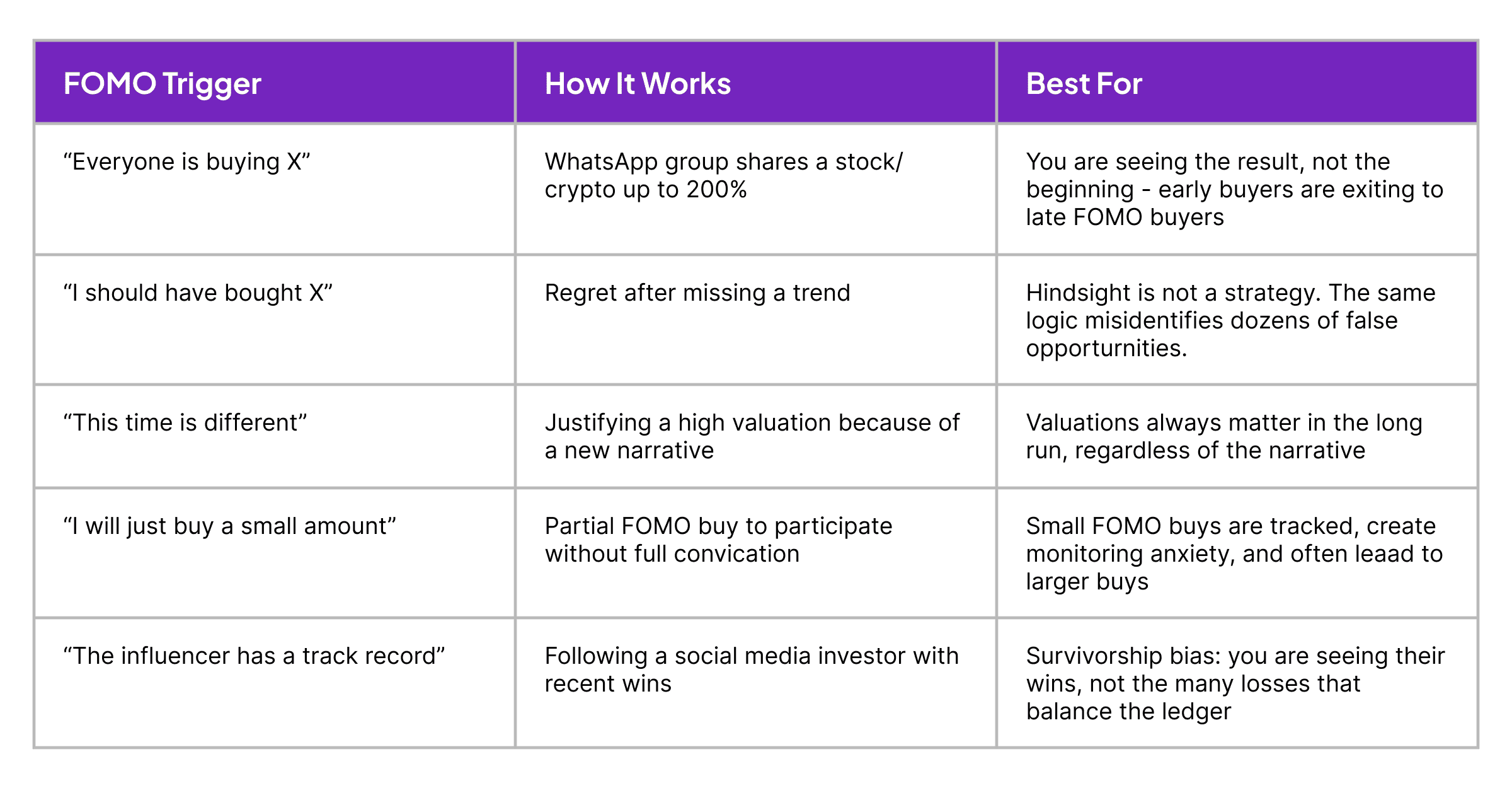
5 FOMO Triggers Saudi Investors Should Recognise
How to Build FOMO Immunity — A Practical Framework
FOMO cannot be eliminated, but it can be systematised away.
Write your investment criteria before looking at any opportunity, what revenue growth, P/E range, sector, and minimum holding period does a stock need to qualify? Apply these criteria to every FOMO tip.
Create a 48-hour rule, any investment idea from social media requires 48 hours of independent research before any capital is deployed.
Maintain a "missing out is fine" portfolio, a portion of your portfolio invested in broad ETFs that captures market returns. When a trend outperforms your holdings, remind yourself that your ETFs are also benefiting.
Track every FOMO trade you almost made, within 3 months, review whether you would have made money. Most FOMO opportunities look far worse with a short time delay.
Focus on what you know, Saudi investors who deeply understand specific TASI sectors (banking, healthcare, telecom) have genuine edge in those areas. Chasing trends in areas you do not understand is pure FOMO.
Invest in a diversified, systematic portfolio on Raseed — not FOMO trades. Start from $1. → Build your disciplined portfolio on Raseed →
Frequently Asked Questions
Q: Is FOMO always a bad signal in investing?
Not always. If FOMO motivates you to research an asset you were already aware of and it passes your investment criteria, the emotional trigger may have led to a sound decision. The problem is when FOMO replaces the research process rather than initiating it.
Q: How is FOMO different from momentum investing?
Momentum investing is a systematic strategy with defined rules for when to buy and sell based on price trends. FOMO is an emotional reaction to a specific trend with no systematic rules. The difference is process: momentum investing has predetermined exit criteria and position sizing; FOMO trading has neither.
Q: Does FOMO affect experienced investors too?
Yes. Research from Hiroshima University (Bawalle et al., PLOS ONE March 2025) showed that overconfident investors — who are typically more experienced — are actually more likely to engage in panic selling and trend-chasing than less confident investors, because they believe they can identify the right moment to act.
Q: What is the best way to deal with FOMO when a stock I know has surged?
Apply your investment criteria to the current valuation, not the past price. If the stock has surged 200% and is now trading at 50x earnings with no change in business fundamentals, FOMO is telling you to buy at the wrong price. If the fundamentals justify the new valuation, it may genuinely still be an opportunity — but that decision should come from analysis, not from the fear of having missed the initial move.
Related Articles on Raseed Learn
Why Investors Panic Sell and What to Do Instead
The Most Common Investing Mistakes GCC Beginners Make
Passive Investing vs Active Trading
Dollar-Cost Averaging for Saudi Investors
This article is for educational and informational purposes only and does not constitute investment advice. All investing involves risk, including the potential loss of principal. Data sourced from publicly available primary sources as of June 2026. Past performance does not guarantee future results. Securities brokerage services are provided by Fullerverse (SC) Limited, licensed and regulated by the Financial Services Authority Seychelles (Licence No. SD152), a wholly-owned subsidiary of Raseed Invest Inc. Raseed Invest Limited is regulated by the DFSA. Capital is at risk.