A Behavioral Finance Guide for Saudi and GCC Investors
Quick Answer: Why Do Investors Panic Sell and What Should You Do Instead?
Panic selling is driven by loss aversion, the pain of losing money feels twice as powerful as the pleasure of an equivalent gain, causing irrational decisions during downturns
In 2024, the average equity investor earned 16.54% versus the S&P 500's 25.02% — an 8.48 percentage-point gap caused largely by behavioral mistakes like selling at lows
When the Fear & Greed Index fell to 3 out of 100 in early 2025, many investors sold at the worst possible moment, locking in permanent losses
The DALBAR 2026 QAIB report shows over the 20-year period to December 2024, the average investor returned 9.24% per year versus the S&P 500's 10.35% — driven largely by poor timing
The solution is not willpower — it is a written investment plan, automated contributions, and a pre-set response protocol for market drops
Panic selling is one of the most costly investing behaviors documented in financial research and it is almost entirely driven by emotion, not logic.
When markets fall sharply, something predictable happens: retail investors sell. Not because the long-term value of their holdings has changed, but because the psychological pain of watching account balances decline activates a fear response that overrides rational judgment. This response is called loss aversion, a concept first documented by behavioral economists Daniel Kahneman and Amos Tversky, which shows that losses feel approximately twice as painful as equivalent gains feel pleasurable.
For Saudi and GCC investors, this behavioral pattern carries a specific cost. TASI hit a 15-month low of 11,270 in April 2025 following oil price declines triggered by tariff fears. Investors who sold at that point locked in permanent losses. Those who held through the volatility recovered as conditions stabilised. The difference between these two outcomes was not investment skill — it was the ability to resist the panic response.
The Real Cost of Panic Selling — What the Data Shows
The gap between market returns and average investor returns is one of the most consistently documented findings in all of finance.
DALBAR's Quantitative Analysis of Investor Behavior (QAIB) has tracked the gap between market returns and actual investor returns every year since 1994. The 2026 QAIB report reveals that in 2024, the average equity investor earned 16.54% compared to the S&P 500's 25.02% — a shortfall of 8.48 percentage points, the second largest in a decade. Over the 20-year period ending December 2024, the average US equity investor returned 9.24% per year versus the S&P 500's 10.35%, meaning the market portfolio was 22% larger than what the average investor actually accumulated after 20 years.
The cause of this persistent underperformance is not bad fund selection or high fees. It is timing, specifically, investors selling after prices fall and buying after prices rise. DALBAR's 2026 report notes that in 2024, its "Guess Right Ratio", the frequency at which investors correctly time inflows or outflows, fell to just 25%. Investors guessed the direction of the market correctly only one in four times. The other three quarters of timing decisions destroyed value.
Key fact for GCC investors: Because TASI is heavily oil-price-linked, Saudi investors face particularly sharp and sudden drawdowns — oil shocks can drop TASI 15% or more in weeks. This volatility amplifies the panic response. Having a pre-written response plan before the next shock arrives is not optional — it is one important step that may help Saudi investors respond more calmly during market stress.
The Psychology Behind Panic Selling
Understanding why panic selling happens is the first step to preventing it.
Loss Aversion
Nobel Prize-winning research from Kahneman and Tversky established that losses feel approximately twice as painful as equivalent gains feel pleasurable. When your portfolio drops SAR 10,000, the emotional pain is roughly equivalent to the pleasure of gaining SAR 20,000. This asymmetry makes selling during downturns feel rational even when it is not.
Herd Behavior
Research in behavioral finance consistently shows that when some investors sell, others follow, not based on new information, but based on observing others' behavior. Social media and WhatsApp groups accelerate this dynamic in Saudi Arabia, where investment discussions spread through tight community networks. A 2025 SSRN paper (Linge, Behavioral Finance, January 2025) identified herd behavior as one of the primary amplifiers of market crashes beyond what economic fundamentals justify.
Recency Bias
When markets are falling, investors project the recent trend forward: if the market has fallen 15% in two weeks, the instinct is to assume it will continue falling. This recency bias is why investors sell near bottoms. In reality, the best single-day returns in the stock market often occur immediately after the worst days. Missing those recovery days through panic selling permanently damages long-term returns.
Understanding the mechanics of risk, including how drawdowns recover over time, is covered in detail in our guide to understanding risk in stock trading, which provides GCC-specific context for interpreting portfolio volatility.
5 Strategies to Avoid Panic Selling
The solution to panic selling is not trying harder to be rational in the moment — it is removing the decision from the moment entirely.
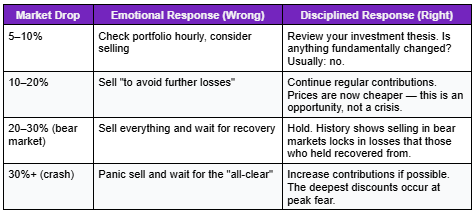
Write your investment plan before the next market drop, decide in advance what you will do if markets fall 10%, 20%, or 30%. A pre-written protocol removes emotional decision-making when you need it most.
Automate your contributions using a fixed monthly investment, dollar-cost averaging removes the timing decision entirely. You invest the same amount every month regardless of market conditions.
Limit portfolio checking frequency, checking your portfolio daily is strongly correlated with panic selling. Research from behavioral finance shows that investors who check monthly or quarterly make significantly better decisions than those who check daily.
Frame losses in terms of time, not percentage, a 20% drop in the S&P 500 has historically recovered to new highs within approximately 2 years. A percentage loss today is a temporary number, not a permanent outcome.
Remove easy access to selling, set a friction rule for yourself: any decision to sell during a market downturn requires a 48-hour waiting period. In almost every case, the panic passes within that window.
Build a disciplined, automated investment plan on Raseed. Start with SAR 500 per month — fractional shares from $1. → Open your Raseed account and invest with discipline →
What to Do During a Market Drop — A Step-by-Step Response
When markets fall sharply, your response plan should be written, not improvised.
Frequently Asked Questions
Q: Is it ever the right decision to sell during a market drop?
Yes, in specific circumstances. If your investment thesis is genuinely broken (not just the price falling), if you have a near-term liquidity need you overlooked, or if a position was always sized too large for your risk tolerance. Selling because of fear alone is the wrong reason.
Q: How long do stock market recoveries usually take after a crash?
Based on S&P 500 historical data, the average bear market (decline of 20%+) has lasted approximately 9.6 months, with recovery to prior highs taking on average about 2 years. TASI recoveries are more variable due to oil price dependency, but the long-term trajectory has been consistently upward.
Q: Why does TASI seem to drop faster and harder than the S&P 500?
TASI is approximately 67% weighted in Saudi Aramco and the energy sector, meaning oil price movements directly translate into index movements. When oil fell below $60/barrel in April 2025, TASI fell sharply as a direct consequence. This is a structural feature of the index, not a sign of weakness in the Saudi economy broadly.
Q: Should I hold cash during market volatility as a GCC investor?
A cash reserve covering 3–6 months of living expenses is prudent regardless of market conditions. Beyond that emergency fund, holding cash as an investment strategy during volatility almost always underperforms staying invested. The challenge is that we never know when the recovery begins and missing even the first 10 best days of a recovery can cut long-term returns by more than half.
Related Articles on Raseed Learn
Understanding Risk in Stock Trading · Dollar-Cost Averaging for Saudi Investors
The Most Common Investing Mistakes GCC Beginners Make · Passive Investing vs Active Trading
This article is for educational and informational purposes only and does not constitute investment advice. All investing involves risk, including the potential loss of principal. Data sourced from publicly available primary sources as of June 2026. Past performance does not guarantee future results. Securities brokerage services are provided by Fullerverse (SC) Limited, licensed and regulated by the Financial Services Authority Seychelles (Licence No. SD152), a wholly-owned subsidiary of Raseed Invest Inc. Raseed Invest Limited is regulated by the DFSA. Capital is at risk.